
CSCS Site Transport & Traffic Management Questions
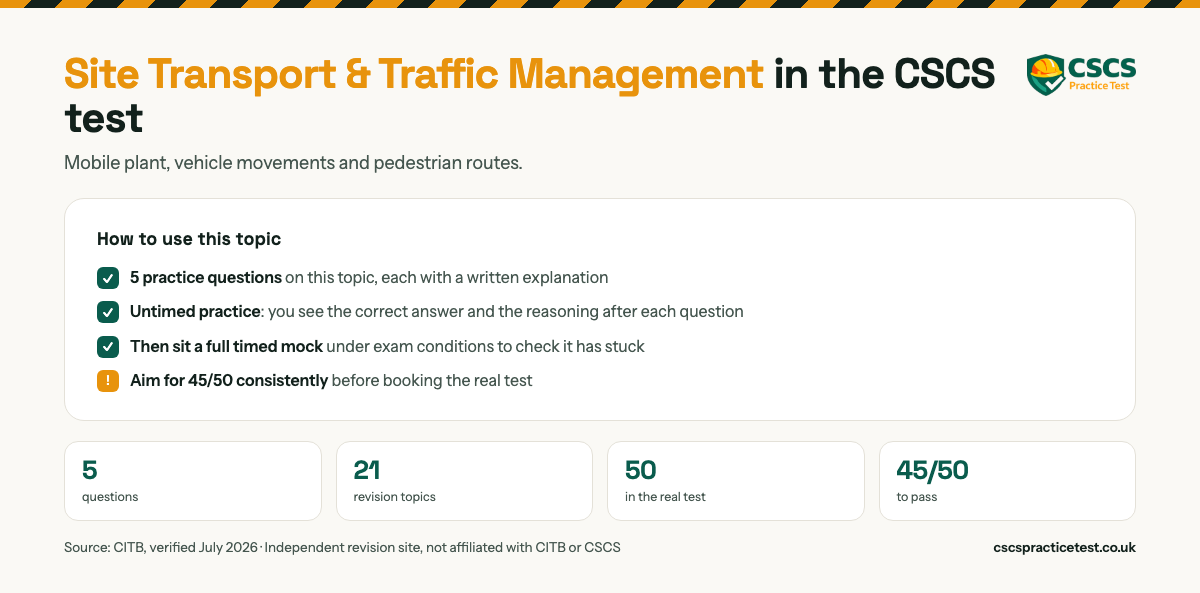
Mobile plant, vehicle movements and pedestrian routes.
These questions cover site transport & traffic managementfor the CITB Health, Safety and Environment (HS&E) test, the exam UK construction workers pass to get a CSCS card.
Site Transport & Traffic Management: practice questions (untimed, instant feedback)
- 50 questions · pass mark 90%
- Untimed practice: you see the correct answer immediately after each question.
- Some questions need more than one answer, and these are clearly marked.
All 50 Site Transport & Traffic Management questions and answers
These are the same 50 questions as the practice test above, written out with the correct answer and the reasoning behind it. Read them through when you want to revise rather than test yourself.
1. Under CDM 2015, how must a construction site be organised so that people and vehicles can get about?
Answer: So that pedestrians and vehicles can move without risks to safety
- A) So that pedestrians and vehicles can move without risks to safety (correct answer)
- B) So that vehicles always have priority over people on every single route
- C) So that walking on site is banned whenever plant is being used
- D) So that only supervisors are allowed to choose where to walk
Why: Regulation 27(1) of CDM 2015 says the site must be organised so that, so far as is reasonably practicable, pedestrians and vehicles can move without risks to health or safety. Layout is the first control. Getting the routes right protects everybody, whereas signs and vests only help once someone is already in the danger area.
2. What does CDM 2015 say a site traffic route has to be?
Answer: Suitable for its users, sufficient in number, well sited and big enough
- A) Signed off by the client before any construction work is allowed to start
- B) Suitable for its users, sufficient in number, well sited and big enough (correct answer)
- C) Surfaced in tarmac and lit by floodlights during every working shift
- D) The same width as the public road that serves the site entrance gate
Why: Regulation 27(2) of CDM 2015 requires traffic routes to be suitable for the persons or vehicles using them, sufficient in number, in suitable positions and of sufficient size. One narrow route shared by everything is the classic failure, because it forces people on foot and heavy plant into the same space.
3. Why must a pedestrian gate that opens onto a site traffic route be set well back from it?
Answer: So people can see approaching vehicles or plant from a place of safety
- A) So delivery drivers have room to park up while their paperwork is signed
- B) So the perimeter fence can be moved without closing the whole of the site
- C) So people can see approaching vehicles or plant from a place of safety (correct answer)
- D) So the gate can be padlocked from the outside at the end of every shift
Why: Regulation 27(3)(b) of CDM 2015 requires a door or gate for pedestrians leading onto a traffic route to be sufficiently separated from it so that people can see any approaching vehicle or plant from a place of safety. Stepping straight out of a gate into the path of a lorry gives nobody time to react.
4. Vehicles and people cannot be kept far enough apart on part of a site. What does CDM 2015 then require?
Answer: Other means of protecting people, plus effective warning arrangements
- A) Written permission from the Health and Safety Executive before starting
- B) Nothing more, because separating people from plant is only advisory
- C) Every worker on foot to be issued with safety goggles and hearing defenders
- D) Other means of protecting people, plus effective warning arrangements (correct answer)
Why: Regulation 27(3)(c) of CDM 2015 requires sufficient separation between vehicles and pedestrians. Where that is not reasonably practicable, other means of protection must be provided and effective arrangements used to warn anyone liable to be crushed or trapped that a vehicle is approaching.
5. What does CDM 2015 require of a loading bay on a construction site?
Answer: At least one exit kept for the exclusive use of people on foot
- A) At least one exit kept for the exclusive use of people on foot (correct answer)
- B) At least two ramps so that lorries can enter and leave freely
- C) A roof over the whole of it to keep stored materials dry in wet weather
- D) A weighbridge at the main entrance to check every delivery load in
Why: Regulation 27(3)(d) of CDM 2015 says any loading bay must have at least one exit for the exclusive use of pedestrians. A loading bay is a trap if the only way out is the same opening the vehicles use, so a pedestrian only exit gives people a guaranteed escape.
6. It is unsafe to walk through a gate meant mainly for vehicles. What does CDM 2015 require?
Answer: A clearly marked pedestrian door nearby, kept free from obstruction
- A) A written permit issued to each worker before using that gateway
- B) A clearly marked pedestrian door nearby, kept free from obstruction (correct answer)
- C) A set of traffic lights that halts vehicles whenever anyone walks
- D) A signaller posted at that gate for the whole of every working day
Why: Regulation 27(3)(e) of CDM 2015 requires at least one pedestrian door in the immediate vicinity of a vehicle gate, clearly marked and kept free from obstruction. If the pedestrian door is blocked by stacked materials or a skip, people go back to using the vehicle gate and the protection is lost.
7. As well as being signed where necessary, what must happen to every site traffic route?
Answer: It must be regularly checked and properly maintained
- A) It must be closed to traffic during hours of darkness
- B) It must be shown on a plan sent to the local council office
- C) It must be regularly checked and properly maintained (correct answer)
- D) It must be repainted in reflective paint once every month
Why: Regulation 27(4) of CDM 2015 says each traffic route must be indicated by suitable signs where necessary, and must be regularly checked and properly maintained. Sites change week by week, so a route that was safe at the start of the job can end up rutted, flooded or blocked.
8. CDM 2015 says a vehicle must not be driven along a traffic route unless, so far as is reasonably practicable, that route is what?
Answer: Free from obstruction and giving sufficient clearance
- A) Coned off along both sides and lit by portable lighting towers
- B) Wide enough for two of the largest lorries to pass at speed
- C) Inspected and signed off by a signaller the same morning
- D) Free from obstruction and giving sufficient clearance (correct answer)
Why: Regulation 27(5) of CDM 2015 says no vehicle is to be driven on a traffic route unless, so far as is reasonably practicable, the route is free from obstruction and permits sufficient clearance. Clearance matters overhead and to the sides, not just ahead of the wheels.
9. What is the first duty that CDM 2015 regulation 28 places on the control of site vehicles?
Answer: Taking steps to prevent or control unintended vehicle movement
- A) Taking steps to prevent or control unintended vehicle movement (correct answer)
- B) Fitting a tachograph to all plant kept on the site overnight
- C) Recording the mileage of each vehicle at the start of a shift
- D) Carrying a first aid kit in the cab of every vehicle on site
Why: Regulation 28(1) of CDM 2015 requires suitable and sufficient steps to prevent or control the unintended movement of any vehicle. Runaway plant kills people who were nowhere near the driver, which is why brakes, chocks and level parking are treated as a legal duty rather than good practice.
10. A vehicle is manoeuvring where the driver cannot see all round. Under CDM 2015, who must warn the people at risk?
Answer: The driver, or the person directing the driver, or both of them
- A) The client, who holds overall control of the whole of the project
- B) The driver, or the person directing the driver, or both of them (correct answer)
- C) The site first aider, who is trained to raise the alarm very quickly
- D) Whichever worker happens to be standing nearest to it at that moment
Why: Regulation 28(2) of CDM 2015 puts the duty to warn on the driver or operator, on the person giving directions where the driver does not have full visibility, or on both. Nobody can assume the other one has done it, so on a blind manoeuvre both should be watching out.
11. How does CDM 2015 say a construction vehicle must be loaded?
Answer: So that it can still be driven, operated or towed safely
- A) So that the load can be seen clearly from the site office window
- B) So that one person working alone can unload it all by hand
- C) So that it can still be driven, operated or towed safely (correct answer)
- D) So that the heaviest items sit directly over the rear axle
Why: Regulation 28(3) of CDM 2015 requires a construction vehicle to be driven, operated or towed safely and to be loaded in such a way that it can be driven, operated or towed safely. A badly placed load changes how the machine steers, brakes and tips long before anything falls off.
12. When does CDM 2015 allow somebody to ride on a construction vehicle?
Answer: Only in a safe place on the vehicle provided for that purpose
- A) Only where the trip across the site is under 100 metres in length
- B) Only when the driver agrees and stays in a very low gear
- C) Only when a supervisor has watched them climb aboard it
- D) Only in a safe place on the vehicle provided for that purpose (correct answer)
Why: Regulation 28(4) of CDM 2015 says a person must not ride on a construction vehicle other than in a safe place provided for that purpose. Riding on a dumper skip, a forklift tine or a trailer drawbar is banned however short the journey is.
13. Loose material is being tipped into a vehicle. When may a person stay on that vehicle while it happens?
Answer: Only if a safe place of work is provided and maintained for them
- A) Only if a safe place of work is provided and maintained for them (correct answer)
- B) Only if the material being handled weighs under about one tonne
- C) Only if they keep both hands on a fixed grab rail throughout the work
- D) Only if the loading is finished within fifteen minutes of starting
Why: Regulation 28(5) of CDM 2015 says nobody may remain on a vehicle during the loading or unloading of loose material unless a safe place of work is provided and maintained for them. Falling spoil and a swinging bucket are the reason, so the default is to get down and stand clear.
14. CDM 2015 regulation 28(6) calls for measures against which risk in particular?
Answer: A vehicle falling into water or running over an embankment edge
- A) A vehicle being driven by somebody from another subcontractor
- B) A vehicle falling into water or running over an embankment edge (correct answer)
- C) A vehicle being stolen from the site compound during the night hours
- D) A vehicle using up more fuel than the hire company has allowed for
Why: Regulation 28(6) of CDM 2015 requires suitable and sufficient measures to stop a vehicle falling into an excavation or pit, or into water, or overrunning the edge of an embankment or earthwork. Edges give way under the weight of plant, so the control has to be physical rather than a verbal warning.
15. Who must make sure that unauthorised people cannot get onto a construction site through the gates?
Answer: The principal contractor, as part of managing the construction phase
- A) The local authority, which licenses the site access from the road
- B) Every worker, each time that they walk through the site entrance
- C) The principal contractor, as part of managing the construction phase (correct answer)
- D) The delivery drivers, who see the entrance more often than anybody else
Why: Regulation 13(4)(b) of CDM 2015 requires the principal contractor to take the necessary steps to prevent access by unauthorised persons to the construction site. Gates, hoarding and a controlled entry point keep members of the public, and children, out of the way of site traffic.
16. Under PUWER 1998, who must have received adequate training in the use of site plant?
Answer: Everyone who uses it and everyone who supervises or manages its use
- A) Only those operators who have been in the job for under six months
- B) Only people holding a driving licence issued in the United Kingdom
- C) Only directly employed staff, because agency workers are exempt
- D) Everyone who uses it and everyone who supervises or manages its use (correct answer)
Why: Regulation 9 of PUWER 1998 requires adequate health and safety training both for everyone who uses work equipment and for anyone who supervises or manages its use. A supervisor who does not understand a machine cannot judge whether it is being used safely.
17. Under PUWER 1998, when may a worker be carried on mobile work equipment?
Answer: Only if it suits carrying people and cuts the risks to them
- A) Only if it suits carrying people and cuts the risks to them (correct answer)
- B) Only if the trip stays on level ground inside the site fence
- C) Only if a supervisor signs a permit for that particular trip
- D) Only if the machine has a fully enclosed cab with a locking door
Why: Regulation 25 of PUWER 1998 says no employee may be carried by mobile work equipment unless it is suitable for carrying persons and has features that reduce the risks to them as low as is reasonably practicable, including risks from wheels or tracks.
18. PUWER 1998 says the risk to a rider from mobile plant rolling over must be minimised. How?
Answer: By stabilising it, or by fitting a protective structure or device
- A) By checking the tyres and the brakes at the end of each week
- B) By stabilising it, or by fitting a protective structure or device (correct answer)
- C) By fitting a governor that holds the machine down to walking pace only
- D) By keeping a second machine nearby to right it after a roll
Why: Regulation 26(1) of PUWER 1998 requires the rollover risk to be minimised by stabilising the equipment, by a structure that stops it going past its side, by a structure giving enough clearance if it goes further, or by a device giving comparable protection.
19. Which regulations require a suitable restraining system where a rider could be crushed if plant rolls over?
Answer: The Provision and Use of Work Equipment Regulations 1998
- A) The Control of Substances Hazardous to Health Regulations
- B) The Reporting of Injuries and Dangerous Occurrences Regulations
- C) The Provision and Use of Work Equipment Regulations 1998 (correct answer)
- D) The Personal Protective Equipment at Work Regulations 1992
Why: Regulation 26(2) of PUWER 1998 says that where anyone carried on mobile work equipment risks being crushed by it rolling over, the employer must ensure it has a suitable restraining system for them. That is the legal root of the seat belt rule on dumpers and rollers.
20. A machine driver cannot see enough directly from the cab. What does PUWER 1998 require?
Answer: Adequate devices to improve vision, so far as is practicable
- A) A written record of the blind spots kept in the site office
- B) A rule that the machine stays away from any open excavation
- C) A warning notice fixed to the outside of the machine body
- D) Adequate devices to improve vision, so far as is practicable (correct answer)
Why: Regulation 28(e) of PUWER 1998 says that where the driver's direct field of vision is inadequate to ensure safety, there must be adequate devices for improving that vision so far as is reasonably practicable. In practice that means extra mirrors, camera systems or both.
21. According to HSE, what is the most effective way to protect people on foot from site vehicles?
Answer: Making the pedestrian and vehicle routes entirely separate
- A) Making the pedestrian and vehicle routes entirely separate (correct answer)
- B) Asking everyone on foot to keep looking around as they walk
- C) Fitting each vehicle with a beacon and a reversing alarm
- D) Holding a toolbox talk about vehicle movements each morning
Why: HSE says the most effective way to separate pedestrian from vehicle activity is to make the routes entirely separate. Alarms, beacons and briefings all rely on somebody noticing in time, whereas a separate route removes the chance of contact altogether.
22. A walkway crosses a site roadway. What does HSE guidance say the crossing point needs?
Answer: Clear markings and signs, with dropped kerbs where the path is raised
- A) A supervisor on hand to escort each person who wants to cross
- B) Clear markings and signs, with dropped kerbs where the path is raised (correct answer)
- C) A locked gate that is opened only when a delivery vehicle is expected in
- D) A steel plate laid over the roadway to protect the path surface
Why: HSE guidance says crossing points should be suitably marked and signposted, and should include dropped kerbs where the walkway is raised above the driving surface. Marking tells drivers where to expect people, and the dropped kerb stops anyone stepping down awkwardly into the road.
23. What does HSE advise about the gateways used to get on and off a construction site?
Answer: Provide separate entry and exit gateways for people and vehicles
- A) Leave the vehicle gate open all day to stop queues on the road
- B) Put the walking gate at the far end of the site from the road
- C) Provide separate entry and exit gateways for people and vehicles (correct answer)
- D) Use one wide gateway so the gateman can watch everyone arrive
Why: HSE guidance on construction traffic management says to provide separate entry and exit gateways for pedestrians and vehicles. The entrance is where site traffic and people on foot are most concentrated, so it is the first place to design the conflict out.
24. Why must materials never be stacked so that they block a site walkway?
Answer: It forces people on foot to step onto the vehicle route to pass
- A) It makes the walkway harder to sweep at the end of the shift
- B) It stops the surface of the walkway drying out after a spell of rain
- C) It hides the walkway markings from the site inspection team
- D) It forces people on foot to step onto the vehicle route to pass (correct answer)
Why: HSE guidance says not to block walkways so that pedestrians have to step onto the vehicle route. A blocked walkway quietly undoes the segregation the site was designed with, and it puts people in the roadway at the point where drivers least expect them.
25. Where does HSE guidance say that workforce and visitor car parking should go?
Answer: Away from the work area, to cut down vehicle movements on site
- A) Away from the work area, to cut down vehicle movements on site (correct answer)
- B) Inside the work area itself, so that people have less far to walk
- C) On the public road outside, freeing up space for storage
- D) Beside the site office, so that arrivals can be watched
Why: HSE guidance says to provide car and van parking for the workforce and visitors away from the work area, as a way of minimising vehicle movements. Every car that does not need to drive through the working area is one less thing for people on foot to avoid.
26. About what proportion of workplace transport deaths happen while a vehicle is reversing?
Answer: Nearly a quarter of them
- A) Almost nine out of every ten
- B) Nearly a quarter of them (correct answer)
- C) About one in fifty of them
- D) Fewer than one in a hundred
Why: HSE states that nearly a quarter of all deaths involving workplace transport occur during reversing. That is why the guidance treats designing out the need to reverse as the main control rather than relying on alarms or mirrors.
27. What does HSE guidance put first when dealing with the risk from reversing?
Answer: Removing the need to reverse, such as by drive-through loading
- A) Painting the rear of each vehicle in a bright warning colour
- B) Training people on foot to listen out for reversing vehicles
- C) Removing the need to reverse, such as by drive-through loading (correct answer)
- D) Fitting a louder reversing alarm to every vehicle on the site
Why: HSE guidance says to remove the need for reversing altogether, for example by setting up one-way systems with drive-through loading and unloading positions. Aids and alarms come further down the list because they only help once the dangerous manoeuvre is already happening.
28. A driver cannot see behind the vehicle and no signaller is available. What does HSE guidance say to do?
Answer: Get out of the cab and check behind the vehicle before reversing
- A) Reverse very slowly while sounding the horn every couple of seconds
- B) Rely on the reversing alarm to warn anybody who is behind it
- C) Ask the closest worker to stand behind and shout a warning
- D) Get out of the cab and check behind the vehicle before reversing (correct answer)
Why: HSE guidance says that if drivers cannot see behind the vehicle they should leave their cab and check behind it before reversing. Sounding the horn or trusting the alarm does not tell the driver whether anyone is actually in the blind area.
29. A driver being guided backwards loses sight of the signaller. What should the driver do?
Answer: Stop the vehicle immediately
- A) Stop the vehicle immediately (correct answer)
- B) Carry on at a slower speed
- C) Carry on and finish the manoeuvre quickly
- D) Sound the horn and keep going
Why: HSE guidance is that if drivers lose sight of the signaller they should know to stop immediately. Losing sight of the signaller may be because the signaller has moved into the vehicle's path, so continuing is exactly the wrong response.
30. Where should a signaller stand while guiding a vehicle backwards?
Answer: In a safe position clear of the vehicle but visible to the driver
- A) In the cab beside the driver so that shouts can be heard clearly
- B) In a safe position clear of the vehicle but visible to the driver (correct answer)
- C) Directly behind the vehicle so the load can be lined up exactly
- D) In the blind spot at the rear corner, where the driver expects
Why: HSE guidance says the signaller needs to stand in a safe position from which to guide the reversing vehicle without being in its way, must be visible to the driver at all times, and should wear high visibility clothing. Standing behind the vehicle is how signallers get killed.
31. Who is allowed to direct vehicle movements on a construction site?
Answer: Only someone trained and authorised to do that particular job
- A) Anybody who happens to be wearing a high visibility vest at the time
- B) Only a workmate employed by the same firm as the driver is
- C) Only someone trained and authorised to do that particular job (correct answer)
- D) Any worker who holds a current CSCS card of any colour whatsoever
Why: HSE guidance on site traffic management states that people who direct vehicle movements, known as signallers, must be trained and authorised to do so. Grabbing the nearest spare pair of hands to wave a lorry back is one of the commonest causes of a fatal reversing accident.
32. What does HSE guidance say about the areas where site vehicles have to reverse?
Answer: Mark them out and keep people who are not needed well clear
- A) Use them to store materials so the ground is not wasted
- B) Let them double as the route to the welfare facilities
- C) Leave them unmarked so that the drivers stay alert while in there
- D) Mark them out and keep people who are not needed well clear (correct answer)
Why: The HSE workplace transport checklist asks whether reversing areas are marked so they are clear to both drivers and pedestrians, and whether non-essential personnel are excluded from them. Fewer people in the area means fewer people in the blind spot.
33. What sort of speed limits does HSE guidance say may suit a large site?
Answer: Limits such as 10, 15 or 20 miles per hour, chosen to suit it
- A) Limits such as 10, 15 or 20 miles per hour, chosen to suit it (correct answer)
- B) The national speed limit, as used on roads beyond the gates
- C) One 40 miles per hour limit applied right across the whole site
- D) No limit at all, provided that every driver has had an induction
Why: HSE guidance says limits of 10, 15 or 20 miles per hour may be appropriate depending on the vehicles used, the site layout and the hazards. The limit has to be worked out from the actual route, its bends and the visibility at junctions.
34. Setting a site speed limit is not enough on its own. What else does HSE guidance expect?
Answer: Telling all drivers about it, signposting it, and enforcing it
- A) Agreeing it with the local highways authority twice a year
- B) Telling all drivers about it, signposting it, and enforcing it (correct answer)
- C) Recording it in the health and safety file held by the client
- D) Fitting a speed limiter to every vehicle that enters the site
Why: HSE guidance says the limit should be communicated to drivers of all vehicles needing access, signposted at appropriate intervals, and enforced, with speed limits written into the site rules and disciplinary action taken as necessary. A limit nobody polices is ignored.
35. What does HSE guidance say about the layout of vehicle routes on site?
Answer: They should avoid sharp bends and bends drivers cannot see round
- A) They should follow the line of the boundary fence wherever able
- B) They should form a square so that distances are easy to judge
- C) They should avoid sharp bends and bends drivers cannot see round (correct answer)
- D) They should have tight bends built in so that drivers slow down
Why: The HSE site layout checklist asks whether vehicle routes avoid sharp or blind bends. A driver who cannot see round a corner cannot stop for whatever is on the other side, and long vehicles also swing wide on a tight bend.
36. Potholes have appeared in a site roadway. What does HSE guidance expect?
Answer: They are repaired promptly rather than left to get worse
- A) They are filled with loose spoil at the end of the week
- B) They are coned off until the job is handed over
- C) They are reported to the client for the health and safety file
- D) They are repaired promptly rather than left to get worse (correct answer)
Why: HSE guidance says site roads should have firm, even and properly drained surfaces, that potholes should not be allowed to develop, and that any found should be repaired promptly. Potholes throw loads about, damage steering and can pitch a small dumper over.
37. Why does HSE guidance want site roads, yards and manoeuvring areas to be well lit?
Answer: So drivers and people on foot can see each other and the route
- A) So drivers and people on foot can see each other and the route (correct answer)
- B) So the site can keep working at night without extra staffing
- C) So cameras can record the number plate of every vehicle in
- D) So materials stored beside the road do not attract thieves
Why: HSE guidance says all roads, manoeuvring areas and yards should be sufficiently lit. In poor light a driver loses the edge of the route and a pedestrian in dark clothing disappears completely, which is why lighting is a transport control and not just a comfort issue.
38. Why is a rollover protective structure on its own not enough to protect a driver?
Answer: It only works if the driver is also wearing a seat restraint
- A) It only works if the machine was serviced within one month
- B) It only works if the driver is also wearing a seat restraint (correct answer)
- C) It only works on machines weighing under about three tonnes
- D) It only works while the machine travels in a straight line
Why: HSE guidance states that a rollover protective structure can reduce injury if a vehicle overturns, but is not effective unless the driver is also wearing a suitable restraint such as a seat belt. Without the belt the driver is thrown out of the protected space and crushed.
39. A machine starts to topple over with the operator belted into the seat. What should the operator do?
Answer: Brace against the seat and hold a secure part inside the cab
- A) Open the cab door and step down onto the ground as it goes over
- B) Stop the engine and climb out through the rear cab window
- C) Brace against the seat and hold a secure part inside the cab (correct answer)
- D) Unclip the seat belt and jump clear on the uphill side of the cab
Why: HSE guidance says a driver whose vehicle begins to topple should brace against the back of the seat and hold firmly onto a secure part inside the cab, and should never try to jump out of a vehicle that is falling over. People who jump land where the machine lands.
40. What does HSE guidance say should be provided where dumpers tip near an excavation or pit?
Answer: Wheel stops set a safe distance back from the edge
- A) A written permit for each load that is tipped there
- B) A hard hat and gloves for everyone in the tipping area
- C) A second dumper waiting in case the first one gets stuck
- D) Wheel stops set a safe distance back from the edge (correct answer)
Why: HSE construction guidance says to provide wheel stops at a safe distance from the edges of excavations and pits to prevent site dumpers falling in. The stop has to be set back far enough that the ground under the wheels does not collapse first.
41. What does HSE guidance say about the way a site dumper skip is filled?
Answer: Loads spread evenly and kept below the top edge of the skip
- A) Loads spread evenly and kept below the top edge of the skip (correct answer)
- B) Loads heaped up to the highest point that the skip will safely hold
- C) Loads placed at the front so weight sits over the front axle
- D) Loads covered over with a sheet before the dumper is driven off
Why: HSE construction guidance says to make sure loads are distributed evenly, do not fill above the top edge of the skip, and do not obscure the driver's vision. An overfilled skip blocks the view forward and makes the machine far easier to tip over.
42. What does HSE guidance say about driving a telehandler with the boom raised?
Answer: Moving with a raised load is dangerous and should be avoided
- A) Moving with a raised load is allowed on any properly surfaced roadway
- B) Moving with a raised load is dangerous and should be avoided (correct answer)
- C) Moving with a raised load is fine below five miles per hour
- D) Moving with a raised load needs a signaller walking out in front
Why: HSE construction guidance on telescopic handlers says that moving with a raised load is dangerous and should be avoided at all times. Raising the load moves the centre of gravity forward and upward, so the machine can tip on ground that would otherwise be fine.
43. How does HSE guidance say people on foot should be kept out of an excavator's working area?
Answer: By providing suitable barriers around the area it works in
- A) By issuing everyone nearby with high visibility overtrousers
- B) By letting people pass only when the engine is running fast
- C) By providing suitable barriers around the area it works in (correct answer)
- D) By asking the operator to shout out before each swing round
Why: HSE construction guidance says people should be kept away from areas of excavator operation by the provision of suitable barriers, and notes that most excavator related deaths involve someone working in the vicinity rather than the driver. A physical barrier keeps people outside the slewing arc.
44. What must be checked before an excavator with a semi-automatic quick hitch starts work?
Answer: That the retaining pin is fitted and the hitch is secure
- A) That the bucket teeth have been sharpened within the last month
- B) That the machine has enough fuel to finish the whole shift
- C) That the tracks have been washed down since the last shift
- D) That the retaining pin is fitted and the hitch is secure (correct answer)
Why: HSE guidance says there should be a system for checking that the pin is in place on the hitch before starting work and every time a different attachment is fitted, and that operators should not use the machine unless satisfied the quick hitch is secured. A missing pin lets the bucket drop off onto whoever is below.
45. What does HSE guidance say must be done to a vehicle before loading or unloading starts?
Answer: The brakes are applied and any stabilisers are put to use
- A) The brakes are applied and any stabilisers are put to use (correct answer)
- B) The engine is left running so the hydraulics stay warm
- C) The driver climbs onto the load bed to watch the work
- D) The sheets and the straps are all removed from the vehicle bed
Why: HSE guidance says to ensure the vehicle or trailer has its brakes applied and all stabilisers are used, so that it is as stable as possible. Loading shifts weight around and a vehicle that can roll or rock while it is being loaded is a crushing hazard.
46. What does HSE guidance say a driver should check at the start of every shift?
Answer: The tyres, the lights and the indicators on the vehicle
- A) The names of the signallers working on site that day
- B) The tyres, the lights and the indicators on the vehicle (correct answer)
- C) The delivery notes and fuel receipts for that day's work
- D) The weather forecast for the whole of the coming working week
Why: HSE guidance says drivers should check tyres, lights and indicators at the start of every shift, and need instruction on carrying out those checks and reporting problems. These are the items most likely to fail and most likely to cause a collision when they do.
47. HSE guidance sums up leaving a parked site vehicle in four steps. What are they?
Answer: Brakes on, engine off, key out, and equipment left safe
- A) Lights on, engine idling, key in, and handbrake released
- B) Load sheeted, tank filled, mirrors set, and cab swept out
- C) Brakes on, engine off, key out, and equipment left safe (correct answer)
- D) Doors shut, radio off, seat back, and windows wound up
Why: HSE guidance on parking gives the sequence as brakes on, engine off, key out and equipment safe, with mounted equipment lowered to the ground. Leaving a bucket or forks in the air, or the key in a running machine, is how unattended plant injures people.
48. A lorry body is raised for tipping on site. What does HSE guidance say?
Answer: Nobody should stand or walk behind the vehicle while it is up
- A) One person should stand behind to watch the load coming out
- B) The driver should sit in the cab with the engine turned off
- C) The tailgate should stay latched until the body is fully up
- D) Nobody should stand or walk behind the vehicle while it is up (correct answer)
Why: HSE guidance says never to allow anyone to stand or walk behind the vehicle when the body is raised or during tipping. It also says the vehicle must never be driven to shake a stuck load free, and the tailgate should be released and locked open or removed before tipping starts.
49. What does HSE guidance say about anything being carried on a site vehicle?
Answer: It must be safely anchored to a vehicle strong enough for it
- A) It must be safely anchored to a vehicle strong enough for it (correct answer)
- B) It must be weighed on a weighbridge before every single journey
- C) It must be sheeted over no matter what material is being carried
- D) It must be loaded by hand rather than by another machine
Why: HSE guidance says employers and duty holders must make sure loads are safely anchored to the vehicle and that the vehicle is strong enough to take the strain. Anchor points bolted only to timber, or straps rated below the load weight, will let go under braking.
50. Why does HSE guidance say cab windows and mirrors must be kept clean and in good repair?
Answer: Dirt or cracks make windows and mirrors much less effective
- A) Clear glass is needed before the machine can be refuelled
- B) Dirt or cracks make windows and mirrors much less effective (correct answer)
- C) Clean glass keeps the cab warmer through the winter months
- D) Dirty glass can set off the reversing alarm far too early
Why: HSE guidance says windows and mirrors normally need to be kept clean and in good repair because dirt or cracks make them less effective, and that drivers should not place items where they block vision. On a muddy site glass and mirrors dirty up within hours.
What this topic covers in the CSCS test
People are killed by vehicles and mobile plant on construction sites every year, and HSE is clear about the cause: the majority of construction transport accidents result from inadequate separation of pedestrians and vehicles. Nearly every question here is asking the same thing in a different way, which is how you keep people and machines apart. The law behind it is regulation 27 of CDM 2015.
- Separating people from vehicles with separate gates, walkways, crossing points and barriers
- Why reversing is avoided, and how one-way systems and turning circles reduce it
- The banksman or signaller, and the need to be trained and authorised
- Reversing aids: mirrors, CCTV, alarms, lighting and high-visibility clothing
- Driver competence, site induction and instructions for visiting drivers
- Plant stability, roll-over protection, seat belts and uneven ground
- Reporting poor lighting, blocked walkways and broken road surfaces
Key facts worth memorising
- Separation is the main control
- HSE says most construction transport accidents come from inadequate separation of pedestrians and vehicles, which is why marked walkways and signed, lit crossings matter more than any single warning device.
- Reversing is a major cause of fatal accidents
- HSE says the need to reverse should be avoided where possible, and suggests one-way systems and turning circles so vehicles can turn without reversing.
- Signallers must be trained and authorised
- People who direct vehicle movements must be trained and authorised to do it, and marshallers appointed to control manoeuvres must be trained in that task.
- Over 60% of dumper deaths are overturns
- HSE reports that over 60% of dumper deaths involve the driver being crushed when the machine overturns, and most of the rest happen when a pedestrian is struck by a moving dumper.
- Seat belts keep you inside the roll-over protection
- Dumpers should have roll-over protection and drivers should wear the belt, because the belt is what holds the operator inside the zone that structure protects.
- Wheel stops at excavation edges
- HSE says to fit wheel stops a safe distance from the edges of excavations and pits, and not to park plant close to an excavation side because the extra loading can bring it down.
What people get wrong
A reversing alarm means it is safe to be behind the vehicle.
The alarm is a warning, not a control. It sits alongside mirrors and CCTV as a visibility aid, and reversing is still a major cause of fatal accidents. Get out of the vehicle route rather than relying on the driver.
Anyone can wave a lorry back if the driver cannot see.
Only trained and authorised people may direct vehicle movements. Stepping in to signal a reversing vehicle without that training puts you in the most dangerous place on site.
A small dumper does not need a seat belt.
Overturning is the biggest killer in dumper incidents, and the belt is the only thing keeping the driver inside the roll-over protection. Fastening it behind you and sitting on it defeats the point.
High-visibility clothing keeps you safe on a vehicle route.
High-vis helps a driver see you, and pedestrians on site should wear it, but it is the last layer. What works is never being in the same place as the vehicle: separate routes, barriers and proper crossings.
Answering these questions in the test
Ask which option puts distance between a person and a moving machine. That option is nearly always the answer. Be suspicious of anything that depends on a driver noticing you, on eye contact, or on a warning device doing its job, because those are what fail in real incidents. Poor conditions have a standard answer too: if a route is badly lit, blocked or breaking up, you report it so it gets fixed or lit, you do not work around it.
Check which card scheme covers your trade
Plant operators are carded by CPCS or NPORS rather than CSCS, and both accept the CITB test, so this bank is the right practice for either. Grades, categories and fees are on CPCS card.
Sources
Written from the following. Where a figure could not be verified against one of these, it has been left out rather than approximated. Our sources and methodology explains how we date and re-check them. Spotted something wrong? Report an error and we will fix it.
Topics that come up alongside site transport & traffic management
Ready for the real thing?
When you are scoring 90% or better here, take a CSCS mock test for Operatives under exam conditions, then how to book the CSCS test.