CSCS Safety Signs & Signals Questions
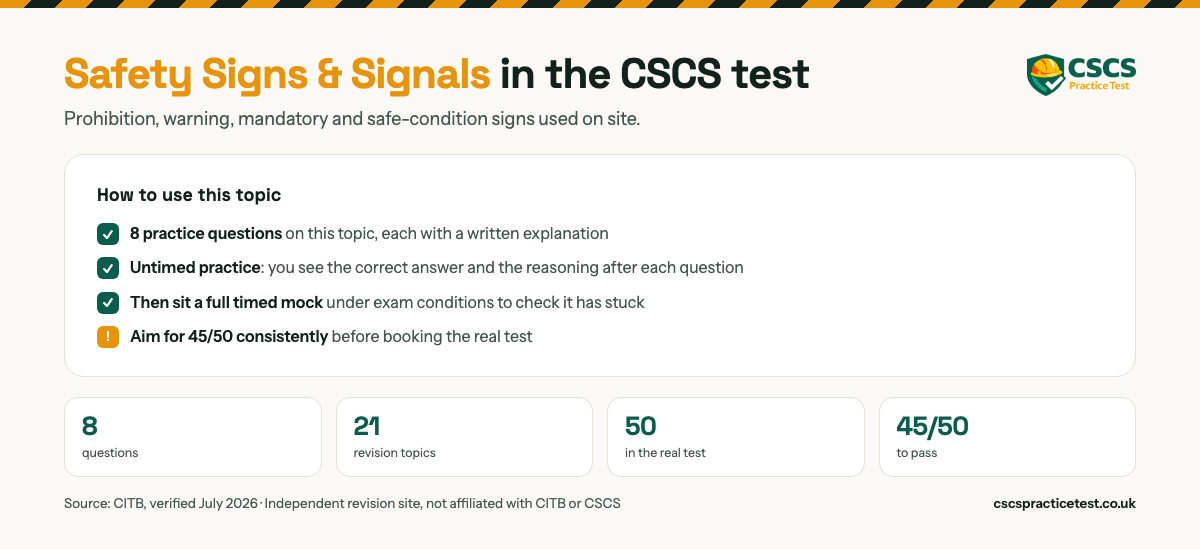
Prohibition, warning, mandatory and safe-condition signs used on site.
These questions cover safety signs & signalsfor the CITB Health, Safety and Environment (HS&E) test, the exam UK construction workers pass to get a CSCS card.
Safety Signs & Signals: practice questions (untimed, instant feedback)
- 50 questions · pass mark 90%
- Untimed practice: you see the correct answer immediately after each question.
- Some questions need more than one answer, and these are clearly marked.
All 50 Safety Signs & Signals questions and answers
These are the same 50 questions as the practice test above, written out with the correct answer and the reasoning behind it. Read them through when you want to revise rather than test yourself.
1. A round blue sign shows a worker wearing a hard hat. What does it mean?
Answer: Head protection must be worn
- A) Dispose of damaged helmets here
- B) Only white helmets are permitted
- C) Take helmets off in this area
- D) Head protection must be worn (correct answer)
Why: A round blue sign is mandatory: here it means head protection must be worn.
2. What do green and white safety signs indicate?
Answer: A safe condition, such as a route or facility
- A) A safe condition, such as a route or facility (correct answer)
- B) Something you must not do
- C) A mandatory action you must take
- D) A warning about a hazard
Why: Green and white signs show safe conditions, for example fire exits, first aid or assembly points.
3. A green sign shows a white cross. What does it mean?
Answer: First aid
- A) Hospital accident and emergency
- B) Emergency assembly point
- C) Fire point
- D) First aid (correct answer)
Why: A white cross on a green background is the standard first-aid sign.
4. What colour are fire-equipment signs?
Answer: Red
- A) Red (correct answer)
- B) Blue
- C) Yellow
- D) Green
Why: Fire-equipment signs are red.
5. What shape is a prohibition sign?
Answer: A circle with a diagonal line through it
- A) A circle with a diagonal line through it (correct answer)
- B) A triangle
- C) A rectangle
- D) A plain circle
Why: Prohibition signs are a red circle with a red diagonal bar, meaning 'you must not'.
6. What does a mandatory sign usually show?
Answer: A white pictogram on blue
- A) An exclamation mark
- B) A white pictogram on blue (correct answer)
- C) A cross
- D) Text only
Why: Mandatory signs use a white symbol on a blue background, meaning 'you must'.
7. Which describes a mandatory sign?
Answer: A blue circle
- A) A red triangle
- B) A white cross
- C) A blue circle (correct answer)
- D) A green square
Why: A blue circle marks a mandatory action you must carry out.
8. Which sign would you expect near a high-noise area?
Answer: Wear ear protection
- A) Wear ear protection (correct answer)
- B) No entry
- C) Slippery surface
- D) First-aid kit
Why: A high-noise zone carries a mandatory 'wear ear protection' sign.
9. What shape and colours does a prohibition signboard use?
Answer: Round, with a black pictogram on white, red edging and a diagonal bar
- A) Round, with a black pictogram on white, red edging and a diagonal bar (correct answer)
- B) Triangular, with a black pictogram on a yellow background and black edging
- C) Square, with a white pictogram on a red background covering half the sign
- D) Round, with a white pictogram on a blue background covering half the sign
Why: Schedule 1 Part II sets prohibitory signs as round, black pictogram on white, with red edging and a diagonal line, the red taking up at least 35% of the area.
10. What shape and colours does a warning signboard use?
Answer: Triangular, with a black pictogram on a yellow background and black edging
- A) Triangular, with a black pictogram on a yellow background and black edging (correct answer)
- B) Round, with a black pictogram on a white background and a red diagonal bar
- C) Rectangular, with a white pictogram on a green background and no edging
- D) Round, with a white pictogram on a blue background and white edging round it
Why: Warning signs are triangular, black pictogram on yellow with black edging, the yellow covering at least 50% of the sign.
11. What shape and colours does a mandatory signboard use?
Answer: Round, with a white pictogram on a blue background covering half the sign
- A) Triangular, with a black pictogram on yellow, telling you to take care
- B) Rectangular, with a white pictogram on green, showing a safe condition
- C) Round, with a black pictogram on white and a red bar across the diagonal
- D) Round, with a white pictogram on a blue background covering half the sign (correct answer)
Why: Mandatory signs are round with a white pictogram on blue, the blue covering at least 50%. Blue means a specific behaviour or action, such as wear PPE.
12. A square green sign with a white pictogram means what?
Answer: An emergency escape route or first-aid facility, a safe condition sign
- A) An emergency escape route or first-aid facility, a safe condition sign (correct answer)
- B) A prohibition that you must not carry out under any circumstances at all
- C) A mandatory instruction that you must follow before entering the area
- D) A warning that you should be careful and take precautions in that area
Why: Green is the safety colour for emergency escape and first aid, meaning no danger, and covers doors, exits, routes, equipment and facilities.
13. A square red sign with a white pictogram of an extinguisher means what?
Answer: The location and identification of fire-fighting equipment on the site
- A) The location and identification of fire-fighting equipment on the site (correct answer)
- B) A prohibition on using that equipment unless you have been trained on it
- C) A warning that there is a high risk of fire in that part of the site
- D) An instruction that everyone must evacuate the building immediately
Why: Fire-fighting signs are rectangular or square, white pictogram on red. Red covers prohibition, danger alarm and fire-fighting equipment, and here it is identification and location.
14. Under the safety colours table, what does yellow or amber mean?
Answer: A warning: be careful, take precautions, and examine what you are doing
- A) Stop or shut down, and evacuate the area as quickly as you safely can
- B) A warning: be careful, take precautions, and examine what you are doing (correct answer)
- C) A mandatory action, most often that you must wear protective equipment
- D) A safe condition, such as an escape route or a first-aid facility nearby
Why: The colours table gives yellow or amber as the warning colour, with the meaning be careful, take precautions, examine.
15. Under the safety colours table, what does blue mean?
Answer: A specific behaviour or action, for example that PPE must be worn there
- A) A warning of a hazard that you should examine before you go any further
- B) A prohibition, marking behaviour that is dangerous and is not allowed
- C) A safe condition, marking exits, escape routes and emergency equipment
- D) A specific behaviour or action, for example that PPE must be worn there (correct answer)
Why: Blue is the mandatory colour. The table gives its meaning as specific behaviour or action, with wear personal protective equipment as the example.
16. Red is used for more than one purpose in the colours table. Which set is correct?
Answer: Prohibition, danger alarm, and the location of fire-fighting equipment
- A) Mandatory action and prohibition, because both tell you what you must do
- B) Prohibition only, since every other use of red would confuse the message
- C) Warning and prohibition, but never for identifying fire-fighting kit
- D) Prohibition, danger alarm, and the location of fire-fighting equipment (correct answer)
Why: The table lists red against prohibition sign, danger alarm and fire-fighting equipment, with meanings covering dangerous behaviour, stop or evacuate, and identification and location.
17. What must happen to a signboard once the situation it refers to no longer exists?
Answer: It must be removed, because the sign no longer conveys a true message
- A) It must be covered over with tape until the same hazard returns again
- B) It must stay up for the rest of the project as a general reminder to all
- C) It must be repainted in green to show the area has now become safe
- D) It must be removed, because the sign no longer conveys a true message (correct answer)
Why: Part II states plainly that the signboard must be removed when the situation to which it refers ceases to exist. Leaving stale signs up teaches people to ignore signs.
18. Why should you avoid putting a lot of signs close together?
Answer: Because too many signs together reduces how effective each one of them is
- A) Because the regulations set a maximum of four signs on any one hoarding
- B) Because each sign has to be individually approved before it can be displayed
- C) Because signs sited too close together must all be the same size and shape
- D) Because too many signs together reduces how effective each one of them is (correct answer)
Why: Part I says the effectiveness of a sign must not be adversely affected by another source of the same type, and that placing too many signs too close together should be avoided.
19. When are safety signs required under regulation 4?
Answer: Where risk remains after collective protection and other measures are used
- A) On every construction site, regardless of what the risk assessment found
- B) Where risk remains after collective protection and other measures are used (correct answer)
- C) Only where the client has specifically asked for signs in the contract
- D) Only in areas of a site where members of the public may be able to enter
Why: Regulation 4 makes signs a residual measure. They are required where the employer, having adopted collective protection and other methods, still cannot avoid or adequately reduce the risk.
20. A sign is put up instead of fitting a guard rail to an open edge. Is that acceptable?
Answer: No. Signs come after collective protection, they do not replace it
- A) Yes, provided the sign is large and is clearly visible from a distance
- B) Yes, as long as everyone on the site has been briefed about the sign
- C) No. Signs come after collective protection, they do not replace it (correct answer)
- D) No, unless the edge is more than two metres above the level below it
Why: Regulation 4 only bites once appropriate techniques for collective protection have been adopted. A sign warning of a drop is not a substitute for physically protecting the edge.
21. What must be done where there is a risk of colliding with obstacles or of falling?
Answer: The area must be marked permanently with a safety colour or signboards
- A) The area must be fenced with rigid barriers at least one metre in height
- B) The area must be inspected by a competent person at the start of each shift
- C) The area must be lit by artificial lighting throughout the working day
- D) The area must be marked permanently with a safety colour or signboards (correct answer)
Why: Part I requires places where there is a risk of colliding with obstacles or of falling to be permanently marked with a safety colour and/or with signboards.
22. How must traffic routes be marked?
Answer: Permanently, using a safety colour along the length of the route
- A) With warning signboards placed at each end of the route on the site
- B) Permanently, using a safety colour along the length of the route (correct answer)
- C) With a mandatory blue sign at every point where the route changes
- D) Only where vehicles and pedestrians are not otherwise kept separate
Why: Part I states that traffic routes must be permanently marked with a safety colour, separately from the requirement to mark obstacles and drops.
23. When must hand signals or verbal communication be used?
Answer: To guide people who are carrying out hazardous or dangerous manoeuvres
- A) Whenever radios are unavailable anywhere on the construction site
- B) Only during the hours of darkness when signboards cannot be read
- C) To guide people who are carrying out hazardous or dangerous manoeuvres (correct answer)
- D) Only where a permanent signboard has been damaged and not replaced
Why: Part I says hand signals and/or verbal communication must be used where the occasion requires, to guide persons carrying out hazardous or dangerous manoeuvres.
24. Two acoustic signals are sounding in the same area at the same time. What is wrong with that?
Answer: It is not allowed, because the signals interfere with one another
- A) Nothing, provided the two signals use clearly different sound patterns
- B) It is not allowed, because the signals interfere with one another (correct answer)
- C) Nothing, as long as one of the two signals is quieter than the other
- D) It is not allowed unless a supervisor is present to explain the signals
Why: Part I lists this directly: two acoustic signals are not to be used at the same time, because a competing source of the same type destroys the message.
25. When must an acoustic signal not be used at all?
Answer: When there is too much ambient noise for the signal to be heard
- A) When the workers in the area are wearing any form of ear protection
- B) When the site is operating outside of its normal working hours
- C) When there is too much ambient noise for the signal to be heard (correct answer)
- D) When the same message is already shown on a permanent signboard
Why: Part I says an acoustic signal is not to be used if there is too much ambient noise. A signal nobody can hear is worse than none, because it is relied on.
26. What does the regulation require about the material a signboard is made from?
Answer: It must be shock resistant and weather resistant for its surroundings
- A) It must be metal, so that it cannot be damaged by site plant or weather
- B) It must be shock resistant and weather resistant for its surroundings (correct answer)
- C) It must be a rigid plastic of at least three millimetres in thickness
- D) It must carry a manufacturer's certificate confirming its expected life
Why: Part II requires signboards to be made of shock and weather-resistant material suitable for the surrounding environment. No specific material is prescribed.
27. Where natural light is poor, what does the guidance in Part II suggest for signboards?
Answer: That phosphorescent colours, reflective materials or lighting are used
- A) That the signs are made larger to compensate for the lack of daylight
- B) That the signs are moved to a position closer to the site entrance
- C) That the number of signs in the area is increased to improve the odds
- D) That phosphorescent colours, reflective materials or lighting are used (correct answer)
Why: Part II says phosphorescent colours, reflective materials or artificial lighting should be used where the level of natural light is poor.
28. Where should a signboard warning of a specific hazard be placed?
Answer: In the immediate vicinity of that hazard, at a suitable height and visible
- A) In the site office, so that it can be pointed out during the induction
- B) In the immediate vicinity of that hazard, at a suitable height and visible (correct answer)
- C) At the site entrance only, so that everyone passes it on their way in
- D) At the highest point of the structure, so it can be seen from a distance
Why: Part II requires signs at the access point for a general hazard, or in the immediate vicinity of a specific hazard or object, at a suitable height and in a well-lit, accessible and visible location.
29. Can a safety sign be used to convey a message other than the one in the Schedule?
Answer: No. Signs may only be used to convey the message set out in the Schedule
- A) Yes, provided the alternative meaning is explained at the site induction
- B) Yes, where the site has no suitable sign for the message it needs to give
- C) No. Signs may only be used to convey the message set out in the Schedule (correct answer)
- D) No, unless the sign has been approved in writing by the site manager
Why: Part I is explicit: safety signs must be used only to convey the message or information specified in the Schedule. Reusing a sign for a local meaning breaks the whole system.
30. When may the 'General danger' warning sign NOT be used?
Answer: To warn about hazardous substances or mixtures, with a narrow exception
- A) To warn about hazardous substances or mixtures, with a narrow exception (correct answer)
- B) To warn about any hazard that already has a specific sign of its own
- C) To warn about electrical hazards, which need their own dedicated sign
- D) To warn about anything at all outside the normal site working hours
Why: An amendment added the rule that the General danger sign must not be used to warn about hazardous substances or mixtures, except to indicate stores of a number of them.
31. Which of these is a prohibition sign in the Schedule?
Answer: No access for unauthorised persons, shown with a red bar across it
- A) Safety helmet must be worn at all times while you are on this site
- B) Danger: electricity, shown on a triangle with a black lightning symbol
- C) No access for unauthorised persons, shown with a red bar across it (correct answer)
- D) Emergency exit, shown as a running figure on a green rectangular sign
Why: The prohibition list includes no smoking, smoking and naked flames forbidden, no access for pedestrians, do not extinguish with water, not drinkable, no access for unauthorised persons, no access for industrial vehicles and do not touch.
32. Which of these is a mandatory sign in the Schedule?
Answer: Eye protection must be worn, shown as a white symbol on a blue disc
- A) Overhead load, warning you that loads are being lifted above the area
- B) Eye protection must be worn, shown as a white symbol on a blue disc (correct answer)
- C) Fire hose, shown as a white pictogram on a square red background
- D) Drop, warning that there is a change of level immediately ahead of you
Why: The mandatory list includes eye, head, ear, respiratory, foot, hand, body and face protection, safety harness, pedestrians must use this route, and a general mandatory sign.
33. Which of these is a warning sign in the Schedule?
Answer: Overhead load, shown as a black pictogram on a yellow triangle
- A) First-aid post, shown as a white cross on a green rectangular sign
- B) Safety boots must be worn, shown as a white symbol on a blue disc
- C) Overhead load, shown as a black pictogram on a yellow triangle (correct answer)
- D) Fire extinguisher, shown as a white pictogram on a red square sign
Why: The warning list includes flammable, explosive, toxic, corrosive and radioactive material, overhead load, industrial vehicles, danger electricity, general danger, laser beam, oxidant, non-ionizing radiation, strong magnetic field, obstacles, drop, biological risk and low temperature.
34. The 'Harmful or irritant material' warning sign was removed from the Schedule. What does that mean in practice?
Answer: It was revoked in 2015, so it is no longer one of the listed warning signs
- A) It was revoked in 2015, so it is no longer one of the listed warning signs (correct answer)
- B) It is still valid but may only be used indoors where chemicals are stored
- C) It was replaced by a blue mandatory sign covering all of the same substances
- D) It may still be used provided a COSHH assessment has been carried out
Why: A 2015 amendment revoked that warning sign from Part II paragraph 3.2, aligning the Regulations with the CLP chemical classification system.
35. What proportion of a warning sign must be yellow?
Answer: At least 50% of the area of the sign, with black edging around it
- A) At least 35% of the area, matching the requirement for prohibition signs
- B) At least 50% of the area of the sign, with black edging around it (correct answer)
- C) At least 75% of the area, so the yellow dominates the black pictogram
- D) There is no set proportion, provided the sign is easy to see and read
Why: Part II specifies at least 50% yellow for warning signs. The 35% figure belongs to the red part of a prohibition sign, which is a common mix-up.
36. What proportion of a prohibition sign must be red?
Answer: At least 35% of the area of the sign, including the edging and the bar
- A) At least 50%, which is the same proportion as the blue on a mandatory sign
- B) At least 25%, since the pictogram itself must remain clearly visible
- C) At least 35% of the area of the sign, including the edging and the bar (correct answer)
- D) The whole background, with only the pictogram left in white on top
Why: Prohibition signs require the red part to take up at least 35% of the area. Mandatory, warning, escape and fire-fighting signs all use at least 50% of their colour.
37. What are permanent signboards required for?
Answer: Prohibitions, warnings, mandatory requirements, escape routes, first aid
- A) Only for prohibitions, since those are the only signs with real legal force
- B) Prohibitions, warnings, mandatory requirements, escape routes, first aid (correct answer)
- C) Only for fire-fighting equipment and the routes leading out of the site
- D) Only for hazards that will remain in place for more than thirty days
Why: Part I lists permanent signboards for prohibitions, warnings and mandatory requirements, and for the location and identification of emergency escape routes and first-aid facilities.
38. When are illuminated signs, acoustic signals or verbal communication used?
Answer: To signal danger, to call for action, and for emergency evacuation
- A) Only during the commissioning phase, before permanent signs are fitted
- B) Only at night, when a painted signboard cannot be read from a distance
- C) Only where the site has no mains power available for permanent signs
- D) To signal danger, to call for action, and for emergency evacuation (correct answer)
Why: Part I groups these as occasional signs, used where the occasion requires to signal danger, to call persons to take a specific course of action, and for emergency evacuation.
39. Two illuminated signs that could be confused with one another are fitted nearby. What does the Schedule say?
Answer: They must not be used at the same time as one another
- A) They may both be used if they are different colours
- B) They must not be used at the same time as one another (correct answer)
- C) They may both be used if a supervisor explains them at induction
- D) They must be fitted at least ten metres apart from one another
Why: Part I states that two illuminated signs which are likely to be confused are not to be used at the same time, and that an illuminated sign is not to be used near a similar illuminated source.
40. Can a safety colour be used instead of a signboard?
Answer: Yes, any of the listed options may be used if they are equally effective
- A) No, a signboard is always required and a colour can only supplement it
- B) No, because safety colours carry no defined meaning in the Regulations
- C) Yes, any of the listed options may be used if they are equally effective (correct answer)
- D) Yes, but only for marking traffic routes and for nothing else on site
Why: Part I allows interchanging: any one of the listed options may be used if equally effective, for example a safety colour or a signboard to mark places where there is an obstacle or a drop.
41. How simple must the pictogram on a signboard be?
Answer: As simple as possible, containing only the essential details needed
- A) As simple as possible, containing only the essential details needed (correct answer)
- B) Detailed enough to show the exact hazard present at that location
- C) It must exactly match the drawing printed in the Regulations themselves
- D) It must include written text alongside it in at least two languages
Why: Part II requires pictograms to be as simple as possible, containing only essential details, and allows slight variation provided the meaning is not obscured.
42. A site uses a pictogram slightly different from the one illustrated in the Regulations. Is that allowed?
Answer: Yes, provided it conveys the same meaning and does not obscure it
- A) No, the pictogram illustrated in the Regulations must be copied exactly
- B) No, unless the sign is being used temporarily during the first fix stage
- C) Yes, provided it conveys the same meaning and does not obscure it (correct answer)
- D) Yes, provided the site keeps a register of every variation that is used
Why: Part II expressly permits pictograms that are slightly different from or more detailed than those shown, provided they convey the same meaning and no adaptation obscures it.
43. Under regulation 4, when are risks treated as having been adequately reduced?
Answer: When there is no longer a significant risk of harm from that work
- A) When the workforce reports that they feel safe carrying out the work
- B) When the risk has been reduced to a level below one in a million
- C) When the residual risk has been recorded in the written assessment
- D) When there is no longer a significant risk of harm from that work (correct answer)
Why: Regulation 4(2) sets the test: risks are adequately reduced only if there is no longer a significant risk of harm, having regard to the magnitude and nature of the risks arising.
44. A green sign showing a stretcher indicates what?
Answer: A first-aid facility, since green marks safe conditions and first aid
- A) A prohibition on moving any casualty until first aid has arrived
- B) A warning that there is a risk of injury in the area immediately ahead
- C) A first-aid facility, since green marks safe conditions and first aid (correct answer)
- D) A mandatory instruction to report all injuries to the site office
Why: The emergency escape and first-aid list includes first-aid post, stretcher, safety shower, eyewash and emergency telephone, all white on green.
45. A red square sign showing a ladder means what?
Answer: That it marks fire-fighting equipment, in this case a fire ladder
- A) That ladders must be used to reach that level rather than a stair
- B) That the use of ladders in that area is prohibited altogether
- C) That there is a warning of a fall hazard from a ladder nearby
- D) That it marks fire-fighting equipment, in this case a fire ladder (correct answer)
Why: The fire-fighting sign list includes fire hose, ladder, fire extinguisher and emergency fire telephone, all white pictograms on red.
46. Does a 'No smoking' sign belong to the prohibition group or the warning group?
Answer: Prohibition, shown as a round sign with a red bar through the pictogram
- A) Prohibition, shown as a round sign with a red bar through the pictogram (correct answer)
- B) Warning, shown as a yellow triangle with a black cigarette pictogram
- C) Mandatory, because it instructs a specific behaviour from everyone there
- D) Fire-fighting, because the risk it addresses is the risk of fire starting
Why: No smoking, and smoking and naked flames forbidden, are both in the prohibition list, so both take the round white sign with red edging and diagonal bar.
47. What does the safety colour green mean in the colours table?
Answer: No danger, covering doors, exits, routes, equipment, and return to normal
- A) Be careful and take precautions, then examine the area before you start work
- B) Stop or shut down, and evacuate the area by the nearest available route
- C) No danger, covering doors, exits, routes, equipment, and return to normal (correct answer)
- D) A mandatory action, most commonly that protective equipment is required
Why: The table gives green against emergency escape and first-aid signs, with the meaning no danger and the instructions covering doors, exits, routes, equipment, facilities and return to normal.
48. 'Do not extinguish with water' is which type of sign?
Answer: A prohibition sign, one of those specifically listed in the Schedule
- A) A warning sign, because it flags a hazard associated with the fire
- B) A prohibition sign, one of those specifically listed in the Schedule (correct answer)
- C) A fire-fighting sign, because it concerns how the fire is to be put out
- D) A mandatory sign, because it directs how the fire must be tackled
Why: It appears in the prohibition list in Part II paragraph 3.1, alongside no smoking and no access for unauthorised persons.
49. Signboards on containers and pipes must be placed how?
Answer: As laid down in Part III of the Schedule, which deals with them directly
- A) Wherever the site finds it most convenient during the fitting-out stages
- B) At both ends of every pipe run, regardless of what the pipe actually carries
- C) As laid down in Part III of the Schedule, which deals with them directly (correct answer)
- D) Only where the contents of the container or pipe are flammable liquids
Why: Part I paragraph 2.1.2 points to Part III, which sets the requirements for signs on containers and pipes carrying dangerous substances.
50. Why does the law treat a sign as a last resort rather than a first response?
Answer: Because a sign only informs, it does not remove or control the hazard
- A) Because signs are expensive to produce and to maintain over a project
- B) Because a sign only informs, it does not remove or control the hazard (correct answer)
- C) Because signs must be approved before they can be put up on a site
- D) Because most workers on a construction site will not read a sign anyway
Why: Regulation 4 only requires signs where collective protection and changes to how the work is organised cannot avoid or adequately reduce the risk. A sign transfers information, not protection.
What this topic covers in the CSCS test
Site signs follow a fixed code set out in Schedule 1 of the Health and Safety (Safety Signs and Signals) Regulations 1996. Shape and colour carry the meaning, so once you know the code you can read a sign you have never seen before. The test leans on exactly that, which is why so many questions describe a shape and a colour rather than showing you a picture.
- The four signboard families: prohibition, warning, mandatory and safe condition
- Fire equipment signs, and why red does two different jobs
- The colour code: red, yellow or amber, blue and green
- Reading an unfamiliar pictogram from its shape and background colour
- Yellow and black or red and white striping for obstacles and drops
- Hand signals for guiding plant, and the signaller's role
- Acoustic and verbal signals, including the evacuation signal
Key facts worth memorising
- Prohibition: you must not
- Round, black pictogram on white, with red edging and a red diagonal bar, and the red must cover at least 35 per cent of the sign.
- Warning: take care
- Triangular, black pictogram on a yellow background with black edging, and the yellow must cover at least 50 per cent of the sign.
- Mandatory: you must
- Round, white pictogram on blue. Nearly every PPE sign on site is this type, including head, eye and ear protection.
- Safe condition and fire equipment
- Both are rectangular or square. Green with a white pictogram means emergency escape or first aid, so a white cross on green is first aid. Red with a white pictogram identifies fire-fighting equipment.
- Striped hazard marking
- Places where you could collide with an obstacle or fall are marked with alternating yellow and black, or red and white, stripes set at roughly 45 degrees.
- The evacuation signal is continuous
- Schedule 1 requires the acoustic signal for evacuation to be continuous, and the hand signal for danger or emergency stop is both arms pointing upwards with the palms facing forwards.
What people get wrong
A red sign always means stop or do not.
Red also identifies fire-fighting equipment. A white pictogram on a solid red rectangle points you to an extinguisher or hose. The prohibition sign is the round one with the diagonal bar through it.
Blue signs are advice you can weigh up.
Blue circles are mandatory. They set out something you must do, and there is no discretion in them.
No sign means the rule does not apply.
The risk assessment and your briefing set the requirement, not the signage. If you were told to wear hearing protection and the sign is missing, wear it and tell your supervisor about the sign.
Putting up plenty of signs makes a site safer.
Signs are only required where a significant risk remains after every other control has been applied, and Schedule 1 says a signboard must be removed once the situation it refers to has ended. Too many signs, or ones that no longer apply, train people to ignore all of them.
Answering these questions in the test
Answer from shape and colour first, and only then look at the pictogram. Round and blue is you must. Round with a red diagonal is you must not. Triangle and yellow is take care. Rectangle and green is safe condition or the way out. Rectangle and red is fire equipment. Learning those five pairings answers most of this section on its own, and it works even when the symbol is one you have never seen. Where a question describes a missing sign, a damaged sign or a sign that contradicts your briefing, the option that lets you carry on regardless is always the wrong one.
Sources
Written from the following. Where a figure could not be verified against one of these, it has been left out rather than approximated. Our sources and methodology explains how we date and re-check them. Spotted something wrong? Report an error and we will fix it.
Topics that come up alongside safety signs & signals
Ready for the real thing?
When you are scoring 90% or better here, take a CSCS mock test for Operatives under exam conditions, then how to book the CSCS test.