
CSCS General Responsibilities & Risk Assessment Questions
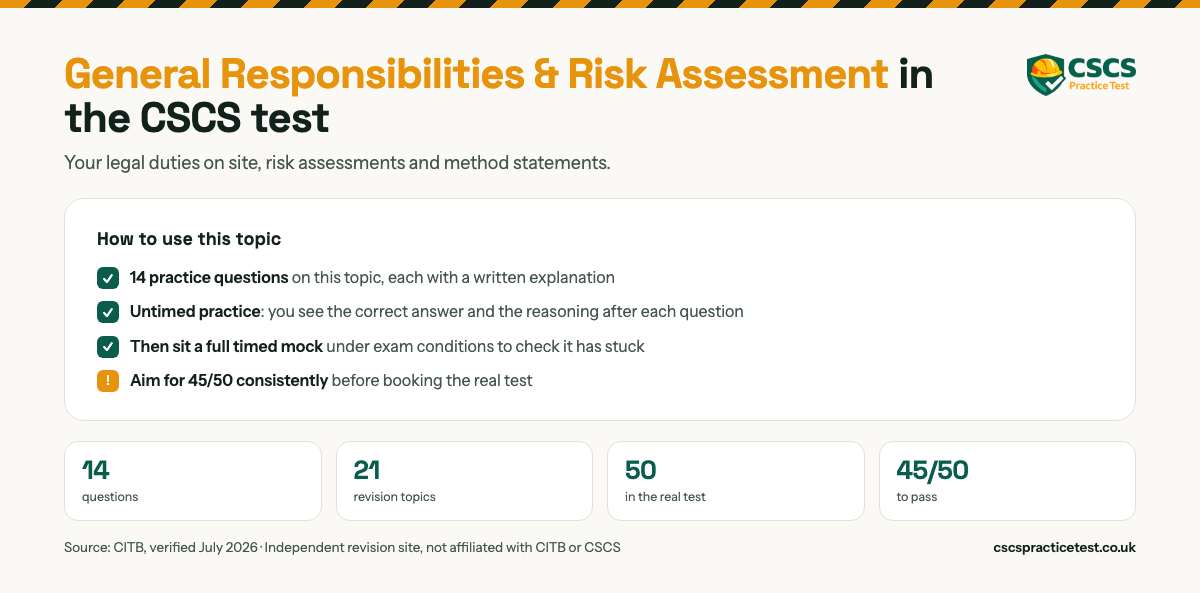
Your legal duties on site, risk assessments and method statements.
These questions cover general responsibilities & risk assessmentfor the CITB Health, Safety and Environment (HS&E) test, the exam UK construction workers pass to get a CSCS card.
General Responsibilities & Risk Assessment: practice questions (untimed, instant feedback)
- 50 questions · pass mark 90%
- Untimed practice: you see the correct answer immediately after each question.
- Some questions need more than one answer, and these are clearly marked.
All 50 General Responsibilities & Risk Assessment questions and answers
These are the same 50 questions as the practice test above, written out with the correct answer and the reasoning behind it. Read them through when you want to revise rather than test yourself.
1. As a worker, which of the following is NOT something the law requires of you?
Answer: Producing your own risk assessments
- A) Not tampering with anything supplied in the interests of health and safety
- B) Taking care of the health and safety of others who could be affected by what you do
- C) Taking reasonable care of your own health and safety
- D) Producing your own risk assessments (correct answer)
Why: Workers must look after themselves and others and not misuse safety provisions, but writing risk assessments is the employer's job, not the worker's.
2. What is the purpose of a risk assessment?
Answer: To identify the hazards and how to carry out the task safely
- A) To set out the site procedure for reporting accidents and injuries
- B) To identify the hazards and how to carry out the task safely (correct answer)
- C) To state the agreed working hours and shift patterns for the site
- D) To show where the first-aid kit and eyewash station are kept on site
Why: A risk assessment identifies the hazards of a task and the safe way to do the job.
3. What is meant by the term 'hazard'?
Answer: Anything in the workplace with the potential to cause harm
- A) A guard or barrier fitted to a machine
- B) Anything in the workplace with the potential to cause harm (correct answer)
- C) The chance that something might happen
Why: A hazard is anything with the potential to cause harm; the chance of it causing harm is the 'risk'.
4. What is the main danger of using a chisel or bolster with a mushroomed head?
Answer: Pieces can break off and fly out at speed
- A) Pieces can break off and fly out at speed (correct answer)
- B) The head forms a jagged edge that cuts your hand
- C) The shaft bends and strains your wrist
- D) You are more likely to strike your own hand
Why: A mushroomed head can shatter, throwing metal fragments. That is the main danger.
5. What must you be in order to operate a power tool?
Answer: Trained and competent
- A) Aged over 16
- B) Trained and competent (correct answer)
- C) A holder of a gold CSCS card
- D) Supervised at all times
Why: You must be trained and competent to use a power tool.
6. You are about to use an air-powered tool. Which three hazards are you most likely to face? (Choose three)
Answers: Airborne dust and flying particles, Hand-arm vibration and Leaking air hoses
- A) Airborne dust and flying particles (correct answer)
- B) Electric shock
- C) Hand-arm vibration (correct answer)
- D) Leaking air hoses (correct answer)
- E) Radiation
Why: Air tools bring dust and flying fragments, vibration and hose failures, but not electric shock or radiation.
7. Which of the following is NOT part of a safe system of work?
Answer: Professional trust
- A) A construction phase plan
- B) A health and safety policy
- C) A permit to work
- D) Professional trust (correct answer)
Why: A safe system of work relies on documented controls, not on trust.
8. How often does the HSE recommend that portable equipment, tools and leads are tested?
Answer: Every three months
- A) At the start of each project
- B) Weekly
- C) Yearly
- D) Every three months (correct answer)
Why: The HSE recommends portable site equipment such as 110V tools is tested around every three months.
9. What hazard does too much oxygen in the air create?
Answer: Materials become more flammable
- A) Breathing gets harder
- B) Fumes turn more toxic
- C) Injuries happen more easily
- D) Materials become more flammable (correct answer)
Why: An oxygen-enriched atmosphere makes materials ignite and burn far more easily.
10. What is every worker's primary responsibility on site?
Answer: To keep themselves and others safe
- A) To check and sign off the site manager's paperwork
- B) To keep themselves and others safe (correct answer)
- C) To operate any site machinery that is needed
- D) To manage the project budget and order materials
Why: Workers must take care of their own safety and not put others at risk.
11. If you spot a hazard on site, what should you do first?
Answer: Report it to your supervisor
- A) Ignore it and carry on working
- B) Report it to your supervisor (correct answer)
- C) Fix it yourself right away without telling anyone
- D) Mention it to a workmate at break
Why: Report hazards to a supervisor so they can be dealt with properly.
12. Who has the main duty to provide a safe workplace?
Answer: The employer, for all of its own employees
- A) The Health and Safety Executive
- B) The site manager who runs the day-to-day work
- C) Each individual worker, looking after themselves
- D) The employer, for all of its own employees (correct answer)
Why: The employer holds the primary legal duty for a safe working environment.
13. What should you do if asked to do a task you have not been trained for?
Answer: Refuse and tell your supervisor
- A) Refuse and tell your supervisor (correct answer)
- B) Attempt it carefully
- C) Copy a colleague
- D) Do it and ask for help if stuck
Why: Don't attempt untrained work. Raise it with your supervisor.
14. Which document sets out the hazards and controls for a specific task?
Answer: The risk assessment
- A) The risk assessment (correct answer)
- B) The site diary
- C) The work schedule
- D) The staff handbook
Why: A risk assessment lists the task's hazards and the controls to manage them.
15. Under the Health and Safety at Work etc. Act 1974, how far does an employer's general duty to protect its own employees extend?
Answer: As far as is reasonably practicable, covering health, safety and welfare
- A) Absolutely, so that no employee may ever be harmed under any circumstance
- B) Only to those risks the employer has been warned about in writing first
- C) Only as far as the employer's liability insurance policy agrees to cover
- D) As far as is reasonably practicable, covering health, safety and welfare (correct answer)
Why: Section 2(1) makes it the duty of every employer to ensure, so far as is reasonably practicable, the health, safety and welfare at work of all employees. The duty is qualified, so it is not absolute, but it is also not limited to written warnings or to whatever an insurer will pay for.
16. Section 2(2)(a) of the 1974 Act names two things an employer must provide and maintain in a safe condition. What are they?
Answer: Plant and systems of work that are safe and without risks to health
- A) Written method statements and the permits to work issued alongside them
- B) First aid boxes and the accident book kept in the site welfare facility
- C) Personal protective equipment and the storage lockers provided for it
- D) Plant and systems of work that are safe and without risks to health (correct answer)
Why: Section 2(2)(a) refers specifically to the provision and maintenance of plant and systems of work that are, so far as is reasonably practicable, safe and without risks to health. The other items are real duties elsewhere in health and safety law, but none of them is what this paragraph lists.
17. Section 2(2)(c) of the 1974 Act lists what an employer must provide so that employees can work safely. Which set is it?
Answer: Information, instruction, training and supervision, so far as is needed
- A) Site security, car parking, canteen facilities and transport to work
- B) Uniforms, lockers, a rest area and a private space to take breaks in
- C) Information, instruction, training and supervision, so far as is needed (correct answer)
- D) Insurance cover, sick pay, a written contract and a company pension scheme
Why: Section 2(2)(c) requires the provision of such information, instruction, training and supervision as is necessary to ensure the health and safety of employees. The other options describe employment benefits or site amenities, which this paragraph does not deal with.
18. What does section 2(2)(d) of the 1974 Act require for any place of work under the employer's control?
Answer: It is kept safe, with safe ways of getting into it and out of it
- A) It is fenced with a solid hoarding at least two metres high all round
- B) It is kept safe, with safe ways of getting into it and out of it (correct answer)
- C) It is registered with the local authority before any work commences
- D) It is inspected by an external consultant at the start of every week
Why: Section 2(2)(d) covers maintaining the place of work in a safe condition and providing and maintaining safe means of access to it and egress from it. Hoarding heights, outside inspections and local authority registration are not requirements of this paragraph.
19. Section 2(2)(e) of the 1974 Act deals with the working environment. What must that environment be adequate as regards?
Answer: Facilities and arrangements for the welfare of employees while at work
- A) Broadband speed and the mobile phone signal available across the site
- B) Storage capacity for materials delivered ahead of the programme dates
- C) Car parking spaces and the security lighting installed to cover those spaces
- D) Facilities and arrangements for the welfare of employees while at work (correct answer)
Why: Section 2(2)(e) requires a working environment that is safe, without risks to health, and adequate as regards facilities and arrangements for employees' welfare at work. Communications, storage and parking are not what the paragraph measures adequacy against.
20. What does section 2(3) of the 1974 Act require an employer to prepare about health and safety?
Answer: A written general policy statement, revised and shown to all employees
- A) A signed contract made between the employer and the safety committee
- B) A written general policy statement, revised and shown to all employees (correct answer)
- C) A confidential file kept for inspectors and withheld from the workforce
- D) A verbal briefing given once to supervisors at the start of a project
Why: Section 2(3) requires a written statement of general policy on health and safety, together with the organisation and arrangements for carrying it out, revised as appropriate and brought to the notice of all employees. A spoken briefing or a document hidden from staff would not satisfy it.
21. Whose health and safety must an employer protect under section 3(1) of the 1974 Act?
Answer: People who are not in its employment but could be affected by the work
- A) Only workers directly supervised by the employer's own managers
- B) People who are not in its employment but could be affected by the work (correct answer)
- C) Only the employees named on that day's site attendance register
- D) Only visitors who have signed in at the site office on arrival
Why: Section 3(1) requires every employer to conduct its undertaking so that persons not in its employment who may be affected are not exposed to risks to their health or safety. That covers the public, visitors and other firms' workers, not just people on a register.
22. Section 3(2) of the 1974 Act places a duty on self-employed people. Which self-employed people does it now catch?
Answer: Those who run an undertaking of a description set out in regulations
- A) Only those who also employ at least one other person to work for them
- B) Every self-employed person in the country, with no exception at all
- C) Those who run an undertaking of a description set out in regulations (correct answer)
- D) Only those who work within the construction industry on a site
Why: As revised, section 3(2) applies to a self-employed person who conducts an undertaking of a prescribed description. The duty is therefore no longer universal across all self-employed people, and it is not limited by headcount or to one industry.
23. Section 4 of the 1974 Act covers a person who controls non-domestic premises used by other people as a place of work. What must that person do?
Answer: Take the measures it is reasonable for someone in their position to take
- A) Take out employers' liability insurance for everyone on the premises
- B) Take the measures it is reasonable for someone in their position to take (correct answer)
- C) Take over all of the health and safety duties owed by each visiting employer
- D) Take a written indemnity from every firm that comes on the premises
Why: Section 4(2) requires the person in control to take such measures as it is reasonable for a person in his position to take, so far as is reasonably practicable, to keep the premises, the access and egress and any plant or substance safe. It does not transfer other employers' duties to them.
24. Section 6 of the 1974 Act places duties on people connected with an article for use at work. Who is caught by it?
Answer: Anyone who designs, manufactures, imports or supplies the article
- A) Anyone who designs, manufactures, imports or supplies the article (correct answer)
- B) Only the hire company that last had the article out on hire to a site
- C) Only the site manager who signed for the article when it was delivered
- D) Only the factory that physically manufactured the finished article
Why: Section 6(1) applies to any person who designs, manufactures, imports or supplies an article for use at work. The duty runs along the whole supply chain rather than stopping at the manufacturer, the hirer or the person who took delivery.
25. What information must be supplied with an article for use at work under section 6 of the 1974 Act?
Answer: What it was designed and tested for, and the conditions for using it safely
- A) A copy of the maker's own company health and safety policy statement
- B) The full commercial price list and the discount terms that were applied
- C) The names of everyone employed on the production line that built it
- D) What it was designed and tested for, and the conditions for using it safely (correct answer)
Why: Section 6(1)(c) requires adequate information about the use for which the article is designed or has been tested and about any conditions needed to make sure it stays safe when set, used, cleaned or maintained. Pricing and staffing details are irrelevant to that duty.
26. Section 7(a) of the 1974 Act places what duty on every employee while at work?
Answer: To take reasonable care for their own safety and for other people's
- A) To take reasonable care for their own safety and for other people's (correct answer)
- B) To take reasonable care only while a supervisor is watching them work
- C) To guarantee that no accident of any kind happens anywhere on the site
- D) To look after themselves but not anyone else working close to them
Why: Section 7(a) requires every employee to take reasonable care for the health and safety of himself and of other persons who may be affected by his acts or omissions at work. It is a duty of reasonable care, not a guarantee, and it is not switched off when nobody is watching.
27. As well as taking reasonable care, what else does section 7 of the 1974 Act require of an employee?
Answer: To co-operate with the employer so its legal duties can be carried out
- A) To co-operate with the employer so its legal duties can be carried out (correct answer)
- B) To pay towards the cost of safety equipment issued to them for the job
- C) To report faults to the enforcing authority instead of the employer
- D) To write their own risk assessment before starting any unfamiliar task
Why: Section 7(b) requires an employee to co-operate with the employer, or any other person with a duty, so far as is necessary to enable that duty or requirement to be performed or complied with. Writing risk assessments and paying for equipment are not employee duties.
28. Section 8 of the 1974 Act says that no person shall do what to anything provided in the interests of health, safety or welfare?
Answer: Intentionally or recklessly interfere with it, or misuse it in any way
- A) Move it between parts of the site without written permission first
- B) Borrow it for personal use at home during evenings or at weekends
- C) Use it for any purpose at all unless a supervisor is standing nearby
- D) Intentionally or recklessly interfere with it, or misuse it in any way (correct answer)
Why: Section 8 prohibits intentionally or recklessly interfering with or misusing anything provided in the interests of health, safety or welfare under the relevant statutory provisions. It is aimed at deliberate or reckless conduct, not at moving or borrowing items as such.
29. Under section 9 of the 1974 Act, what is the position on charging an employee for statutory safety provision?
Answer: No charge may be levied on the employee for it, in any form at all
- A) No charge may be levied on the employee for it, in any form at all (correct answer)
- B) A reasonable charge is allowed to cover the wear and tear on the item
- C) A charge is allowed provided the employee agrees to it in writing first
- D) A charge is allowed once the employee has been in the job for a year
Why: Section 9 states that no employer shall levy or permit to be levied on any employee any charge in respect of anything done or provided under a specific requirement of the relevant statutory provisions. Consent, length of service and wear and tear make no difference.
30. If a safety offence by one duty holder is caused by the act or default of somebody else, what does section 36 allow?
Answer: That other person can also be charged with and convicted of the offence
- A) Only the original duty holder is prosecuted, since the duty was theirs
- B) That other person can also be charged with and convicted of the offence (correct answer)
- C) No prosecution is possible until the duty holder has been convicted
- D) The matter can only be handled through internal disciplinary action
Why: Section 36(1) provides that where the commission of an offence is due to the act or default of some other person, that other person is guilty of the offence, and may be charged and convicted whether or not proceedings are taken against the first person.
31. When can a company director be personally guilty of an offence committed by the company under the 1974 Act?
Answer: Where it happened with their consent or connivance, or through their neglect
- A) Only if the director personally signed the written safety policy statement
- B) Only where the director was physically present when the incident occurred
- C) Where it happened with their consent or connivance, or through their neglect (correct answer)
- D) Whenever the company is convicted, because directors are always liable
Why: Section 37(1) makes a director, manager, secretary or similar officer guilty as well as the company where the offence was committed with their consent or connivance, or was attributable to any neglect on their part. Mere office holding is not enough, nor is presence required.
32. In a prosecution for failing to do something so far as is reasonably practicable, who has to prove what?
Answer: The accused must prove that no more could reasonably practicably be done
- A) The injured person must prove a cheaper and safer method was available
- B) The accused must prove that no more could reasonably practicably be done (correct answer)
- C) Neither side proves it, as the court decides the point on its own facts
- D) The prosecution must prove beyond any real doubt that more could be done
Why: Section 40 reverses the usual burden. It is for the accused to prove that it was not practicable or not reasonably practicable to do more than was in fact done, or that there was no better practicable means than the one actually used.
33. Section 40 of the 1974 Act refers to three different standards of duty. Which set of three is it?
Answer: Practicable, reasonably practicable, and best practicable means
- A) Mandatory, advisory, and optional depending on the size of the firm
- B) Possible, affordable, and convenient for the contractor to arrange
- C) Immediate, medium term, and long term depending on the risk rating
- D) Practicable, reasonably practicable, and best practicable means (correct answer)
Why: Section 40 applies where a duty is to do something so far as is practicable, or so far as is reasonably practicable, or to use the best practicable means. Those are the three qualified standards the Act uses, and they are not tiers of urgency or of advice.
34. Which of these duties in the 1974 Act is stated with no 'reasonably practicable' qualification attached to it at all?
Answer: The section 8 ban on interfering with or misusing safety provisions
- A) The section 8 ban on interfering with or misusing safety provisions (correct answer)
- B) The employer's duty towards its own employees under section 2(1)
- C) The duty of a person in control of premises under section 4(2) of the Act
- D) The employer's duty to people who are not employees under section 3(1)
Why: Section 8 is worded absolutely: no person shall intentionally or recklessly interfere with or misuse the thing provided. Sections 2(1), 3(1) and 4(2) are each expressly qualified by the words so far as is reasonably practicable.
35. What standard must an employer's risk assessment meet under regulation 3 of the Management Regulations 1999?
Answer: It has to be suitable and sufficient for the risks being assessed
- A) It has to be signed by every employee before work is allowed to start
- B) It has to run to at least ten pages and be checked by an outside body
- C) It has to be approved in advance by the relevant enforcing authority
- D) It has to be suitable and sufficient for the risks being assessed (correct answer)
Why: Regulation 3(1) requires every employer to make a suitable and sufficient assessment of the risks to employees and to people not in its employment. There is no page count, no prior approval by the regulator and no requirement for workforce signatures.
36. When must an employer record the significant findings of a risk assessment under the Management Regulations 1999?
Answer: Whenever that single employer has five or more employees working for it
- A) Whenever the work is expected to last longer than thirty calendar days
- B) Whenever the site has more than five separate contractors working on it
- C) Only when the enforcing authority asks in writing to inspect the record
- D) Whenever that single employer has five or more employees working for it (correct answer)
Why: Regulation 3(6) applies where the employer employs five or more employees. The trigger counts that employer's own employees, so it is not about the length of the job, the number of contractors present, or any request from an inspector.
37. Besides the significant findings, what else must be written down under regulation 3(6) of the Management Regulations 1999?
Answer: Any group of the employees identified by it as being especially at risk
- A) The total cost of every control measure the employer has considered using
- B) Any group of the employees identified by it as being especially at risk (correct answer)
- C) The date on which the enforcing authority last inspected the workplace
- D) The names and home addresses of everyone who took part in the assessment
Why: Regulation 3(6) requires the employer to record the significant findings of the assessment and any group of his employees identified by it as being especially at risk. Personal details, costings and inspection dates are not part of that record.
38. Regulation 3(3) of the Management Regulations 1999 says a risk assessment must be reviewed in which circumstances?
Answer: If it may no longer be valid, or the work has significantly changed
- A) If it may no longer be valid, or the work has significantly changed (correct answer)
- B) Only after an accident that has been reported to the enforcing authority
- C) Only when a new employee joins the company and has to be inducted
- D) Exactly once every twelve months, whatever else happens in between
Why: Regulation 3(3) requires a review where there is reason to suspect the assessment is no longer valid or there has been a significant change in the matters to which it relates, and any resulting changes must then be made. A fixed annual cycle is not what the regulation says.
39. When assessing risks to a young person, what must an employer take particular account of under the Management Regulations 1999?
Answer: Their inexperience, their lack of awareness of risk and their immaturity
- A) The hours of unpaid overtime that they say they are willing to work
- B) Their examination results and the qualifications they gained at school
- C) Their inexperience, their lack of awareness of risk and their immaturity (correct answer)
- D) Their height and weight measured against the average adult on that site
Why: Regulation 3(5)(a) requires particular account to be taken of the inexperience, lack of awareness of risks and immaturity of young persons, alongside factors such as workplace layout and the training given. Exam results and physical size are not the statutory test.
40. Regulation 5 of the Management Regulations 1999 requires arrangements covering which activities, for the protective measures?
Answer: Effective planning, organisation, control, monitoring and review
- A) Purchasing, delivery, storage, distribution and disposal of material
- B) Advertising, recruitment, selection, appointment and staff appraisal
- C) Effective planning, organisation, control, monitoring and review (correct answer)
- D) Design, tendering, pricing, contracting and final account settlement
Why: Regulation 5(1) requires appropriate arrangements for the effective planning, organisation, control, monitoring and review of the preventive and protective measures, having regard to the nature and size of the undertaking. The other lists describe commercial processes, not this duty.
41. What must every employer do under regulation 7 of the Management Regulations 1999?
Answer: Appoint one or more competent people to help it comply with the law
- A) Appoint one or more competent people to help it comply with the law (correct answer)
- B) Appoint a full time safety officer for every single site it operates
- C) Appoint a safety representative chosen by a recognised trade union
- D) Appoint an outside consultant even where its own staff are competent
Why: Regulation 7(1) requires the appointment of one or more competent persons to assist the employer in undertaking the measures needed to comply with the relevant statutory provisions. Union appointed safety representatives arise under different provisions.
42. How does regulation 7 of the Management Regulations 1999 define a competent person?
Answer: Someone with enough training, experience or knowledge to assist properly
- A) Someone voted into the role by the workforce employed on that site
- B) Someone with enough training, experience or knowledge to assist properly (correct answer)
- C) Someone holding a degree in occupational health and safety management
- D) Someone who has worked in the construction industry for more than ten years
Why: Regulation 7(5) treats a person as competent where he has sufficient training and experience or knowledge and other qualities to enable him properly to assist. Competence is therefore about capability for the task, not a particular qualification, a time served rule or a vote.
43. What sort of information must an employer give employees under regulation 10 of the Management Regulations 1999?
Answer: Comprehensible and relevant information on the risks and the measures
- A) Only the information that an employee specifically asks a manager for
- B) Technical documents written for engineers rather than for site workers
- C) Comprehensible and relevant information on the risks and the measures (correct answer)
- D) A complete copy of every regulation that applies to the whole industry
Why: Regulation 10(1) requires comprehensible and relevant information on the risks identified by the assessment, the preventive and protective measures and the emergency procedures. Information the workforce cannot understand does not meet the comprehensible test.
44. Regulation 13 of the Management Regulations 1999 says that when giving employees tasks, an employer must consider what?
Answer: Their capabilities as regards health and safety for the task given
- A) Their willingness to work additional hours at very short notice
- B) Their length of service with the company and their hourly rate of pay
- C) Their capabilities as regards health and safety for the task given (correct answer)
- D) Their membership of a trade union recognised by that same employer
Why: Regulation 13(1) requires every employer, in entrusting tasks to employees, to take into account their capabilities as regards health and safety. Pay, service and union membership have nothing to do with whether a worker can do the job safely.
45. Under regulation 13 of the Management Regulations 1999, when must employees be given adequate health and safety training?
Answer: On recruitment, and again when they meet new or increased risks
- A) Only when the enforcing authority requires it after an inspection
- B) On recruitment, and again when they meet new or increased risks (correct answer)
- C) Only after they have successfully completed a probationary period
- D) Once every three years, whatever changes to their job happen between
Why: Regulation 13(2) requires training on recruitment and on exposure to new or increased risks, for example a transfer, new work equipment, new technology or a new system of work. There is no three year cycle and no probation qualifying period.
46. Regulation 13(3) of the Management Regulations 1999 says health and safety training must take place when?
Answer: During working hours, rather than in the employee's own unpaid time
- A) During working hours, rather than in the employee's own unpaid time (correct answer)
- B) Whenever it suits the employer, including unpaid evening sessions
- C) At weekends only, so that production is never interrupted by it
- D) In the employee's own time, with the cost refunded to them afterwards
Why: Regulation 13(3)(c) requires the training to take place during working hours. It must also be repeated periodically where appropriate and adapted to take account of new or changed risks.
47. Regulation 14 of the Management Regulations 1999 requires an employee to use equipment provided by the employer in what way?
Answer: In line with the training received and the instructions they were given
- A) Only under the direct visual supervision of a qualified site manager
- B) In whatever way the employee finds quickest and most efficient to work
- C) In line with the training received and the instructions they were given (correct answer)
- D) In line with the maker's handbook, overriding employer instructions
Why: Regulation 14(1) requires employees to use machinery, equipment, dangerous substances, transport equipment, means of production and safety devices in accordance with both the training received and the employer's instructions. Personal preference does not override that.
48. What must an employee report to the employer under regulation 14(2) of the Management Regulations 1999?
Answer: Serious and immediate danger, and any shortcoming in the arrangements
- A) Serious and immediate danger, and any shortcoming in the arrangements (correct answer)
- B) Only damage that carries an obvious and immediate financial cost
- C) Any disagreement with a supervisor about how a job should be run
- D) Any minor breach of the company dress code noticed among colleagues
Why: Regulation 14(2) requires an employee to inform the employer, or a colleague with specific safety responsibility, of any work situation representing serious and immediate danger and of any shortcoming in the employer's protection arrangements.
49. Under regulation 15 of CDM 2015, what must a contractor do about construction work carried out under its control?
Answer: Plan, manage and monitor it so that it is done without risks to health
- A) Delegate all of it to the principal contractor and take no further part
- B) Record it in a daily written log handed to the client every evening
- C) Plan, manage and monitor it so that it is done without risks to health (correct answer)
- D) Price it accurately so the safety measures can be recovered from a client
Why: Regulation 15(2) requires a contractor to plan, manage and monitor construction work carried out by the contractor or by workers under its control, to ensure that so far as is reasonably practicable it is carried out without risks to health and safety.
50. What must a contractor satisfy itself about before appointing someone to work on a construction site under CDM 2015?
Answer: That they have, or are obtaining, the necessary skills, knowledge and training
- A) That they hold a current driving licence valid in the United Kingdom
- B) That they have worked for at least one other contractor in the past
- C) That they will accept the rate of pay that has been offered to them
- D) That they have, or are obtaining, the necessary skills, knowledge and training (correct answer)
Why: Regulation 15(7) prevents a contractor employing or appointing a person to work on a construction site unless that person has, or is in the process of obtaining, the necessary skills, knowledge, training and experience for the tasks allocated to them.
What this topic covers in the CSCS test
Almost every other topic in the test rests on two ideas from this one: everybody on site carries a legal duty, and every task gets planned before it starts. This section covers who is responsible for what under the Health and Safety at Work etc. Act 1974, and how a risk assessment turns a hazard into a job that can be done safely. Get it right and a lot of the rest of the syllabus follows from it.
- Employer duties under section 2 of the Health and Safety at Work etc. Act 1974
- Worker duties under sections 7 and 8, including not misusing anything provided for safety
- The difference between a hazard and a risk, and what a risk assessment is for
- The general principles of prevention, and why PPE ranks last among controls
- Safe systems of work: the health and safety policy, the construction phase plan, permits to work
- Reporting hazards, refusing untrained work, and stopping when conditions change
- Condition and inspection of hand tools and portable powered equipment
Key facts worth memorising
- The employer holds the main duty
- Section 2 of the Health and Safety at Work etc. Act 1974 requires every employer to ensure the health, safety and welfare of employees so far as is reasonably practicable.
- Your duty as a worker
- Section 7 requires you to take reasonable care for yourself and for anyone affected by what you do, and to co-operate with your employer, but it does not require you to write risk assessments.
- Section 8 stands on its own
- No person may intentionally or recklessly interfere with or misuse anything provided in the interests of health, safety or welfare, so removing a guard is an offence even if nobody is hurt.
- Hazard is not risk
- A hazard is anything with the potential to cause harm; the risk is how likely that harm is and how serious it would be.
- Five or more employees
- At five or more employees the employer must record the significant findings of the risk assessment and must have a written health and safety policy.
- Collective controls beat individual ones
- Schedule 1 of the Management of Health and Safety at Work Regulations 1999 requires risks to be combated at source and collective protective measures to be given priority over individual ones.
- 110 V tools on site
- HSE recommends 110 V portable site equipment gets a user check weekly, a formal visual inspection monthly, and a combined inspection and test before first use on site and then every three months.
What people get wrong
Producing the risk assessment is part of my job as a worker.
The duty to make a suitable and sufficient assessment sits with the employer, and with self-employed people for their own work. Your job is to work to it and to speak up when the job on the ground stops matching it.
Being self-employed means the law does not apply to me.
Regulation 3(2) of the Management Regulations requires a self-employed person to assess the risks to themselves and to anyone else affected by their work.
If I can see a hazard I should just fix it myself.
Report it to your supervisor first. Something you are not trained or authorised to touch may need isolating, a permit, or a proper repair, and a quick fix can leave a worse hazard behind.
Experienced trades trusting each other counts as a safe system of work.
A safe system of work is documented: the risk assessment, the method statement, the permit to work and the construction phase plan. Trust is not a control measure.
Answering these questions in the test
When a question asks what you should do, look for the answer that stops the unsafe activity and tells somebody with authority. The test almost never rewards pressing on, improvising or sorting it out quietly. Watch the wording carefully in this section, because several questions list three genuine worker duties and one employer duty and ask you to spot the odd one out, and others ask which answer is false rather than true. If two options both look reasonable, choose the one that removes the hazard over the one that manages around it, because that ranking runs through the whole syllabus.
Background reading
Drilling the questions tells you what you are getting wrong. It does not always tell you why. For this topic that is covered in The 5 Steps of Risk Assessment. The five steps you were taught on your induction, and the five HSE actually publishes now.
Sources
Written from the following. Where a figure could not be verified against one of these, it has been left out rather than approximated. Our sources and methodology explains how we date and re-check them. Spotted something wrong? Report an error and we will fix it.
- legislation.gov.uk/ukpga/1974/37/part/I/crossheading/general-duties
- legislation.gov.uk/uksi/1999/3242/regulation/3/made
- legislation.gov.uk/uksi/1999/3242/schedule/1/made
- hse.gov.uk/simple-health-safety/risk/steps-needed-to-manage-risk.htm
- hse.gov.uk/simple-health-safety/policy/index.htm
- hse.gov.uk/electricity/electricequip.htm
Topics that come up alongside general responsibilities & risk assessment
Ready for the real thing?
When you are scoring 90% or better here, take a CSCS mock test for Operatives under exam conditions, then how to book the CSCS test.