How Many Questions Are in the CSCS Test?
·
The CITB Health, Safety and Environment test has 50 multiple-choice questions and lasts 45 minutes. That is the same for all three versions: Operatives, Specialist and Managers & Professionals. You need 45 correct (90%) to pass, so you can afford five wrong answers.
50
questions
45
minutes
~54s
per question
5
wrong allowed
The types of question you will see
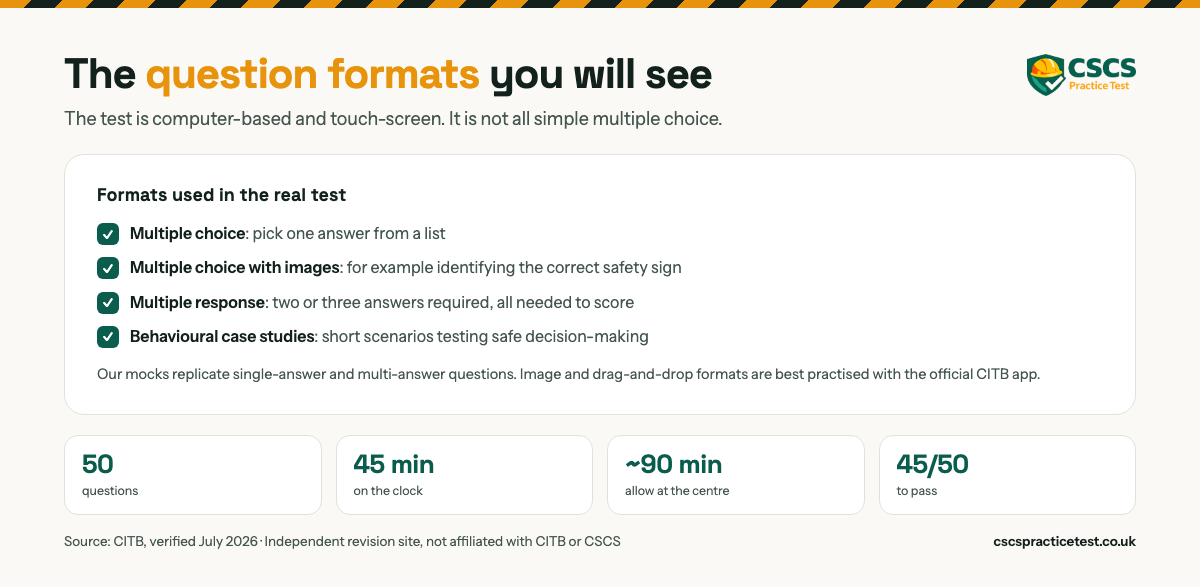
The test is computer-based and touch-screen. Beyond standard multiple-choice, CITB uses several question formats:
- Multiple choice: pick one answer from a list.
- Multiple choice with images: for example choosing the correct safety sign.
- Multiple response: questions that ask for two or three answers; you must select them all to score.
- Behavioural case studies: short scenarios that test safe decision-making rather than pure recall.
Our mock tests replicate the single-answer and multi-answer formats. Image-based and drag-and-drop questions are best practised with the official CITB revision app.
Behavioural case study questions
These are the ones people ask about most, because they feel different from the rest of the test. Instead of asking whether you know a rule, a behavioural case study drops you into a short site scenario and asks what you would do. A worker spots a damaged guardrail. The kettle in the canteen has a frayed cable. Your colleague has taken his hard hat off. The question is about the decision, not the definition.
CITB does not currently publish how many of the 50 questions are behavioural case studies. Its own pages describe the test only as 50 questions in 45 minutes, and say the test is under continual review. You will find confident numbers on other revision sites, often a specific count split across a specific number of scenarios. We have left those out because we could not trace any of them back to CITB, and a number that was true a few years ago is worse than no number at all.
How to answer them
There is a pattern, and once you see it these become the easiest marks on the paper. The correct answer is almost always the one that stops the unsafe work and tells somebody, even when another option looks more helpful, more productive or less awkward. Answers that keep the job moving, that work around a hazard, that leave it for somebody else, or that wait until the end of the shift to mention it, are the wrong ones. Answer as the person who reports it now.
The knowledge behind these scenarios is the same as the rest of the test, so there is nothing separate to revise. Work through the CSCS test questions and answers by topic, and read the explanations rather than just checking whether you got it right. The explanation is where the reasoning lives, and the reasoning is what these questions test.
Timing on the day
Although the exam itself is 45 minutes, allow longer at the centre. You should arrive at least 15 minutes early, and before the clock starts there is a short tutorial explaining how to navigate the test. A countdown timer runs on screen throughout. Plan for roughly an hour and a half at the test centre in total.
Practise the real format now with our CSCS mock test for Operatives runs 50 questions against a 45-minute countdown with the same 90% pass mark, and flags multi-answer questions exactly as the real test does.
For the exam end to end, start with what the CITB HS&E test is. The two numbers people ask about next are the CSCS test pass mark and how hard the CSCS test is.
Knowing the shape of the paper is one thing and covering it is another. The CSCS test revision plan says what to work through and in what order, and the CSCS touch screen test page covers the on-screen question formats.
Format verified against citb.co.uk, July 2026.