
UPDATED JULY 2026
CSCS Card Changes 2025-2026
CSCS has changed more rules in the last eighteen months than in the decade before it. Here is every change that affects cardholders, what it means in practice, and what to do about it, newest first, with the official source behind each one.
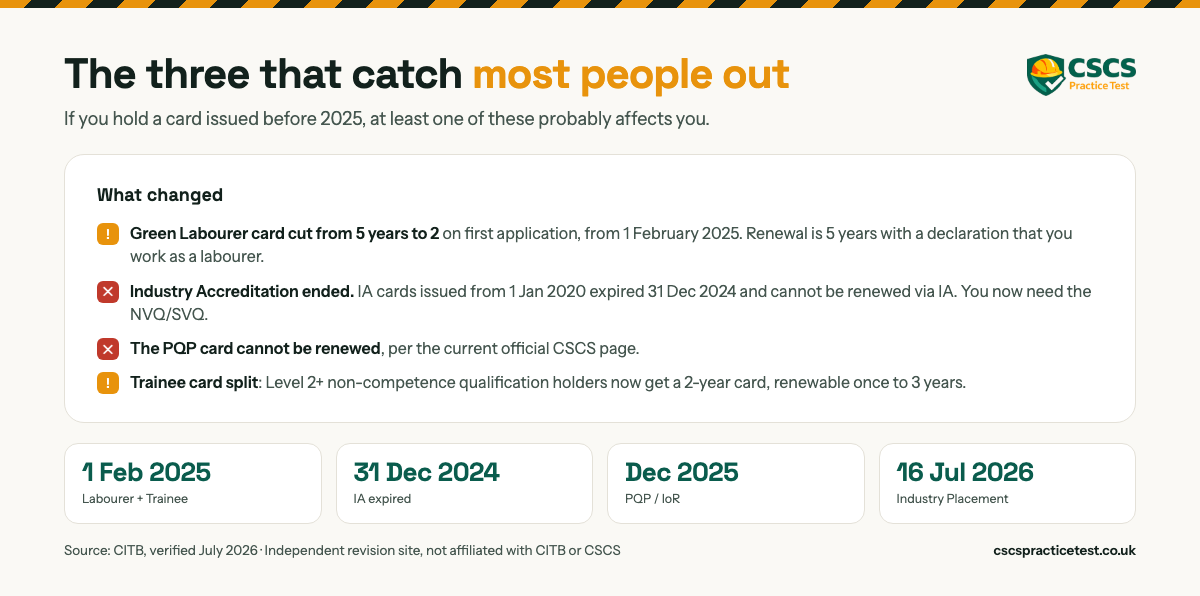
The three that catch most people out
- Your new Green Labourer card lasts 2 years, not 5.
- Industry Accreditation is gone. You now need the NVQ/SVQ.
- The official CSCS page states the PQP card cannot be renewed.
The full timeline
Industry Placement card: new application requirements
Who it affects: Students on construction qualifications with a work placement
CSCS confirmed changes to the application requirements for the Industry Placement card. The card remains for those on a qualification or training programme requiring at least three weeks of work placement.
What to do: Check the current requirements with your training provider before applying. This change is very recent.
PQP cards via the Institute of Roofing route get a fixed expiry
Who it affects: Professionally Qualified Person cardholders who applied via the IoR
Following the dissolution of the Institute of Roofing, PQP cards issued through that route between 1 and 31 December 2025 carry a fixed expiry date of 30 September 2026.
What to do: If this is your card, plan an alternative route now. Check which other CSCS-approved professional body covers your discipline.
Green Labourer card cut from 5 years to 2 on first application
Who it affects: Anyone applying for their first Labourer card
The initial Labourer card now lasts two years instead of five. Renewal is for a further five years, but only with a signed declaration confirming you are employed in a labouring role. Your HS&E test pass counts as valid for three years when renewing that initial card.
What to do: Diarise your expiry date and keep evidence you work as a labourer. If the declaration suggests you are not labouring, the application will be queried or declined.
Trainee card split for non-competence qualification holders
Who it affects: Holders of an approved Level 2+ occupation-related non-competence qualification
This group now receives a two-year Trainee card, which can be renewed once for a three-year card on proof of registration onto an NVQ/SVQ or an agreed alternative.
What to do: Register onto your NVQ/SVQ early. You need that proof to get the three-year renewal.
Industry Accreditation (grandfather rights) ended
Who it affects: Blue, Gold and Black cardholders who qualified via IA
Industry Accreditation cards issued from 1 January 2020 expired on 31 December 2024 and cannot be renewed through IA. The NVQ/SVQ route is now the only way to hold these cards.
What to do: If you held an IA card, you need the relevant construction NVQ/SVQ for your occupation before you can renew.
Building Safety Act pressure and 'no card, no site'
Who it affects: All construction workers
The tightening of the Labourer card sits inside a broader push, driven by the Building Safety Act, to ensure cardholders genuinely hold the competence their card claims. Most principal contractors continue to operate a strict 'no card, no site' policy.
What to do: Hold the card that matches your actual occupation. A skilled worker on a Labourer card can be refused site access.
Digital-first: My CSCS and virtual cards
Who it affects: All applicants
CSCS has moved to a digital-first model. The My CSCS app is the 'Digital Skills Passport'. Once your application is approved, your virtual card is available immediately, before the physical card arrives.
What to do: Apply through the My CSCS app for the fastest route; the card fee is £36.
Has the test itself changed?
The CITB HS&E test format is unchanged: 50 questions, 45 minutes, 45/50 (90%) to pass, £23.50 per attempt. The Managers & Professionals test content was broadened in June 2023 and is no longer role-specific, so MAP candidates should revise widely. See what the CITB HS&E test is for the full picture.
All changes verified against official CSCS news and card pages on cscs.uk.com, July 2026. We update this page as CSCS publishes new rules, but always confirm with CSCS before acting.