
Do I Need a CSCS Card?
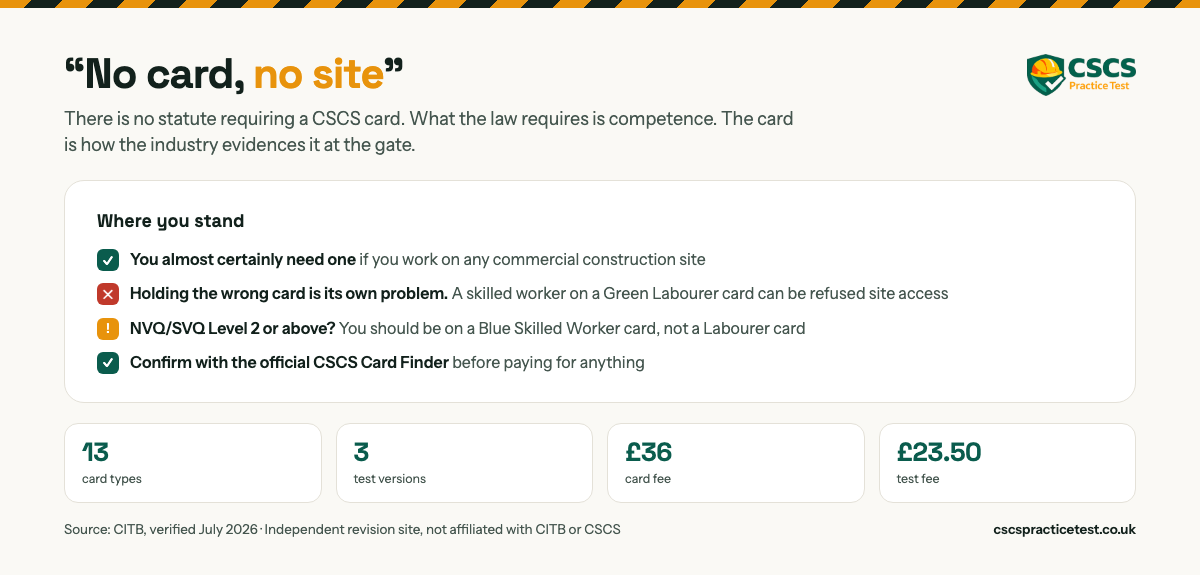
The straight answer: a CSCS card is not a legal requirementunder UK law. But almost every principal contractor requires one for site access, so in practice you need one to work. That distinction matters, and it is why “no card, no site” is the phrase you will hear.
Before the question of whether you need one, it is worth being clear what a CSCS card is. It is the construction industry's evidence that a worker holds the training and qualifications for the job they do on site, issued by CSCS rather than by government. What Is a CSCS Card? covers the scheme, the card colours and the CITB HS&E test that sits behind every card.
Not the law, but the industry standard
There is no statute saying “you must hold a CSCS card”. What the law does require is that workers are competent for the work they do. The card is how the industry evidences that competence at the gate, which is why contractors make it a condition of access.
You almost certainly need one if…
- You work on a commercial construction site of any size
- You are a labourer, a skilled tradesperson, a supervisor or a manager on site
- You are an apprentice, trainee or on a work placement
- You visit sites regularly in a professional or technical role
Holding a card and getting through the gate are not quite the same thing. Site access teams increasingly check a CSCS card by scanning it rather than glancing at it, using CSCS Smart Check, which CSCS describes as the only platform that verifies all 2.3 million cards displaying the CSCS logo. If you want to see what the gate sees, Check a CSCS Card walks through the check from both sides.
Holding the wrong card is its own problem
Before any of that, check the card you need actually comes from CSCS. Several trades are carded by other schemes entirely, and one of them does not accept the CITB HS&E test at all, so the whole route differs. CSCS test by trade answers that in one place.
This is the part people miss. CSCS is explicit that a skilled worker holding a Green Labourer card can be refused site access, because that card is for unskilled labouring duties only. Since February 2025 the Labourer card has been tightened further: first cards now last two years, and renewal requires a declaration that you genuinely work as a labourer. If you hold a construction NVQ/SVQ Level 2 or above, you should be on a Blue Skilled Worker card.
How to work out which card you need
- Check your occupation and qualification level against the CSCS card types.
- Confirm with the official CSCS Card Finder. It is the authoritative router.
- Note which HS&E test that card requires: Operatives, a Specialist topic, or MAP.
- Practise, pass the test, then apply for the card.
Start free: CSCS mock test for Operatives and see where you stand before you spend anything.
The rules have tightened recently, and the CSCS card changes for 2025 and 2026 cover what moved: the end of Industry Accreditation, the shorter first Labourer card, and the Trainee card split.
Card requirements verified against cscs.uk.com, July 2026. Site access policies are set by individual contractors. Check with your employer or principal contractor.