
CSCS CDM Regulations Questions
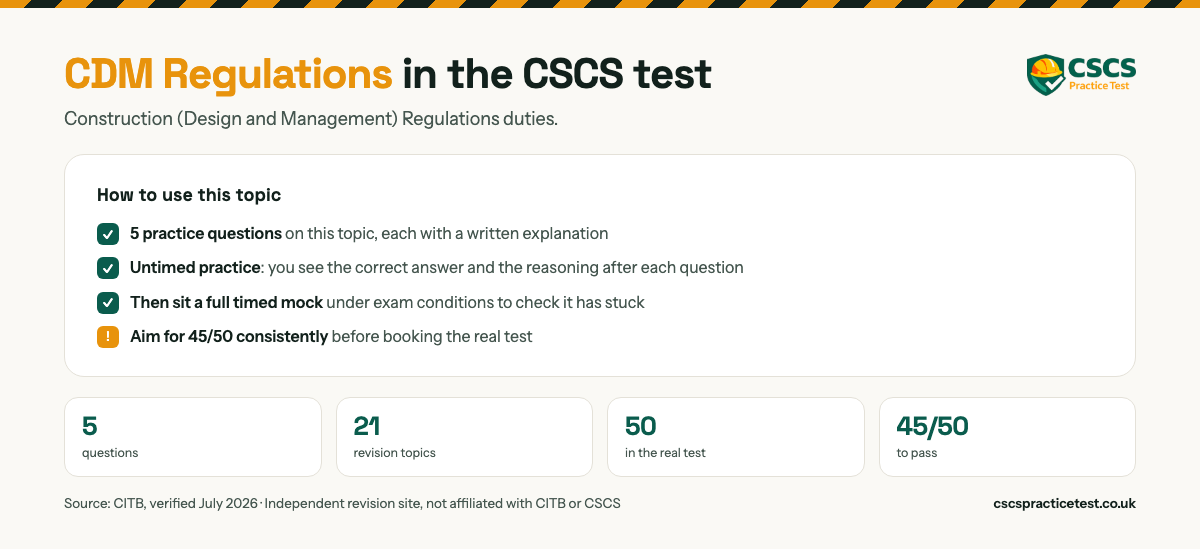
Construction (Design and Management) Regulations duties.
These questions cover cdm regulationsfor the CITB Health, Safety and Environment (HS&E) test, the exam UK construction workers pass to get a CSCS card.
CDM Regulations: practice questions (untimed, instant feedback)
- 50 questions · pass mark 90%
- Untimed practice: you see the correct answer immediately after each question.
- Some questions need more than one answer, and these are clearly marked.
All 50 CDM Regulations questions and answers
These are the same 50 questions as the practice test above, written out with the correct answer and the reasoning behind it. Read them through when you want to revise rather than test yourself.
1. Under CDM 2015, who is the client on a construction project?
Answer: Any person for whom a construction project is carried out
- A) Any person for whom a construction project is carried out (correct answer)
- B) The main contractor who runs the site from day to day
- C) The designer who prepares the drawings for the works
- D) Whoever pays the wages of the workers employed on the site
Why: Regulation 2(1) defines a client as any person for whom a project is carried out. The role follows who the work is being done for, not who runs the site, so a client can be a company, a public body or a private individual.
2. Under CDM 2015, what makes a person a domestic client?
Answer: The work is not in the course or furtherance of their business
- A) The work involves fewer than 5 workers on site at any one time
- B) The work is not in the course or furtherance of their business (correct answer)
- C) The work costs less than the financial limit set by the HSE
- D) The work is on a house rather than on a commercial building or unit
Why: Regulation 2(1) defines a domestic client as a client for whom a project is carried out which is not in the course or furtherance of that client's business. The test is the purpose of the work, not the type of building or its cost.
3. Under CDM 2015, which description matches a contractor?
Answer: Anyone who, in furtherance of a business, manages construction work
- A) Only a business that employs more than 5 people on the site
- B) Any person who is paid to be present on a construction site
- C) Anyone who, in furtherance of a business, manages construction work (correct answer)
- D) Only a firm that holds a direct contract with the client paying for it
Why: Regulation 2(1) defines a contractor as any person who, in the course or furtherance of a business, carries out, manages or controls construction work. Sub-contractors and self-employed people are contractors too, whoever holds the main contract.
4. Under CDM 2015, who counts as a designer?
Answer: Anyone whose business prepares or modifies a design for the work
- A) Only a qualified architect who is registered with a professional body
- B) Only the person who signs off the final drawings for the job
- C) Anyone who reads a drawing while carrying out work on site
- D) Anyone whose business prepares or modifies a design for the work (correct answer)
Why: Regulation 2(1) defines a designer as any person who, in the course or furtherance of a business, prepares or modifies a design, or arranges for or instructs others to do so. A contractor who changes a detail on site is acting as a designer.
5. Under CDM 2015, when does the construction phase begin and end?
Answer: It runs from the start of construction work until that work ends
- A) It runs from the start of construction work until that work ends (correct answer)
- B) It runs from contract signature until the final account is agreed
- C) It runs from the first design brief until the building is handed over
- D) It runs from the project notification until the last worker leaves
Why: Regulation 2(1) defines the construction phase as the period beginning when construction work in a project starts and ending when construction work in that project is completed. It is tied to the work itself, not to contracts or paperwork.
6. Under CDM 2015, what is pre-construction information?
Answer: Information the client holds or can obtain that is relevant to the work
- A) The full set of drawings issued to the site office before work begins on site
- B) Information the client holds or can obtain that is relevant to the work (correct answer)
- C) The written method statements that are produced by each contractor
- D) The record of every inspection that is carried out before the work starts
Why: Regulation 2(1) defines pre-construction information as information in the client's possession, or reasonably obtainable by or on behalf of the client, which is relevant to the construction work and is proportionate to the risks involved.
7. Under CDM 2015, what must a client do about managing a project?
Answer: Make suitable arrangements, allowing enough time and resources
- A) Carry out the risk assessments for every task on the site
- B) Supervise the contractor's operatives throughout the works
- C) Make suitable arrangements, allowing enough time and resources (correct answer)
- D) Appoint a safety adviser to run the whole site on the client's behalf
Why: Regulation 4(1) requires a client to make suitable arrangements for managing a project, including the allocation of sufficient time and other resources. Squeezing the programme or the budget is itself a breach, because rushed work is unsafe work.
8. Under CDM 2015, a client's arrangements are only suitable if they secure what for workers?
Answer: The welfare facilities set out in Schedule 2 to the Regulations
- A) A cash allowance so that workers can buy their welfare off the site
- B) Written approval of the welfare cabins by the local council
- C) Welfare provided only once the job passes 30 working days on site
- D) The welfare facilities set out in Schedule 2 to the Regulations (correct answer)
Why: Regulation 4(2)(b) says arrangements are suitable only if they ensure that the facilities required by Schedule 2 are provided for anyone carrying out construction work. Welfare is a client duty from the outset, not an optional extra.
9. Under CDM 2015, what must a client do with the management arrangements once work starts?
Answer: Maintain and review them throughout the whole of the project
- A) Maintain and review them throughout the whole of the project (correct answer)
- B) Hand them over to the principal contractor to take them on
- C) Freeze them so that the agreed method cannot ever be altered
- D) Swap them for the construction phase plan as soon as it is written
Why: Regulation 4(3) requires the client to ensure the arrangements are maintained and reviewed throughout the project. Projects change as they go, so arrangements set once at the start would quickly stop matching the real risks.
10. Under CDM 2015, when must a client provide pre-construction information?
Answer: As soon as practicable, to designers and contractors considered
- A) Within 30 working days of the construction phase actually beginning
- B) As soon as practicable, to designers and contractors considered (correct answer)
- C) Only after the winning contractor has signed the main contract documents
- D) Only once the principal designer has asked for it in writing
Why: Regulation 4(4) requires the client to provide pre-construction information as soon as is practicable to every designer and contractor appointed, or being considered for appointment. Tenderers need it to price and plan the work safely.
11. Under CDM 2015, what must a client do about the principal designer and principal contractor?
Answer: Take reasonable steps to check that they comply with their duties
- A) Attend the site each week in order to inspect the work that they control
- B) Take over their duties once the construction phase has started
- C) Take reasonable steps to check that they comply with their duties (correct answer)
- D) Sign off every risk assessment that either of them produces on site
Why: Regulation 4(6) requires the client to take reasonable steps to ensure that the principal designer complies with regulations 11 and 12 and that the principal contractor complies with regulations 12 to 14. Appointing them does not end the client's interest.
12. Under CDM 2015, what must a client do with the health and safety file when selling the structure?
Answer: Give it to the buyer and make sure they know what it is for
- A) Send a copy to the local authority building control team
- B) Keep it for 5 years and then destroy it securely on the site
- C) Return it to the principal designer for safe long term storage
- D) Give it to the buyer and make sure they know what it is for (correct answer)
Why: Regulation 4(7) says a client who disposes of their interest in the structure complies by giving the health and safety file to the person who acquires that interest and ensuring they are aware of its nature and purpose. The file follows the building.
13. Under CDM 2015, when must a client appoint a principal designer and a principal contractor?
Answer: When more than one contractor is, or will be, on the project
- A) When more than one contractor is, or will be, on the project (correct answer)
- B) When the project is expected to last for more than 30 working days
- C) When the value of the construction work exceeds 500,000 pounds
- D) When the client has no experience of construction work at all
Why: Regulation 5(1) requires the client to appoint a principal designer and a principal contractor in writing where there is, or it is reasonably foreseeable there will be, more than one contractor. The trigger is the number of contractors, not size, length or value.
14. Under CDM 2015, by when must those two appointments be made?
Answer: As soon as practicable and always before the construction phase
- A) Before the notification of the project reaches the Executive
- B) As soon as practicable and always before the construction phase (correct answer)
- C) Within 14 days of the client first inviting tenders for the work
- D) At any point before the health and safety file is handed on
Why: Regulation 5(2) says the appointments must be made as soon as is practicable and, in any event, before the construction phase begins. Appointing late wastes the pre-construction phase, which is when most risk can still be designed out.
15. Under CDM 2015, what happens if a commercial client fails to appoint a principal designer?
Answer: The client must carry out the principal designer duties instead
- A) The lead designer is appointed automatically by the Executive
- B) The duties pass to the largest contractor working on the site
- C) The client must carry out the principal designer duties instead (correct answer)
- D) The project must stop until that appointment is finally made
Why: Regulation 5(3) provides that if the client fails to appoint a principal designer, the client must fulfil the principal designer duties in regulations 11 and 12. The duties do not disappear, they land back on the client.
16. Under CDM 2015, which project is notifiable to the Executive?
Answer: One scheduled to exceed 500 person days of construction work
- A) One scheduled to use more than 5 contractors at any one time
- B) One scheduled to cost more than 250,000 pounds to complete
- C) One scheduled to last longer than 10 working days on site
- D) One scheduled to exceed 500 person days of construction work (correct answer)
Why: Regulation 6(1) makes a project notifiable if the construction work is scheduled to last longer than 30 working days and have more than 20 workers working simultaneously at any point, or to exceed 500 person days. Either limb is enough on its own.
17. Under CDM 2015, who must notify a notifiable project, and to whom?
Answer: The client, in writing, to the Executive before work starts
- A) The client, in writing, to the Executive before work starts (correct answer)
- B) The principal contractor, by telephone, to the local council
- C) The principal designer, in writing, to the building control body
- D) The largest contractor on site, in writing, to the Executive
Why: Regulation 6(2) places the duty on the client to give notice in writing to the Executive as soon as is practicable before the construction phase begins. On a domestic client's project regulation 7(1) moves that duty to the contractor or principal contractor.
18. Under CDM 2015, what must happen to the notice for a notifiable project?
Answer: It is displayed in the site office where workers can read it
- A) It is sealed in the health and safety file until the very end
- B) It is displayed in the site office where workers can read it (correct answer)
- C) It is lodged with the local authority before the work starts
- D) It is posted to every worker's home address before they start
Why: Regulation 6(3)(b) requires the notice to be clearly displayed in the construction site office in a comprehensible form where it can be read by any worker engaged in the construction work, and updated periodically if necessary.
19. Under CDM 2015, on a domestic client's job with only one contractor, who takes on the client duties?
Answer: The contractor who is carrying out the construction work
- A) The designer who prepares the drawings for that whole job
- B) The building control body dealing with the approval process
- C) The contractor who is carrying out the construction work (correct answer)
- D) The domestic client, who keeps every single one of those duties
Why: Regulation 7(1)(a) transfers the client duties in regulations 4(1) to (7) and 6 to the contractor where a domestic client's project has only one contractor. Householders are not expected to manage construction health and safety themselves.
20. Under CDM 2015, on a domestic client's job with more than one contractor, who normally takes the client duties?
Answer: The principal contractor appointed for that project
- A) The principal designer, without any written agreement
- B) The domestic client, who retains all of the duties
- C) The first contractor to arrive on the site each day
- D) The principal contractor appointed for that project (correct answer)
Why: Regulation 7(1)(b) passes the domestic client's duties to the principal contractor where there is more than one contractor. Under regulation 7(1)(c) the principal designer takes them on only if there is a written agreement to that effect.
21. Under CDM 2015, what must a designer or contractor appointed to a project have?
Answer: The skills, knowledge and experience to fulfil that role
- A) The skills, knowledge and experience to fulfil that role (correct answer)
- B) A recognised qualification from an approved awarding body
- C) At least 5 years of experience of that same type of work
- D) Membership of a trade association for that discipline
Why: Regulation 8(1) requires anyone appointed to have the skills, knowledge and experience, and if an organisation the organisational capability, necessary to fulfil the role safely. It is about proven ability for that job, not a single certificate.
22. Under CDM 2015, what must a contractor do if they lack the capability for a role they are offered?
Answer: Refuse it, because they must not accept the appointment
- A) Accept it, provided the client agrees to it in writing
- B) Refuse it, because they must not accept the appointment (correct answer)
- C) Accept it and hire a consultant to sign the paperwork
- D) Accept it and tell the client after work has started
Why: Regulation 8(2) states that a designer or contractor must not accept an appointment unless they meet the skills, knowledge, experience and organisational capability conditions in regulation 8(1). The duty to say no sits with the person being appointed.
23. Under CDM 2015, who must a person with a duty under the Regulations co-operate with?
Answer: Anyone working on the project or on an adjoining site
- A) Only the principal contractor and their site supervisors
- B) Only those who are named in the construction phase plan
- C) Anyone working on the project or on an adjoining site (correct answer)
- D) Only the people directly employed by the same firm
Why: Regulation 8(4) requires co-operation with any other person working on or in relation to a project, at the same or an adjoining construction site, so far as is needed for duties to be fulfilled. Neighbouring sites can create risks for each other.
24. Under CDM 2015, what must a person working under another's control do about a danger they notice?
Answer: Report it to the person whose control they work under
- A) Note it in a diary and raise it at the next review
- B) Report it straight to the Executive within 10 days
- C) Put it right themselves without telling anyone else
- D) Report it to the person whose control they work under (correct answer)
Why: Regulation 8(5) requires a person working on a project under the control of another to report anything they are aware of that is likely to endanger their own health or safety or that of others. Reporting up the chain is what gets the hazard fixed.
25. Does CDM 2015 apply to a small extension on a private house?
Answer: Yes, CDM applies to all construction work, domestic included
- A) Yes, CDM applies to all construction work, domestic included (correct answer)
- B) No, domestic work of any size falls outside the Regulations entirely
- C) No, unless the work has to be notified to the Executive first
- D) Yes, but only once more than 5 workers are on the job at once
Why: HSE guidance confirms that CDM 2015 applies to all construction work, including domestic projects. Notification changes only whether the Executive must be told, not whether the Regulations bite, and regulation 7 decides who carries the client duties.
26. Under CDM 2015, what must a designer check before starting design work?
Answer: That the client is aware of the duties the client owes
- A) That the project has already been notified to the Executive
- B) That the client is aware of the duties the client owes (correct answer)
- C) That the principal contractor has already been appointed
- D) That the construction phase plan has been drawn up first
Why: Regulation 9(1) says a designer must not commence work on a project unless satisfied that the client is aware of the client's duties under the Regulations. Designers are often the first professionals a client meets, so the reminder starts with them.
27. Under CDM 2015, what must a designer do first about foreseeable risks in a design?
Answer: Eliminate them so far as is reasonably practicable
- A) Pass them to the principal contractor to deal with
- B) Price them into the tender documents for the works
- C) Eliminate them so far as is reasonably practicable (correct answer)
- D) List them in the construction phase plan for the site
Why: Regulation 9(2) requires the designer, taking account of the general principles of prevention and any pre-construction information, to eliminate foreseeable risks so far as is reasonably practicable. Designing a hazard out beats managing it for years.
28. Under CDM 2015, what must a designer do with a risk that cannot be eliminated?
Answer: Reduce or control it and tell the principal designer
- A) Leave it out of the information passed to others
- B) Plan, manage and monitor the work that creates it
- C) Wait for the principal contractor to redesign it
- D) Reduce or control it and tell the principal designer (correct answer)
Why: Regulation 9(3) requires the designer, so far as is reasonably practicable, to reduce or control the risk through the design process, provide information about it to the principal designer, and ensure appropriate information reaches the health and safety file.
29. Under CDM 2015, what must a designer provide along with the design itself?
Answer: Enough information to help others comply with their duties
- A) Enough information to help others comply with their duties (correct answer)
- B) A signed certificate confirming that the design is fully safe
- C) A priced bill of quantities for all of the construction work
- D) A copy of the designer's professional indemnity insurance certificate
Why: Regulation 9(4) requires the designer to take all reasonable steps to provide, with the design, sufficient information about the design, construction or maintenance of the structure to help the client, other designers and contractors meet their duties.
30. Under CDM 2015, what is the principal designer responsible for?
Answer: Planning, managing and monitoring the pre-construction phase
- A) Checking the finished structure before it is handed over to the client
- B) Planning, managing and monitoring the pre-construction phase (correct answer)
- C) Planning, managing and monitoring the construction work on site
- D) Supervising the trades who carry out the work on site each day
Why: Regulation 11(1) requires the principal designer to plan, manage and monitor the pre-construction phase and co-ordinate health and safety matters during it. The construction phase is the principal contractor's responsibility under regulation 13.
31. Under CDM 2015, what must the principal designer do about the other designers?
Answer: Ensure that they comply with their own designer duties
- A) Plan, manage and monitor their work on the site each week
- B) Employ them directly so that they can be controlled
- C) Ensure that they comply with their own designer duties (correct answer)
- D) Prepare all of their designs personally for the project
Why: Regulation 11(4) requires the principal designer to ensure that all designers comply with their duties in regulation 9. The principal designer does not do their design work for them, but must check that the design duties are actually being met.
32. Under CDM 2015, what is the principal designer's role with pre-construction information?
Answer: Assist the client to provide it and pass it on promptly
- A) Hold it back until each contractor is formally appointed
- B) Replace it with the construction phase plan when ready
- C) Send it to the Executive along with the project notification
- D) Assist the client to provide it and pass it on promptly (correct answer)
Why: Regulation 11(6) requires the principal designer to assist the client in providing the pre-construction information required by regulation 4(4), and to provide it promptly and in a convenient form to every designer and contractor appointed or being considered.
33. Under CDM 2015, what must the principal designer do with the principal contractor?
Answer: Liaise and share information about the construction phase
- A) Liaise and share information about the construction phase (correct answer)
- B) Direct their site staff on how to sequence all the works
- C) Audit their accounts before the site is handed back over
- D) Avoid contact so that the two roles stay fully separate
Why: Regulation 11(7) requires the principal designer to liaise with the principal contractor for the duration of the appointment and share information relevant to planning, managing and monitoring the construction phase. Design risk knowledge must reach the site.
34. Under CDM 2015, when must the principal contractor draw up the construction phase plan?
Answer: In the pre-construction phase, before the site is set up
- A) As soon as the Executive acknowledges the notification
- B) In the pre-construction phase, before the site is set up (correct answer)
- C) In the first week after the construction site is established
- D) Once the health and safety file has been fully completed
Why: Regulation 12(1) requires the principal contractor to draw up the construction phase plan, or arrange for it to be drawn up, during the pre-construction phase and before setting up a construction site. The plan has to exist before anyone starts work.
35. Under CDM 2015, what must the construction phase plan set out?
Answer: The health and safety arrangements and the site rules
- A) The training records of everyone employed on site
- B) The design calculations for the finished structure
- C) The health and safety arrangements and the site rules (correct answer)
- D) The programme of payments due to each contractor
Why: Regulation 12(2) requires the construction phase plan to set out the health and safety arrangements and site rules, taking account where necessary of any industrial activities taking place on the site. It is a working document, not a commercial one.
36. Under CDM 2015, what must the construction phase plan include for work involving particular risks?
Answer: Specific measures for the work listed in Schedule 3
- A) A separate permit issued by the Executive for it
- B) A note that only the client can authorise the work
- C) An exemption signed by the site manager in charge
- D) Specific measures for the work listed in Schedule 3 (correct answer)
Why: Regulation 12(2) requires the plan to include specific measures for work in the categories set out in Schedule 3. Schedule 3 covers work with particular risks such as burial under earthfalls, drowning, high voltage power lines and the use of explosives.
37. Under CDM 2015, how must the principal designer help with the construction phase plan?
Answer: By giving the principal contractor the information held
- A) By giving the principal contractor the information held (correct answer)
- B) By writing the plan on the principal contractor's behalf
- C) By approving the plan before the construction phase begins
- D) By sending the plan to the Executive for its formal agreement
Why: Regulation 12(3) requires the principal designer to assist the principal contractor by providing all information they hold that is relevant to the plan, including pre-construction information from the client and information from designers under regulation 9(3)(b).
38. Under CDM 2015, who prepares the health and safety file, and when?
Answer: The principal designer, during the pre-construction phase
- A) The building control body, when the work is signed off
- B) The principal designer, during the pre-construction phase (correct answer)
- C) The principal contractor, at the end of the site works
- D) The client's insurer, before the site is handed over
Why: Regulation 12(5) requires the principal designer to prepare the health and safety file during the pre-construction phase. It holds information likely to be needed during any later project, so that future workers know what is hidden in the structure.
39. Under CDM 2015, what happens to the health and safety file if the principal designer leaves early?
Answer: It passes to the principal contractor to keep updated
- A) It is archived and restarted by the next designer
- B) It is closed off and no further entries are made
- C) It passes to the principal contractor to keep updated (correct answer)
- D) It passes to the Executive until a replacement starts
Why: Regulation 12(8) requires the principal designer to pass the file to the principal contractor if the appointment concludes before the end of the project, and regulation 12(9) then makes the principal contractor responsible for reviewing and updating it.
40. Under CDM 2015, who receives the health and safety file at the end of the project?
Answer: The client, who needs it for any later work on the structure
- A) The Executive, which stores it for the life of the building
- B) The principal designer, who retains it permanently on file
- C) The local authority, which keeps it with the approval papers
- D) The client, who needs it for any later work on the structure (correct answer)
Why: Regulation 12(10) requires the principal designer, or the principal contractor where there is no principal designer, to pass the health and safety file to the client at the end of the project. The client then keeps it available for anyone who needs it.
41. Under CDM 2015, what must the principal contractor do during the construction phase?
Answer: Plan, manage and monitor it and co-ordinate health and safety
- A) Plan, manage and monitor it and co-ordinate health and safety (correct answer)
- B) Prepare the designs that are needed for the remaining site work
- C) Approve the client's own arrangements for managing the job
- D) Check the finished building against the planning consent
Why: Regulation 13(1) requires the principal contractor to plan, manage and monitor the construction phase and co-ordinate health and safety matters during it, so that the work is carried out without risks to health or safety so far as is reasonably practicable.
42. Under CDM 2015, what must the principal contractor do about the contractors on site?
Answer: Organise co-operation between them, including successive ones
- A) Limit the site to one contractor working at any one time
- B) Organise co-operation between them, including successive ones (correct answer)
- C) Employ them all directly on exactly the same terms and conditions
- D) Keep them apart so that their work never overlaps at any point
Why: Regulation 13(3)(a) requires the principal contractor to organise co-operation between contractors, including successive contractors on the same site. Handovers between trades are a common point at which risks get missed.
43. Under CDM 2015, what must the principal contractor ensure is provided on site?
Answer: A suitable site induction for those working there
- A) A personal set of tools supplied by the client
- B) A permit to work signed by the local authority
- C) A suitable site induction for those working there (correct answer)
- D) A printed copy of the health and safety file
Why: Regulation 13(4)(a) requires the principal contractor to ensure that a suitable site induction is provided. An induction tells workers the rules, hazards and emergency arrangements for that particular site before they start.
44. Under CDM 2015, what must the principal contractor do about welfare facilities?
Answer: Provide Schedule 2 facilities all through the build phase
- A) Provide them only once 20 workers are on the site together
- B) Provide them only for the workers they employ directly
- C) Provide them only after the first month of the works
- D) Provide Schedule 2 facilities all through the build phase (correct answer)
Why: Regulation 13(4)(c) requires the principal contractor to ensure that facilities complying with Schedule 2 are provided throughout the construction phase. Welfare must be there from day one and for everyone on site, not just the principal contractor's own staff.
45. Under CDM 2015, what must the principal contractor do with the workers on site?
Answer: Consult them in good time on matters affecting their safety
- A) Consult them in good time on matters affecting their safety (correct answer)
- B) Ask them to sign a waiver covering all of the risks of the job
- C) Test them on the site rules before each shift begins
- D) Keep them away from the construction phase plan itself
Why: Regulation 14(b) requires the principal contractor to consult workers or their representatives in good time on matters connected with the project that may affect their health, safety or welfare, where their employer has not already consulted them.
46. Under CDM 2015, what must every contractor do about the work they control?
Answer: Plan, manage and monitor it so it is done safely
- A) Leave the planning of it to the principal designer
- B) Plan, manage and monitor it so it is done safely (correct answer)
- C) Report it to the Executive at the end of each week
- D) Copy the method already used by the principal contractor
Why: Regulation 15(2) requires a contractor to plan, manage and monitor construction work carried out by the contractor or by workers under the contractor's control, so far as is reasonably practicable without risks to health and safety.
47. Under CDM 2015, what must a contractor do where more than one contractor is on the project?
Answer: Follow the principal contractor's directions and the plan
- A) Draw up their own construction phase plan for the site
- B) Report directly to the client rather than to anyone else
- C) Follow the principal contractor's directions and the plan (correct answer)
- D) Work only to their own method statement and ignore everything else
Why: Regulation 15(3) requires a contractor to comply with directions given by the principal designer or the principal contractor, and with the parts of the construction phase plan relevant to that contractor's work. One site needs one set of controls.
48. Under CDM 2015, who draws up the construction phase plan when only one contractor is involved?
Answer: That contractor, before the construction site is set up
- A) The client, before any contractor is invited to tender
- B) The designer, as part of the drawings for the project
- C) Nobody, because no plan is needed for such a project
- D) That contractor, before the construction site is set up (correct answer)
Why: Regulation 15(5) requires the sole contractor to draw up a construction phase plan, or arrange for one, as soon as is practicable before setting up a construction site. Regulation 15(6) means it must still meet the content requirements of regulation 12(2).
49. Under CDM 2015, who may a contractor appoint to work on a construction site?
Answer: Someone with, or gaining, the skills and training needed
- A) Someone with, or gaining, the skills and training needed (correct answer)
- B) Someone who has held a valid card for at least 3 full years
- C) Someone who has worked for the same contractor before
- D) Anyone at all, provided a supervisor signs their timesheet
Why: Regulation 15(7) stops a contractor employing or appointing anyone unless that person has, or is in the process of obtaining, the necessary skills, knowledge, training and experience for the tasks allocated to them. Trainees are covered while they learn.
50. Under CDM 2015, what does HSE guidance say construction workers must do about site rules?
Answer: Always follow the site rules and procedures that apply
- A) Follow them only on projects notified to the Executive
- B) Always follow the site rules and procedures that apply (correct answer)
- C) Follow only the rules that their own employer sets
- D) Follow them only when a supervisor is present on site
Why: HSE guidance for workers under CDM 2015 states that workers must always follow site rules and procedures, co-operate with other duty holders and report any risks they find to whoever controls the work on site.
What this topic covers in the CSCS test
The Construction (Design and Management) Regulations 2015 set out who is responsible for health and safety on a project, and at which stage. You will not be asked to quote regulation numbers, but you are expected to know the duty holders, the two key documents and which document belongs to whom. CDM applies to all construction work, including work on someone's home, and workers are duty holders in their own right.
- The duty holders: commercial and domestic clients, designers, principal designers, principal contractors, contractors and workers
- When a principal designer and principal contractor must be appointed, and by whom
- The construction phase plan: who draws it up, when, and who checks it exists
- The health and safety file: who prepares it, who updates it, who ends up with it
- Notifiable projects and the F10 notification thresholds
- Welfare, inductions and site security as principal contractor duties
- Workers' own duties to take care, cooperate, report and be consulted
Key facts worth memorising
- More than one contractor is the trigger
- Where a project involves, or is likely to involve, more than one contractor, the client must appoint a principal designer and a principal contractor in writing before the construction phase begins.
- Construction phase plan
- The principal contractor draws it up before the site is set up, the sole contractor does it on single contractor projects, and the client must ensure it exists before the construction phase begins.
- Health and safety file
- The principal designer prepares it and keeps it updated, passes it to the principal contractor if their own appointment ends early, and at the end of the project it goes to the client.
- F10 notification thresholds
- A project is notifiable if the construction work is scheduled to last longer than 30 working days and have more than 20 workers working simultaneously at any point, or to exceed 500 person days.
- Who notifies and when
- A commercial client notifies HSE as soon as practicable before the construction phase begins and the notice is displayed in the site office; for a domestic client the contractor or principal contractor does it.
- Workers are duty holders
- Workers must take care of themselves and others, report anything likely to endanger anyone, cooperate with other duty holders, and be consulted on matters affecting their health, safety and welfare.
What people get wrong
The principal designer provides the welfare facilities.
Welfare comes from contractors, with the principal contractor making sure it is there throughout and the client making sure arrangements exist. The principal designer manages health and safety in the pre-construction phase.
CDM only applies to large notifiable projects.
CDM 2015 applies to all construction work. Notification is a separate threshold and telling HSE about a project neither adds nor removes anyone's duties.
The principal contractor writes the health and safety file.
The principal designer prepares it. The principal contractor supplies information for it, and only takes it over if the principal designer's appointment concludes before the project does.
CDM is paperwork for managers and has nothing to do with me.
Workers appear in HSE's own table of CDM duty holders, with duties to take care, cooperate and report, and a right to be consulted.
Answering these questions in the test
Sort the duty holders by phase and these questions become easy. The principal designer owns the pre-construction phase and the health and safety file. The principal contractor owns the construction phase and everything in it: the construction phase plan, inductions, site security, coordinating contractors and welfare. The client appoints both in writing and must satisfy itself the plan and welfare are in place before work starts. Most questions put a document or a facility with the wrong duty holder, so check the phase first.
Sources
Written from the following. Where a figure could not be verified against one of these, it has been left out rather than approximated. Our sources and methodology explains how we date and re-check them. Spotted something wrong? Report an error and we will fix it.
- hse.gov.uk/construction/cdm/2015/summary.htm
- hse.gov.uk/construction/cdm/2015/index.htm
- legislation.gov.uk/uksi/2015/51/regulation/4/made
- legislation.gov.uk/uksi/2015/51/regulation/5/made
- legislation.gov.uk/uksi/2015/51/regulation/6/made
- legislation.gov.uk/uksi/2015/51/regulation/12/made
- hse.gov.uk/forms/notification/f10.htm
Topics that come up alongside cdm regulations
Ready for the real thing?
When you are scoring 90% or better here, take a CSCS mock test for Operatives under exam conditions, then how to book the CSCS test.