
CSCS Health & Welfare Questions
Welfare facilities, hygiene and occupational health.
These questions cover health & welfarefor the CITB Health, Safety and Environment (HS&E) test, the exam UK construction workers pass to get a CSCS card.
Health & Welfare: practice questions (untimed, instant feedback)
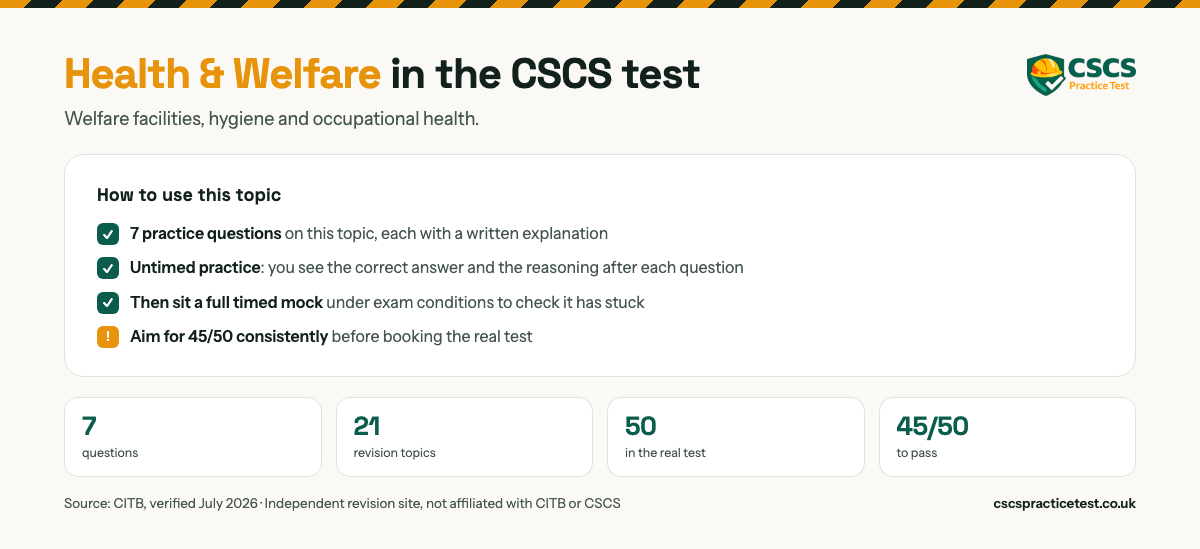
- 50 questions · pass mark 90%
- Untimed practice: you see the correct answer immediately after each question.
- Some questions need more than one answer, and these are clearly marked.
All 50 Health & Welfare questions and answers
These are the same 50 questions as the practice test above, written out with the correct answer and the reasoning behind it. Read them through when you want to revise rather than test yourself.
1. Someone has burnt their hand. What is the best immediate action?
Answer: Cool the hand in cold water or under a cold running tap
- A) Cool the hand in cold water or under a cold running tap (correct answer)
- B) Rub barrier cream or petroleum jelly straight onto the burn
- C) Get them to carry on working so the hand keeps moving freely
- D) Wrap a clean dry handkerchief tightly round the burnt hand
Why: Cooling a burn with cold running water limits the damage; creams or cloths can trap heat or cause infection.
2. You find pigeon droppings and nests where you need to work. What should you do?
Answer: Stop work and ask for advice
- A) Work on carefully to avoid disturbing them
- B) Stop work and ask for advice (correct answer)
- C) Attempt to catch the birds
- D) Wait until the birds leave
Why: Bird droppings can carry disease such as psittacosis, so stop and seek advice before continuing.
3. Why must drinking water be available on site?
Answer: To keep workers hydrated
- A) To keep workers hydrated (correct answer)
- B) To wash down tools and brushes
- C) To mix concrete and mortar on site
- D) To dilute cleaning chemicals
Why: Drinking water is a welfare requirement that helps prevent dehydration.
4. Which of these is NOT a required site welfare facility?
Answer: A canteen serving hot food
- A) Toilets that are kept clean and lit
- B) A canteen serving hot food (correct answer)
- C) Somewhere to change out of work clothes
- D) Washing facilities with soap and hot water
Why: Toilets, washing and changing facilities are required; a hot-food canteen is not.
5. Why is suitable site lighting important?
Answer: To help prevent accidents and injuries
- A) To lift the mood of everyone working on site
- B) To help prevent accidents and injuries (correct answer)
- C) To cut the site's monthly electricity bill
- D) To speed the work up towards the deadline
Why: Good lighting keeps hazards visible and helps prevent accidents.
6. When should a first-aid kit be checked and restocked?
Answer: Whenever it is used
- A) Once a month, on a set date
- B) At the end of every week
- C) Whenever it is used (correct answer)
- D) Once a day, when work finishes
Why: Restock a first-aid kit whenever it is used so it is always complete.
7. Which statement about welfare facilities is true?
Answer: Employers must provide somewhere to store and dry clothing
- A) Workers must bring their own cleaning supplies and hand towels
- B) Employers must provide somewhere to store and dry clothing (correct answer)
- C) Toilets need not be separated by gender or fitted with locks
- D) Small sites with only a few workers need no toilet facilities
Why: Employers must provide facilities to store and dry workers' clothing.
8. Under Schedule 2 to CDM 2015, where must sanitary conveniences on a construction site be provided?
Answer: At readily accessible places, in suitable and sufficient numbers
- A) At readily accessible places, in suitable and sufficient numbers (correct answer)
- B) Only inside the site office block, whatever the site layout is
- C) At the site entrance only, so that deliveries pass them on the way in
- D) Wherever the client decides once the project has been handed over
Why: Schedule 2 paragraph 1(1) sets two tests at once: the conveniences must be suitable and sufficient, and they must be at readily accessible places. A toilet that exists but sits at the far end of a long site fails the accessibility test, so counting units alone is not enough.
9. Schedule 2 requires rooms containing site toilets to be ventilated and lit. How is that duty qualified?
Answer: It applies so far as is reasonably practicable in the circumstances
- A) It applies only when the site has a mains electricity supply connected
- B) It applies only to toilets that are plumbed into a foul drainage run
- C) It applies only once more than twenty five workers are on the site
- D) It applies so far as is reasonably practicable in the circumstances (correct answer)
Why: Paragraph 1(2) opens with the words so far as is reasonably practicable, which lets the standard flex with what a site can actually achieve. It is not switched on or off by mains power, drainage or headcount, so each of the other answers invents a threshold the paragraph does not contain.
10. What standard does Schedule 2 set for the condition of sanitary conveniences on site?
Answer: Kept in a clean and orderly condition so far as is reasonably practicable
- A) Kept in a clean and orderly condition so far as is reasonably practicable (correct answer)
- B) Replaced with brand new units at the start of every calendar month
- C) Inspected and approved by the local authority before first being used
- D) Emptied by a licensed waste contractor at the end of every single shift
Why: Paragraph 1(3) requires the conveniences and their rooms to be kept clean and orderly so far as is reasonably practicable. That is a continuing standard of upkeep. Replacement, council approval and a fixed emptying interval are practices some sites adopt, but none of them is what the paragraph demands.
11. When may a site provide sanitary conveniences that are not in separate men's and women's rooms?
Answer: When each convenience sits in its own room that locks from the inside
- A) When each convenience sits in its own room that locks from the inside (correct answer)
- B) When the site is expected to last for fewer than thirty full working days
- C) When the principal contractor writes the reason into the site welfare log
- D) When everyone working on site that week happens to be the same sex
Why: Paragraph 1(4) requires separate rooms for men and women, with one exception: where each convenience is in a separate room whose door can be secured from the inside. Privacy is delivered by the lock, so the exception turns on the layout, not on project length, paperwork or who is on site that week.
12. Under Schedule 2, when must showers be included in the washing facilities on a site?
Answer: When the nature of the work, or health reasons, make showers necessary
- A) Whenever a site has been running continuously for more than six weeks
- B) Whenever the workforce on the site rises above twenty five people
- C) When the nature of the work, or health reasons, make showers necessary (correct answer)
- D) Only when the work involves asbestos removal by a licensed contractor
Why: Paragraph 2(1) requires washing facilities including showers if required by the nature of the work or for health reasons. The trigger is the work itself, such as heavy soiling or contamination. Licensed asbestos work does need showers, but naming it as the only trigger reads the test far too narrowly.
13. Where does Schedule 2 say washing facilities must be provided in relation to site toilets?
Answer: In the immediate vicinity of every sanitary convenience on the site
- A) At least fifty metres away, to keep clean water clear of foul waste
- B) In the immediate vicinity of every sanitary convenience on the site (correct answer)
- C) In the canteen only, since that is where workers actually eat meals
- D) Anywhere on site, provided a sign points the way to the nearest one
Why: Paragraph 2(2)(a) puts washing facilities in the immediate vicinity of every sanitary convenience, whether or not they are also provided elsewhere. The point is that hands are washed straight after use. A distant or signposted facility breaks that link and does not satisfy the paragraph.
14. Besides beside the toilets, where else does Schedule 2 require washing facilities on site?
Answer: In the vicinity of any changing rooms that Schedule 2 requires on site
- A) Beside the main site gate, so that workers can wash before signing in each day
- B) Inside the site office, next to the first-aid kit and accident book
- C) In the vicinity of any changing rooms that Schedule 2 requires on site (correct answer)
- D) Next to the drinking water point, so one supply serves both of them
Why: Paragraph 2(2)(b) requires washing facilities in the vicinity of any changing rooms required by paragraph 4, whether or not provided elsewhere as well. Workers changing out of contaminated clothing need to wash at that point, which is why the duty is tied to the changing room rather than the gate or the office.
15. What water supply must site washing facilities include under Schedule 2?
Answer: Clean hot and cold water, or warm water, and running where practicable
- A) Cold water only, because a hot supply carries a risk of scalding
- B) Clean hot and cold water, or warm water, and running where practicable (correct answer)
- C) Bottled water refilled each day by the principal contractor's staff
- D) Water held at exactly forty degrees centigrade at every single outlet
Why: Paragraph 2(3)(a) calls for a supply of clean hot and cold water, or warm water, and that it be running water so far as is reasonably practicable. Cold only fails because grease and dirt need warm water to shift, and no fixed temperature figure appears anywhere in the paragraph.
16. Apart from a water supply, what two things must site washing facilities include?
Answer: Soap or another means of cleaning, and towels or another way to dry
- A) A mirror above each basin and a lockable cabinet for personal items
- B) Soap or another means of cleaning, and towels or another way to dry (correct answer)
- C) Barrier cream and a bin for used disposable overalls and glove liners
- D) An eyewash station and a supply of alcohol hand gel at every doorway
Why: Paragraph 2(3)(b) and (c) require soap or other suitable means of cleaning and towels or other suitable means of drying. Both are named because washing is only finished once hands are dry. Barrier cream, gel and eyewash serve other purposes and are not substitutes for either item.
17. Schedule 2 usually requires separate washing facilities for men and women. Which facilities fall outside that rule?
Answer: Facilities used only for washing the hands, the forearms and the face
- A) Facilities kept inside a locked welfare unit close to the site gate
- B) Facilities used only for washing the hands, the forearms and the face (correct answer)
- C) Facilities that are used by fewer than five workers on any one day
- D) Facilities that are fed by a portable water bowser rather than a mains supply
Why: Paragraph 2(7) disapplies the separate facilities rule in paragraph 2(6) for facilities provided for washing hands, forearms and the face only. There is no question of undressing at a row of hand basins, so the propriety concern falls away. Headcount and water source are irrelevant to the exception.
18. What does Schedule 2 require of the drinking water supply on a construction site?
Answer: An adequate supply of wholesome water at readily accessible places
- A) Bottled mineral water issued to each worker at the start of the shift
- B) Water tested for bacteria by an external laboratory every fortnight
- C) A supply kept in the canteen only, so that no water is wasted on site
- D) An adequate supply of wholesome water at readily accessible places (correct answer)
Why: Paragraph 3(1) requires an adequate supply of wholesome drinking water at readily accessible and suitable places. Wholesome means fit to drink, which mains water normally is, so bottled water is one option rather than a requirement. No testing interval or canteen restriction appears in the paragraph.
19. When must a drinking water supply on a construction site be marked with a conspicuous sign?
Answer: Where a sign is necessary for reasons of health or safety on that site
- A) Where a sign is necessary for reasons of health or safety on that site (correct answer)
- B) Only where the water is drawn from a source other than the public mains
- C) On every project without exception, from the very first day of work
- D) Only where water that is unfit to drink is also stored close to it
Why: Paragraph 3(2) requires conspicuous marking by an appropriate sign where that is necessary for reasons of health or safety. Non-potable water nearby is the classic example, but it is only an example. Making the duty absolute, or tying it to the source of the water, misreads the qualifier.
20. When does Schedule 2 excuse a site from providing cups at a drinking water point?
Answer: When the water comes out as a jet that people can drink from easily
- A) When every worker has signed to say they will bring their own bottle
- B) When the water point stands inside the canteen rather than out on site
- C) When fewer than ten workers are present on the site on a working day
- D) When the water comes out as a jet that people can drink from easily (correct answer)
Why: Paragraph 3(3) requires a sufficient number of suitable cups or other drinking vessels unless the water is in a jet from which persons can drink easily. A drinking fountain removes the need for a vessel altogether. A signed undertaking, a location or a headcount does not.
21. Under Schedule 2, what two conditions together trigger the duty to provide changing rooms?
Answer: Special clothing has to be worn and changing elsewhere is not possible
- A) The job runs beyond thirty days and more than twenty workers are used
- B) The site sits in a built-up area and the work involves any wet trades
- C) Workers travel to the site by public transport and the weather is cold
- D) Special clothing has to be worn and changing elsewhere is not possible (correct answer)
Why: Paragraph 4(1) applies where a worker has to wear special clothing for the work and cannot, for reasons of health or propriety, be expected to change elsewhere. Both limbs must be satisfied. Duration, location, trade and travel arrangements have no part in the test.
22. When must site changing rooms be separated, or separately used, by men and women?
Answer: Where separation is necessary for reasons of propriety on that site
- A) Where separation is necessary for reasons of propriety on that site (correct answer)
- B) Whenever the changing room is shared by two or more different trades
- C) Only once the site has been in operation for longer than three months
- D) Only when a female worker asks the principal contractor in writing
Why: Paragraph 4(2) requires separate changing rooms, or separate use of rooms, by men and women where necessary for reasons of propriety. The duty rests on the employer's judgement of the circumstances, so it does not wait for a written request, a time period, or a mix of trades.
23. What must every changing room on a construction site be provided with?
Answer: Seating, so that workers can sit down while they change their clothing
- A) A shower cubicle, whether or not the work makes showering necessary
- B) Full length mirrors fixed to at least two walls of the changing room
- C) Seating, so that workers can sit down while they change their clothing (correct answer)
- D) A locked cash box for the wallets, phones and vehicle keys left on site
Why: Paragraph 4(3)(a) states plainly that changing rooms must be provided with seating. Pulling off wet boots while standing on one leg is how people fall over. Showers are governed by paragraph 2 and only where the work requires them, and mirrors are not mentioned at all.
24. Besides seating, what must site changing rooms include where that is necessary?
Answer: Means of drying special clothing and workers' own clothing or effects
- A) Means of drying special clothing and workers' own clothing or effects (correct answer)
- B) Heating that holds the room above sixteen degrees for the whole shift
- C) A separate changing room for each trade working on the construction site
- D) A washing machine so that soiled overalls can be laundered on the site
Why: Paragraph 4(3)(b) requires facilities, where necessary, to dry any special clothing and any personal clothing or effects. Putting on wet clothing the next morning is a genuine health risk on outdoor sites. Laundering, a fixed temperature and one room per trade are all additions the paragraph never makes.
25. What secure storage does Schedule 2 require on a construction site where it is necessary?
Answer: Lockable space for special clothing, everyday clothing and personal effects
- A) Lockable space for special clothing, everyday clothing and personal effects (correct answer)
- B) A safe for the site petty cash and for the keys to plant left on site
- C) A locked skip for contaminated waste and used personal protection kit
- D) A sealed store for the hazardous substances brought onto the site
Why: Paragraph 4(4) requires facilities to lock away special clothing not taken home, workers' own clothing not worn during working hours, and their personal effects. All three categories are listed. Petty cash, waste and hazardous substances are handled under other rules entirely.
26. What does Schedule 2 require by way of rest facilities on a construction site?
Answer: Suitable rest rooms or rest areas, sited where they are easy to reach
- A) Suitable rest rooms or rest areas, sited where they are easy to reach (correct answer)
- B) A staffed canteen serving at least one hot meal on every working day
- C) Rest facilities off site, within a ten minute walk of the main site gates
- D) A break room, but only on sites that will last for more than six months
Why: Paragraph 5(1) requires suitable and sufficient rest rooms or rest areas at readily accessible places. Either a room or an area will do, so long as it is suitable and easy to reach. A staffed canteen goes beyond the duty and off site provision defeats the accessibility test.
27. How must site rest rooms and rest areas be furnished under Schedule 2?
Answer: With enough tables and enough seats that have backs for those using them
- A) With benches only, since fixed seating is easier to keep clean on site
- B) With one chair for every worker signed onto the site that same morning
- C) With standing tables, which keep breaks short and keep workers alert
- D) With enough tables and enough seats that have backs for those using them (correct answer)
Why: Paragraph 5(2)(a) requires an adequate number of tables and adequate seating with backs for the number of people likely to use them at any one time. Backs matter because a rest break should let the back recover. Benches without backs and standing tables both fail that wording.
28. What must site rest facilities include, where necessary, for a pregnant worker?
Answer: Suitable facilities letting a pregnant or nursing worker rest lying down
- A) A private office fitted with a telephone line for calling her midwife
- B) Shorter working hours agreed in writing with the principal contractor
- C) An exemption from wearing any personal protective equipment on site
- D) Suitable facilities letting a pregnant or nursing worker rest lying down (correct answer)
Why: Paragraph 5(2)(b) requires, where necessary, suitable facilities for any woman at work who is pregnant or nursing to rest lying down. Lying down is the operative phrase, so a chair in the corner is not enough. Hours and protective equipment are governed by other law.
29. What arrangements must Schedule 2 rest rooms and rest areas include for food?
Answer: Suitable arrangements so that meals can be both prepared and eaten
- A) Suitable arrangements so that meals can be both prepared and eaten (correct answer)
- B) A vending machine kept stocked with cold food and soft drinks all day
- C) A hot food counter staffed for at least one hour on every working day
- D) A refrigerator provided for each trade contractor working on the site
Why: Paragraph 5(2)(c) requires suitable arrangements to ensure that meals can be prepared and eaten. Both activities are covered, which is why a bare table is not enough. A vending machine, a staffed counter and a fridge per contractor all go beyond or beside what the paragraph asks for.
30. Which specific item does Schedule 2 name as a requirement in site rest rooms and rest areas?
Answer: A means of boiling water, so that hot drinks can be made during breaks
- A) A microwave oven able to reheat the meals that workers bring in from home
- B) A means of boiling water, so that hot drinks can be made during breaks (correct answer)
- C) A refrigerator for storing perishable food safely throughout the shift
- D) A drying cabinet for the wet coats and boots worn during outdoor work
Why: Paragraph 5(2)(d) requires the means for boiling water, listed separately from the meal arrangements in 5(2)(c). A microwave or fridge may help satisfy 5(2)(c), but only boiling water is named in its own right. Drying facilities belong to changing rooms under paragraph 4(3)(b).
31. What does Schedule 2 say about the temperature of site rest rooms and rest areas?
Answer: They must be maintained at a temperature appropriate for those using them
- A) They must be held at exactly twenty one degrees throughout the shift
- B) They must be maintained at a temperature appropriate for those using them (correct answer)
- C) They need heating only between the months of October and March each year
- D) They need no heating at all, since workers are dressed for outdoor work
Why: Paragraph 5(2)(e) requires rest rooms and rest areas to be maintained at an appropriate temperature. The word appropriate is deliberately relative rather than numeric, so no fixed figure and no fixed season appear. Outdoor clothing is not an answer, since the point of the break is to warm up.
32. For how long must a principal contractor ensure that Schedule 2 welfare facilities are provided?
Answer: Throughout the whole of the construction phase of that project
- A) Until the construction phase plan has been signed off by the client
- B) For the first six weeks only, after which contractors provide their own
- C) Only while more than five workers are present on the site at one time
- D) Throughout the whole of the construction phase of that project (correct answer)
Why: Regulation 13(4)(c) requires the principal contractor to ensure that facilities complying with Schedule 2 are provided throughout the construction phase. Welfare cannot be scaled back once work is under way, so a plan signature, a fixed period and a headcount trigger are all wrong.
33. Which of these must a principal contractor ensure under regulation 13(4) of CDM 2015?
Answer: That a suitable site induction is provided for people on the site
- A) That every worker holds a current supervisor level safety scheme card
- B) That a suitable site induction is provided for people on the site (correct answer)
- C) That each contractor carries its own employers liability cover in place
- D) That the health and safety file is completed before work starts on site
Why: Regulation 13(4)(a) requires the principal contractor to ensure a suitable site induction is provided. Induction is how site specific risks reach the worker on day one. The health and safety file is a principal designer duty under regulation 12(5), and insurance is not a CDM matter.
34. What does regulation 13(4) require a principal contractor to do about access to the site?
Answer: To take the necessary steps to keep unauthorised people off the site
- A) To record every visitor's vehicle registration number in a gate log
- B) To fit turnstiles operated by biometric readers at every entrance point
- C) To take the necessary steps to keep unauthorised people off the site (correct answer)
- D) To close the site to all visitors while any lifting operation is running
Why: Regulation 13(4)(b) requires the necessary steps to prevent access by unauthorised persons. The regulation names the outcome, not the method, so hoarding, gates or a manned entrance may all serve. Biometric turnstiles and vehicle logs are specific measures the regulation never prescribes.
35. What welfare duty does regulation 15 of CDM 2015 place on an ordinary contractor?
Answer: To meet Schedule 2 so far as it affects them and the workers they control
- A) None at all, because welfare is solely the principal contractor's job
- B) To pay the principal contractor a share of the welfare unit hire costs
- C) To meet Schedule 2 so far as it affects them and the workers they control (correct answer)
- D) To provide a separate welfare unit for each contractor on that site
Why: Regulation 15(11) requires a contractor to ensure, so far as is reasonably practicable, that Schedule 2 is complied with so far as it affects the contractor or any worker under that contractor's control. The duty is shared rather than delegated upward, and it is about provision rather than cost sharing.
36. What must a client's arrangements for managing a project ensure about welfare facilities?
Answer: That Schedule 2 facilities are provided for those carrying out the work
- A) That the welfare units on site are owned by the client rather than being hired
- B) That welfare costs are excluded from the contractor's tender price
- C) That Schedule 2 facilities are provided for those carrying out the work (correct answer)
- D) That the client inspects the welfare units in person once every week
Why: Regulation 4(2)(b) states that a client's arrangements are only suitable if they ensure the facilities required by Schedule 2 are provided for anyone carrying out construction work. That is why welfare has to be priced and programmed in, not squeezed out of a tender or left to chance.
37. Which clothing must accommodation under the Workplace Regulations 1992 be provided for?
Answer: Clothing not worn during working hours, and special clothing kept at work
- A) Only the high visibility clothing issued by the employer to each worker
- B) Only clothing that has been contaminated by a hazardous substance
- C) Clothing not worn during working hours, and special clothing kept at work (correct answer)
- D) Only the clothing of workers who are directly employed at that workplace
Why: Regulation 23(1) covers two categories: the clothing of any person at work which is not worn during working hours, and special clothing worn at work but not taken home. Both everyday clothes and site clothing are caught, so limiting it to one garment type or to direct employees is wrong.
38. When must workplace clothing accommodation keep work clothing apart from other clothing?
Answer: Where separation is needed to avoid health risks or damage to clothing
- A) On every site, whether or not the work actually makes any of the clothing dirty
- B) Only where the workplace also stores personal protective equipment
- C) Only where the employer has more than fifty employees at that workplace
- D) Where separation is needed to avoid health risks or damage to clothing (correct answer)
Why: Regulation 23(2)(b) requires separate accommodation for clothing worn at work and other clothing where that is necessary to avoid risks to health or damage to the clothing. Dusty or contaminated overalls next to a coat is the situation aimed at, so it is not an unconditional duty.
39. Besides separation where propriety requires it, what three things must workplace changing facilities be?
Answer: Easily accessible, of sufficient capacity and provided with seating
- A) Heated, ventilated and fitted with individual lockable cubicles
- B) Easily accessible, of sufficient capacity and provided with seating (correct answer)
- C) Signed, inspected every week and recorded in the workplace safety file
- D) Carpeted, mirrored and supplied with clean towels for every single user
Why: Regulation 24(2) requires separate facilities for men and women where necessary for propriety and, following the 2002 amendment, that the facilities are easily accessible, of sufficient capacity and provided with seating. Capacity matters because a queue at shift change defeats the purpose.
40. When must workplace rest facilities include suitable facilities for eating meals?
Answer: Where food eaten at the workplace would otherwise be likely to be contaminated
- A) Whenever more than ten people are employed at that particular workplace
- B) Only where the workplace has no shops or cafes within walking distance
- C) Where food eaten at the workplace would otherwise be likely to be contaminated (correct answer)
- D) Only where the employer chooses to run a subsidised staff canteen
Why: Regulation 25(2)(b) ties the duty to contamination risk: rest facilities must include suitable facilities to eat meals where food eaten in the workplace would otherwise be likely to become contaminated. Dusty or chemical work is the trigger, not headcount or the local high street.
41. What do the Workplace Regulations 1992 require of rest rooms in relation to tobacco smoke?
Answer: Suitable arrangements to protect non-smokers from discomfort from smoke
- A) That smoking is permitted anywhere in them, provided ashtrays are out
- B) That a separately ventilated smoking room adjoins every single rest room
- C) That smokers must take their breaks at different times from the non-smokers
- D) Suitable arrangements to protect non-smokers from discomfort from smoke (correct answer)
Why: Regulation 25(3)(a) requires rest rooms and rest areas to include suitable arrangements to protect non-smokers from discomfort caused by tobacco smoke. It fixes the outcome, protection of non-smokers, rather than mandating a separate smoking room or a split break rota.
42. What do the Workplace Regulations 1992 say about rest room seating for disabled workers?
Answer: It must be adequate in number for them and suitable for them to use
- A) It must be identical to the seating used by every other worker there
- B) It is required only where a disabled worker asks for it in writing
- C) It must be placed in a separate room from the general rest seating
- D) It must be adequate in number for them and suitable for them to use (correct answer)
Why: Regulation 25(3)(b)(ii) requires seating which is adequate for the number of disabled persons at work and suitable for them. Two tests apply, quantity and suitability, so identical seating for everyone can fail the suitability limb. Nothing turns on a written request or a separate room.
43. Under the Workplace Regulations 1992, what triggers the duty to provide facilities for eating meals?
Answer: Meals being eaten regularly at the workplace by the people working there
- A) The workplace employing more than twenty five people on any one day
- B) Meals being eaten regularly at the workplace by the people working there (correct answer)
- C) The employer providing food free of charge to workers at the workplace
- D) The workplace being more than a mile from the nearest public cafe
Why: Regulation 25(5) requires suitable and sufficient facilities for people at work to eat meals where meals are regularly eaten in the workplace. The trigger is the established pattern of eating there. Headcount, free food and distance from shops appear nowhere in the regulation.
44. How do the Workplace Regulations 1992 treat lighting and ventilation of rooms containing toilets?
Answer: They must be adequately ventilated and lit, with no practicability test
- A) They are required only in workplaces built after the Regulations began
- B) They are required unless the toilets are used by fewer than five staff
- C) They must be adequately ventilated and lit, with no practicability test (correct answer)
- D) They are needed only where the toilets have no window to the outside air
Why: Regulation 20(2)(a) states flatly that sanitary conveniences are not suitable unless the rooms containing them are adequately ventilated and lit. Unlike Schedule 2 to CDM 2015, no reasonably practicable qualifier appears, so the standard is absolute in a fixed workplace.
45. What standard do the First-Aid Regulations 1981 set for first-aid equipment and facilities?
Answer: Whatever is adequate and appropriate in the circumstances of the case
- A) Whatever is adequate and appropriate in the circumstances of the case (correct answer)
- B) A sealed kit of one standard size, listed in a schedule to the rules
- C) One kit for every ten employees, checked and then resealed each month
- D) Equipment supplied and maintained by the local ambulance service trust
Why: Regulation 3(1) requires equipment and facilities that are adequate and appropriate in the circumstances for first aid to be rendered to employees. The standard is deliberately risk based rather than a fixed list, so a low risk office and a high risk site will not need the same provision.
46. What makes a person suitable to render first aid under the First-Aid Regulations 1981?
Answer: Having the training and qualifications appropriate to the circumstances
- A) Being named on the notice board as the person in charge of the kit
- B) Holding a full driving licence so that casualties can be driven to hospital
- C) Having the training and qualifications appropriate to the circumstances (correct answer)
- D) Having worked at that establishment for at least twelve full months
Why: Regulation 3(2) says a person is not suitable unless they have undergone such training and hold such qualifications as are appropriate in the circumstances. Competence is what counts. Being named on a notice, holding a licence or long service proves nothing about training.
47. What may an employer do when a first-aider is absent in temporary and exceptional circumstances?
Answer: Appoint a person to take charge of casualties and of the first-aid kit
- A) Suspend all work at the establishment until the first-aider returns
- B) Appoint a person to take charge of casualties and of the first-aid kit (correct answer)
- C) Rely on the emergency services being called by whoever is present
- D) Send injured employees home and record the injury on the following day
Why: Regulation 3(3) treats it as sufficient compliance if an appointed person takes charge of the situation relating to an injured or ill employee and of the equipment and facilities. It is a short term bridge during absence, not a reason to stop work or to leave the site uncovered.
48. Which factors decide whether an appointed person will do instead of a trained first-aider?
Answer: The nature of the work, the number of employees and where the site is
- A) The employer's insurance premium and the overall length of the contract term
- B) The distance to the nearest accident and emergency department only
- C) The nature of the work, the number of employees and where the site is (correct answer)
- D) The number of accidents recorded in the book over the previous year
Why: Regulation 3(4) lists exactly three matters: the nature of the undertaking, the number of employees at work and the location of the establishment. Distance to hospital is only part of the location question, and premiums and past accident counts are not in the regulation at all.
49. What two requirements apply to any first-aid room provided under the 1981 Regulations?
Answer: It must take stretchers easily and it must be marked with a sign
- A) It must take stretchers easily and it must be marked with a sign (correct answer)
- B) It must be staffed at all times and hold a stock of prescribed drugs
- C) It must contain a bed and a direct telephone line through to hospital
- D) It must be locked between uses and inspected by a doctor once a year
Why: Regulation 3(5) requires any first-aid room to be easily accessible to stretchers and other equipment needed to convey patients, and to be sign-posted with a sign complying with the Safety Signs and Signals Regulations 1996. Access and signage are the two named tests.
50. What must an employer tell employees under regulation 4 of the First-Aid Regulations 1981?
Answer: The first-aid arrangements, including where the kit and first-aiders are
- A) The name of the insurance company that handles any injury claims
- B) The first-aid arrangements, including where the kit and first-aiders are (correct answer)
- C) The total number of accidents that were reported at the workplace last year
- D) The cost of the first-aid provision, so that it can be budgeted for
Why: Regulation 4 requires the employer to inform employees of the arrangements made for first aid, including the location of equipment, facilities and personnel. Provision that nobody can find is provision wasted, which is why location is spelled out in the regulation itself.
What this topic covers in the CSCS test
Welfare on site is a legal minimum, not a perk. Schedule 2 of CDM 2015 lists the facilities every construction site must have, and they must be there from the first day of the job to the last. The test covers those facilities alongside the everyday health risks of site work: dehydration, poor lighting, contaminated ground and the harmful micro-organisms that groundwork, demolition and refurbishment can disturb.
- The five Schedule 2 headings: toilets, washing, drinking water, changing rooms and lockers, rest facilities
- Who provides welfare and who has to check that it happens
- What washing facilities must include, and why washing is a health control
- Drinking water, rest areas and the means of boiling water
- First-aid provision: needs assessment, first-aiders, appointed persons, restocking the kit
- Harmful micro-organisms disturbed by groundwork, demolition and refurbishment
Key facts worth memorising
- The five Schedule 2 headings
- Sanitary conveniences, washing facilities, drinking water, changing rooms and lockers, and facilities for rest, with rest areas having tables, seating with backs, somewhere meals can be prepared and eaten, and the means of boiling water.
- What washing facilities must include
- Clean hot and cold, or warm, water (running so far as reasonably practicable), soap or another means of cleaning, and towels or another means of drying, sited next to every toilet and near any changing rooms.
- Drinking water
- An adequate supply of wholesome drinking water at readily accessible places, signed where needed for health or safety, with cups unless it is a jet people can drink from directly.
- Storing and drying clothing
- Changing rooms need seating and, where necessary, facilities to dry special and personal clothing, plus lockable storage for clothing and personal effects.
- Who provides it
- Contractors provide welfare for workers under their control, the principal contractor must ensure it is there from the start of the project to the finish, and commercial clients must make sure those arrangements exist.
- First-aid minimum
- A suitably stocked first-aid kit, an appointed person to take charge of arrangements and call the emergency services, and information for employees, with kits checked frequently and restocked soon after any use.
What people get wrong
Small or short jobs do not need welfare facilities.
Everyone working on a construction site must have access to toilets and facilities for washing, changing, eating and rest. Mobile units, a central compound or an agreed arrangement to use nearby facilities are all acceptable, but none removes the requirement.
A canteen serving hot food is a required welfare facility.
It is not on the Schedule 2 list. What is required is a rest area where meals can be prepared and eaten, with tables, seating and the means of boiling water.
Hand sanitiser and a small sink in a portable toilet will do.
HSE says that is inadequate unless other suitable washing facilities are nearby. You must be able to wash hands, face and forearms properly.
The first-aid kit gets checked monthly, so it will be fine.
Restock it soon after any use rather than waiting for the next scheduled check.
Answering these questions in the test
Most welfare questions test whether you can separate 'must be provided' from 'would be nice'. Toilets, washing, drinking water, somewhere to change and store or dry clothing, and somewhere to sit and eat are all required; hot meals and a staffed canteen are not. Where a facility is dirty, broken, out of supplies or too far away, the answer is to report it. On health risks the pattern holds: if you disturb ground, drainage or an old building and are not sure what you have found, ask before you carry on.
Background reading
Drilling the questions tells you what you are getting wrong. It does not always tell you why. For this topic that is covered in Heat, Cold and Weather Risks on Site. What the law does and does not require when it is too hot, too cold or too windy to work safely.
Sources
Written from the following. Where a figure could not be verified against one of these, it has been left out rather than approximated. Our sources and methodology explains how we date and re-check them. Spotted something wrong? Report an error and we will fix it.
- legislation.gov.uk/uksi/2015/51/schedule/2/made
- hse.gov.uk/construction/healthrisks/welfare/index.htm
- hse.gov.uk/construction/healthrisks/welfare/toilets-and-washing.htm
- hse.gov.uk/construction/healthrisks/hazardous-substances/harmful-micro-organisms.htm
- hse.gov.uk/firstaid/what-employers-need-to-do.htm
Topics that come up alongside health & welfare
Ready for the real thing?
When you are scoring 90% or better here, take a CSCS mock test for Operatives under exam conditions, then how to book the CSCS test.