
CSCS Mental Health & Wellbeing Questions
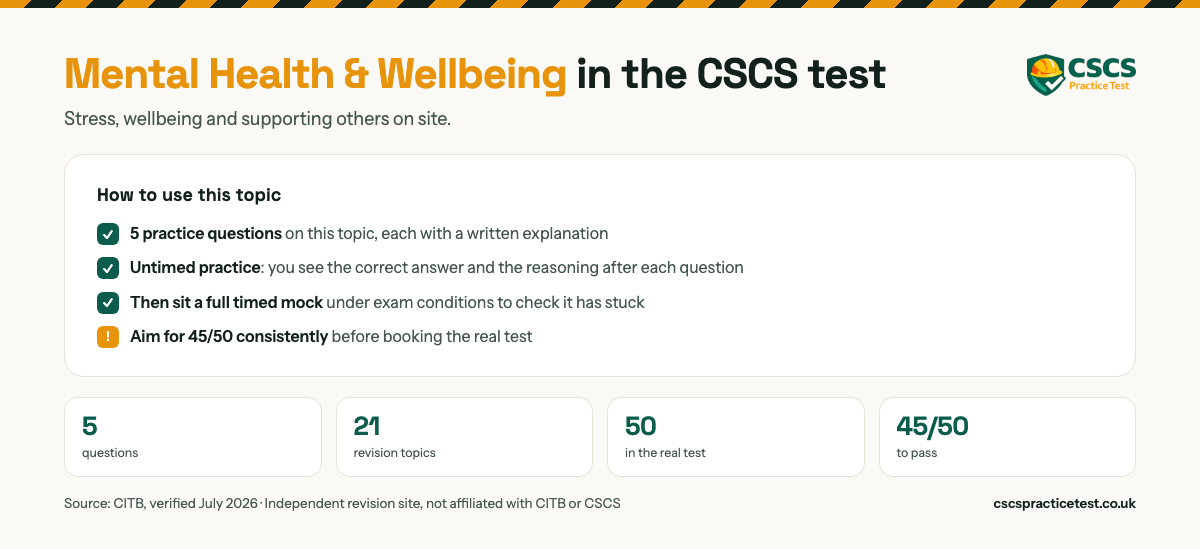
Stress, wellbeing and supporting others on site.
These questions cover mental health & wellbeingfor the CITB Health, Safety and Environment (HS&E) test, the exam UK construction workers pass to get a CSCS card.
Mental Health & Wellbeing: practice questions (untimed, instant feedback)
- 50 questions · pass mark 90%
- Untimed practice: you see the correct answer immediately after each question.
- Some questions need more than one answer, and these are clearly marked.
All 50 Mental Health & Wellbeing questions and answers
These are the same 50 questions as the practice test above, written out with the correct answer and the reasoning behind it. Read them through when you want to revise rather than test yourself.
1. How does HSE define work-related stress?
Answer: The adverse reaction people have to excessive pressures placed on them
- A) The adverse reaction people have to excessive pressures placed on them (correct answer)
- B) A recognised mental illness that a doctor must formally diagnose first
- C) Any pressure at all that a worker meets in the course of a normal shift
- D) Tiredness caused by working more than eight hours without a rest break
Why: HSE defines stress as the adverse reaction people have to excessive pressures or other types of demand placed on them. Pressure on its own is normal at work. It becomes stress when a person cannot cope with it.
2. Which statement matches what HSE says about stress and illness?
Answer: Stress is not an illness in itself, but it can make you ill
- A) Stress has no effect at all on a person's physical health or fitness
- B) Stress is not an illness in itself, but it can make you ill (correct answer)
- C) Stress is an illness that always needs to be treated with drugs
- D) Stress only affects workers who are already unwell in some way
Why: HSE is clear that stress is not an illness, but it can make you ill. It can cause symptoms that affect how you feel both physically and mentally, so it is worth acting early.
3. HSE's Management Standards cover six areas of work design that can affect stress levels. Which list is correct?
Answer: Demands, control, support, relationships, role and change
- A) Hours, pay, travel, tools, weather and site facilities
- B) Planning, briefing, checking, recording, review and audit
- C) Demands, control, support, relationships, role and change (correct answer)
- D) Demands, costs, safety, training, targets and daily supervision
Why: The six Management Standards are demands, control, support, relationships, role and change. If these areas are not managed properly they are the main causes of work-related stress.
4. Under the HSE Management Standard for Demands, what should an employer provide?
Answer: Adequate and achievable demands for the agreed hours of work
- A) Stretching targets so that workers stay busy for a full shift
- B) The same workload for everyone, whatever their level of experience
- C) A workload that each worker is left to sort out for themselves
- D) Adequate and achievable demands for the agreed hours of work (correct answer)
Why: Demands covers workload, work patterns and the work environment. The standard is met when demands are achievable in the hours agreed and people's skills match the job.
5. What is the HSE Management Standard for Control about?
Answer: How much say a person has in the way they do their work
- A) How much say a person has in the way they do their work (correct answer)
- B) How closely a supervisor checks each task done on site
- C) How many workers a site manager is allowed to control
- D) How much control the client keeps over the site budget
Why: Control means how much say a person has in the way they do their work. Being consulted on work patterns and being able to use your skills and initiative both reduce stress.
6. The HSE Management Standard for Support covers which of the following?
Answer: Encouragement, sponsorship and resources from the organisation
- A) Technical support supplied by the maker of the plant on site
- B) Encouragement, sponsorship and resources from the organisation (correct answer)
- C) Financial support paid to workers who report feeling stressed
- D) Legal support given to workers who take an employer to court
Why: Support is the encouragement, sponsorship and resources provided by the organisation, line management and colleagues. The standard is met when workers say they get adequate information and support.
7. Under the Management Standard for Relationships, employees should be able to say that they are:
Answer: Not subjected to unacceptable behaviours such as bullying at work
- A) Free to choose which gang or work team they get placed into on site
- B) Able to work on their own without speaking to any other colleagues
- C) Not subjected to unacceptable behaviours such as bullying at work (correct answer)
- D) Personal friends with every other member of their own working gang
Why: Relationships is about promoting positive working to avoid conflict and dealing with unacceptable behaviour. Bullying at work is a recognised cause of work-related stress.
8. The Management Standard for Role is met when employees say that they:
Answer: Understand their role and their responsibilities at work
- A) Have been promoted at least once in the last few years
- B) Are given a completely different role every few weeks
- C) Can take on whichever role they fancy on a given day
- D) Understand their role and their responsibilities at work (correct answer)
Why: Role is about whether people understand their role in the organisation and whether the employer makes sure they do not have conflicting roles. Unclear or clashing duties are a known stressor.
9. What does the HSE Management Standard for Change deal with?
Answer: How organisational change, large or small, is managed and communicated
- A) How organisational change, large or small, is managed and communicated (correct answer)
- B) How often a site changes its normal working hours through the winter months
- C) How quickly a worker can change trade or move across to a new employer
- D) How changes to the daily weather forecast are passed on to the site staff
Why: Change covers how organisational change, however big or small, is managed and communicated. Workers should be engaged when a business is going through change.
10. What does the law require an employer to do about work-related stress?
Answer: Assess the risk of stress and act on it, as with other health risks
- A) Keep a register of every worker who has ever felt under any pressure
- B) Assess the risk of stress and act on it, as with other health risks (correct answer)
- C) Provide free private counselling sessions for every worker on the site
- D) Send anyone reporting stress home until a GP signs them back on again
Why: Employers have a legal duty to protect workers from stress at work by doing a risk assessment and acting on it. It is the same duty they have for any other health and safety risk.
11. Two workers are under the same pressure but only one becomes stressed. What does HSE say about this?
Answer: What stresses one person may not affect another person at all
- A) Only workers who are new to the industry can be affected by it
- B) Pressure affects office staff but not people working outdoors
- C) What stresses one person may not affect another person at all (correct answer)
- D) Everyone reaches their limit at exactly the same level of pressure
Why: Stress affects people differently and what stresses one person may not affect another. Skills, experience, age and disability can all affect whether a worker can cope.
12. Which of these is listed by HSE as a sign of stress in a team?
Answer: More arguments, higher staff turnover and more sickness absence
- A) More overtime worked and more materials being ordered for the job
- B) More toolbox talks being held and more near miss reports being filed
- C) More new starters joining and more training courses being booked
- D) More arguments, higher staff turnover and more sickness absence (correct answer)
Why: Team level signs include arguments, higher staff turnover, more reports of stress, more sickness absence, decreased performance and more complaints and grievances.
13. A change in the way a worker acts can be a sign of stress. Which example does HSE give?
Answer: Taking more time off, arriving later or being more twitchy
- A) Taking more time off, arriving later or being more twitchy (correct answer)
- B) Wearing correct PPE and arriving on site before the start time
- C) Asking a lot of questions during the site induction on day one
- D) Volunteering for extra duties and taking on more training
Why: HSE says a change in the way someone acts can signal stress, for example taking more time off, arriving for work later, or being more twitchy or nervous than usual.
14. Which of these does HSE list as a change in how someone thinks or feels that can signal stress?
Answer: Mood swings, being withdrawn and losing motivation or confidence
- A) Increased confidence when taking on unfamiliar tasks on site
- B) Mood swings, being withdrawn and losing motivation or confidence (correct answer)
- C) Sharper concentration, better sleep patterns and a bigger appetite
- D) Greater interest in socialising with the rest of the work gang at breaks
Why: Changes in thinking or feeling include mood swings, being withdrawn, loss of motivation, commitment and confidence, and stronger emotional reactions such as being more tearful or aggressive.
15. Which of these does HSE list as a sign of stress you might notice in yourself?
Answer: Feeling negative, indecisive, isolated or unable to concentrate
- A) Feeling hungry towards the end of a long shift on a busy site
- B) Feeling stiff in the morning after a hard day of physical work
- C) Feeling negative, indecisive, isolated or unable to concentrate (correct answer)
- D) Feeling settled, patient and able to plan the week comfortably
Why: If you are stressed you may feel negative, indecisive, isolated or nervous, or find you cannot concentrate. You may also eat more or less than usual or have trouble sleeping.
16. A supervisor notices several signs of stress in a worker. What does HSE advise the supervisor to do?
Answer: Encourage them to see their GP, as signs can point to other conditions
- A) Wait a month or so to see whether the behaviour settles down by itself
- B) Move them onto a quieter task and avoid raising the subject with them
- C) Ask their workmates to find out quietly what is wrong at home for them
- D) Encourage them to see their GP, as signs can point to other conditions (correct answer)
Why: HSE says managers who are worried about these signs should encourage the worker to see their GP, because the same signs can be symptoms of other conditions. If work has caused the problem, they must also act on that.
17. You are feeling the signs of stress at work. What does HSE say is important?
Answer: Talk to someone, for example your manager, as soon as possible
- A) Talk to someone, for example your manager, as soon as possible (correct answer)
- B) Keep it to yourself until your next annual appraisal comes round
- C) Book time off sick and only explain yourself once you are back at work
- D) Report it straight to HSE rather than to anyone on the site
Why: HSE says it is important to talk to someone, for example your manager. Speaking up early gives them the chance to help and stops the situation getting worse.
18. The pressure you are under is caused by your own line manager. Who else does HSE suggest you could talk to?
Answer: A trade union or employee rep, HR, an EAP or your own GP
- A) Another worker's line manager on a completely different site
- B) A trade union or employee rep, HR, an EAP or your own GP (correct answer)
- C) The client's quantity surveyor or the main contractor's buyer
- D) The security guard on the gate or the person in the canteen
Why: If the pressure comes from your line manager, check what policies exist. If there are none, HSE suggests your trade union or employee representative, HR, the employee assistance programme or counselling service if there is one, or your GP.
19. Many workers stay quiet about stress because of the stigma attached to it. What does HSE say?
Answer: Stress is not a weakness and it can happen to anyone
- A) Stress is only an issue for workers nearing retirement
- B) Stress is a private matter that work cannot help with
- C) Stress is not a weakness and it can happen to anyone (correct answer)
- D) Stress is a sign that a worker is in the wrong trade
Why: HSE states plainly that stress is not a weakness and can happen to anyone. Stigma stops people speaking up, which lets problems grow.
20. Your employer has carried out a stress risk assessment. What must they do with the results?
Answer: Share the results of the risk assessment with the workers
- A) Keep the results confidential from everyone except HSE
- B) Send the results to each worker's GP for their records
- C) Display the results at the site gate for the public to see
- D) Share the results of the risk assessment with the workers (correct answer)
Why: Your employer has a legal duty to assess the risks to your health from stress at work and to share the results of any risk assessment with you.
21. When would HSE consider investigating work-related stress at a workplace?
Answer: Where several workers are affected and the employer has been told
- A) Where several workers are affected and the employer has been told (correct answer)
- B) Whenever any single worker phones to say they are feeling stressed
- C) Only after the worker involved has already resigned from the company
- D) Only once a worker has been off sick for six months or longer
Why: HSE only considers investigating where it is evident that several employees are affected and there is evidence of a wider organisational failing. Concerns should be raised with the employer first.
22. What is HSE's Stress Talking Toolkit designed to do?
Answer: Help managers start conversations with workers about causes of stress
- A) Provide a medical questionnaire that screens every worker for anxiety
- B) Help managers start conversations with workers about causes of stress (correct answer)
- C) Replace the need for the employer to do any stress risk assessment at all
- D) Give managers a fixed script for disciplinary meetings about absence
Why: The Talking Toolkits help managers hold simple, practical conversations that identify causes of stress and possible solutions. HSE warns they must not be used on their own instead of managing the risks.
23. According to HSE's construction Talking Toolkit, who holds overall responsibility for managing work-related stress?
Answer: The employer, who must also support supervisors and site managers
- A) The client, who sets the programme and the agreed completion date
- B) The occupational health provider appointed for the whole project
- C) The employer, who must also support supervisors and site managers (correct answer)
- D) Each individual worker, who has to manage their own pressure at work
Why: HSE states that overall responsibility for managing work-related stress rests with the employer, who must make sure supervisors and site managers are properly supported to tackle it.
24. HSE's construction Talking Toolkit ranks stress, depression and anxiety where among causes of work-related ill health in construction?
Answer: They are the second biggest cause of work-related ill health
- A) They are the single biggest cause of work-related ill health
- B) They are the smallest recorded cause of work-related ill health
- C) They are not counted as work-related ill health in construction
- D) They are the second biggest cause of work-related ill health (correct answer)
Why: HSE says stress, depression and anxiety are the second biggest cause of work-related ill health in the construction industry. Only musculoskeletal disorders account for more.
25. HSE statistics for 2024/25 show how many workers in Great Britain suffering from work-related stress, depression or anxiety?
Answer: About 964,000 workers, counting new and long-standing cases
- A) About 964,000 workers, counting new and long-standing cases (correct answer)
- B) About 12,000 workers, counting new and long-standing cases
- C) About 3.4 million workers, counting new and long-standing cases
- D) About 150,000 workers, counting new and long-standing cases
Why: HSE estimated 964,000 workers suffering from work-related stress, depression or anxiety in 2024/25, which was 52 per cent of all work-related ill health.
26. ONS analysis of suicide by occupation in England, for deaths registered from 2011 to 2015, found what for low skilled male labourers, particularly in construction?
Answer: Their risk of suicide was three times the male national average
- A) Their risk of suicide was about ten times the national average
- B) Their risk of suicide was three times the male national average (correct answer)
- C) Their risk of suicide was the same as the male national average
- D) Their risk of suicide was about half the male national average
Why: ONS found the risk of suicide among low skilled male labourers, particularly those in construction roles, was three times higher than the male national average. It is why suicide prevention matters so much in this industry.
27. In the same ONS analysis, which skilled trades group had the highest risk of suicide among men?
Answer: Building finishing trades, such as plasterers and decorators
- A) Metal forming trades, such as welders and sheet metal workers
- B) Vehicle trades, such as mechanics and auto electricians
- C) Building finishing trades, such as plasterers and decorators (correct answer)
- D) Electrical trades, such as electricians, linesmen and cable jointers
Why: ONS found the highest risk among men in skilled trades was in the building finishing trades. Plasterers and painters and decorators had more than double the risk of suicide of the male national average.
28. Which work-related issues does HSE say may play a part in someone becoming suicidal?
Answer: Job insecurity, discrimination, work stressors and bullying
- A) Long journeys, poor weather and a lack of parking near site
- B) Working in a small team rather than for a very large firm
- C) Being asked to attend a routine health surveillance check
- D) Job insecurity, discrimination, work stressors and bullying (correct answer)
Why: HSE says an issue or combination of issues such as job insecurity, discrimination, work stressors and bullying may play a part in people becoming suicidal. Work factors can add to feelings of humiliation or isolation.
29. Which of these does HSE list as a sign that someone may be struggling?
Answer: Neglecting themselves and giving away their possessions
- A) Neglecting themselves and giving away their possessions (correct answer)
- B) Booking a holiday and telling colleagues about the plans
- C) Asking a supervisor for extra training on a new machine
- D) Bringing a packed lunch instead of buying food from a van
Why: HSE lists signs including ups and downs in mood, not wanting to mix socially, changes to sleeping or eating, neglecting themselves, increased alcohol or drug use, and giving away possessions.
30. You think a workmate may be suicidal. What does HSE advise?
Answer: Encourage them to get help from their GP, an EAP or the Samaritans
- A) Tell the rest of the gang so that they can all keep an eye out too
- B) Encourage them to get help from their GP, an EAP or the Samaritans (correct answer)
- C) Say nothing at all, in case raising it puts the idea into their head
- D) Wait for them to raise the subject themselves before doing anything
Why: HSE says to encourage them to seek help from their GP, the employee assistance programme, the Samaritans, or a trusted friend or family member. Asking does not plant the idea.
31. What is the Samaritans free telephone number and when can it be used?
Answer: 116 123, which is free to call day or night, all year round
- A) 0345 123 116, charged at the standard landline call rate
- B) 116 123, which can only be reached from a landline phone
- C) 116 123, which is free to call day or night, all year round (correct answer)
- D) 116 123, but only between 9am and 5pm on working weekdays
Why: Samaritans can be called free on 116 123, day or night, 365 days a year, from landlines and mobiles including pay as you go. HSE names Samaritans as a source of help.
32. Which helpline does the Lighthouse Charity run for construction workers and their families?
Answer: The Construction Industry Helpline, free and open 24 hours
- A) The Construction Skills Helpline, open in office hours only
- B) The Site Managers Advice Line, open on weekdays until 6pm only
- C) The Building Trades Legal Line, open by appointment only
- D) The Construction Industry Helpline, free and open 24 hours (correct answer)
Why: The Lighthouse Charity, formerly the Lighthouse Club, runs the Construction Industry Helpline. It gives free, confidential emotional, physical and financial wellbeing support 24 hours a day, 7 days a week.
33. What is Mates in Mind?
Answer: A UK charity raising awareness of mental ill health in construction
- A) A UK charity raising awareness of mental ill health in construction (correct answer)
- B) A government agency that inspects construction sites for stress risks
- C) A trade union branch that represents supervisors across construction
- D) An insurance scheme that pays out on work-related stress claims
Why: Mates in Mind is a UK charity that raises awareness, improves understanding and addresses the stigma of mental ill health. It works across industries with a focus on construction.
34. HSE often refers to an employee assistance programme, or EAP. What is one?
Answer: A confidential support and counselling service some employers provide
- A) A government grant paid to employers who take on new apprentices
- B) A confidential support and counselling service some employers provide (correct answer)
- C) A savings scheme that helps workers pay for their own hand tools and kit
- D) A written plan setting out how a worker will be disciplined at work
Why: An employee assistance programme is a confidential counselling and support service that some employers provide. HSE lists it alongside your GP as somewhere to turn if you are struggling.
35. HSE quotes what proportion of people in the UK will have a mental health problem at some point?
Answer: One in four people, though most problems are mild and short term
- A) One in a thousand people, nearly all needing hospital treatment
- B) One in two hundred people, mostly those who work in offices
- C) One in four people, though most problems are mild and short term (correct answer)
- D) One in fifty people, and most problems are severe and lasting
Why: HSE states that one in four people in the UK will have a mental health problem at some point. Most are mild, tend to be short term and are treated successfully by a GP.
36. Which does HSE name as the most common mental health problems?
Answer: Anxiety and depression, often a reaction to a difficult life event
- A) Psychosis and hallucinations, usually brought on by working long shifts
- B) Phobias about heights, mainly seen among scaffolders and roofers
- C) Memory loss and confusion, which are linked to older age alone
- D) Anxiety and depression, often a reaction to a difficult life event (correct answer)
Why: HSE says anxiety and depression are the most common mental health problems. They are often a reaction to a difficult life event such as bereavement, but can also be caused by work issues.
37. A worker already had a mental health condition before joining the company. What does HSE say about the effect of work?
Answer: Work can aggravate a pre-existing condition and worsen the symptoms
- A) Work can aggravate a pre-existing condition and worsen the symptoms (correct answer)
- B) Work has no effect at all on a condition that started outside of work
- C) Work always improves a condition once the person has settled in
- D) Work only matters if the condition first appeared after they were hired
Why: HSE says work can aggravate pre-existing conditions, and problems at work can bring on symptoms or make their effects worse. The employer's duty applies whether work caused the problem or made it worse.
38. What does HSE say about most people who have mental health problems?
Answer: Most are treated by their GP and continue to work productively
- A) Most are barred from all safety critical work for life by law
- B) Most are treated by their GP and continue to work productively (correct answer)
- C) Most have to give up work altogether once they are diagnosed
- D) Most need a long stay in hospital before they can work again
Why: HSE says most people with mental health problems are diagnosed and treated by their GP and carry on working productively. Evidence shows that staying in work can be a great help.
39. A worker tells their manager about a mental health condition. What does HSE say the manager should focus on?
Answer: Concentrate on reasonable adjustments rather than the diagnosis
- A) Ask the worker to explain their diagnosis to the whole team
- B) Leave it alone until occupational health makes contact first
- C) Concentrate on reasonable adjustments rather than the diagnosis (correct answer)
- D) Insist on seeing the full medical notes before doing anything
Why: HSE says managers should concentrate on making reasonable adjustments at work rather than understanding the diagnosis. The GP, medical support or occupational health can advise on what will help.
40. Under the Equality Act 2010, when does a mental health condition count as a disability?
Answer: When a mental impairment has a substantial, long term adverse effect
- A) When a worker has been signed off sick for more than four weeks
- B) When the condition was caused entirely by something that happened at work
- C) When a hospital consultant rather than a GP has made the diagnosis
- D) When a mental impairment has a substantial, long term adverse effect (correct answer)
Why: Section 6 of the Equality Act 2010 says a person has a disability if a physical or mental impairment has a substantial and long term adverse effect on their ability to carry out normal day to day activities.
41. Reasonable adjustments are agreed for a worker with a mental health condition. Who pays for them?
Answer: The employer, who cannot pass the cost on to the disabled person
- A) The employer, who cannot pass the cost on to the disabled person (correct answer)
- B) The worker, who must fund any change made for their own benefit
- C) The client, who has to add the cost to the main contract price
- D) The insurer, who has to meet the cost of all such adjustments
Why: Section 20 of the Equality Act 2010 sets out the duty to make reasonable adjustments and states that the person who has that duty cannot require the disabled person to pay any of the cost.
42. You are coming back to work after time off sick with a mental health condition. What does HSE advise?
Answer: Agree a return to work plan with your manager before you go back
- A) Leave it to occupational health to tell your manager the plan
- B) Agree a return to work plan with your manager before you go back (correct answer)
- C) Return on full normal duties from the very first day back at work
- D) Wait until you feel a hundred per cent before contacting work
Why: HSE advises talking to your manager and agreeing a plan for your return before you come back. A written plan helps you both agree when you have reached business as usual.
43. What does HSE say about assumptions made about a worker with a mental health condition?
Answer: It is discriminatory to assume what they can do or how much leave they need
- A) It is normal practice to assume they cannot be promoted for a year or two
- B) It is acceptable to assume they should avoid all outdoor site work
- C) It is discriminatory to assume what they can do or how much leave they need (correct answer)
- D) It is sensible to assume they will always need more supervision than others
Why: HSE says it is discriminatory to make assumptions about people's capabilities, their promotability or the amount of sick leave they may need because of their illness. Ask the person instead.
44. HSE recommends talking about mental health and stress within teams. Why?
Answer: It helps reduce the stigma and creates a more supportive environment
- A) It allows the employer to record who has a condition on a register
- B) It means the employer can move affected people onto lighter duties
- C) It gives the site a reason to reduce the number of rest breaks taken
- D) It helps reduce the stigma and creates a more supportive environment (correct answer)
Why: HSE says promoting good mental health and talking about it within teams helps reduce or remove stigma and provides a more supportive, understanding environment.
45. How should mental health be dealt with in an employer's first aid needs assessment?
Answer: It should consider the need to support workers who become mentally unwell
- A) It should consider the need to support workers who become mentally unwell (correct answer)
- B) It should be left out, because first aid only ever covers physical injuries
- C) It should list the names of every worker who has ever had a condition
- D) It should replace the separate risk assessment for work-related stress
Why: HSE says that as part of your first aid at work needs assessment you should consider the potential need to support workers who might become ill at work because of a mental health issue.
46. How does HSE define fatigue?
Answer: A decline in mental or physical performance from exertion or sleep loss
- A) A drop in output caused by tools or plant that are badly maintained
- B) A decline in mental or physical performance from exertion or sleep loss (correct answer)
- C) A short lived feeling of tiredness that a hot drink will always put right
- D) A medical condition that only affects people who work on night shifts
Why: HSE describes fatigue as a decline in mental and physical performance resulting from prolonged exertion, sleep loss or disruption of the internal body clock. It comes from excessive working time or poor shift patterns.
47. According to HSE, what does fatigue do to a person at work?
Answer: It slows reactions, causes memory lapses and leads to risk being underestimated
- A) It affects mood only and has no measurable effect on how people do the work
- B) It reduces physical strength but leaves decision making completely intact
- C) It slows reactions, causes memory lapses and leads to risk being underestimated (correct answer)
- D) It sharpens concentration for short periods before any real tiredness sets in
Why: HSE says fatigue results in slower reactions, reduced ability to process information, memory lapses, decreased awareness, underestimation of risk and reduced coordination. It can lead to errors, accidents and ill health.
48. Under the Working Time Regulations 1998, what daily rest is an adult worker entitled to?
Answer: Not less than eleven consecutive hours in each 24 hour period
- A) Not less than eight consecutive hours of rest in each 24 hour period
- B) Not less than fourteen consecutive hours in each 24 hour period
- C) Whatever rest the employer decides is right for that shift pattern
- D) Not less than eleven consecutive hours in each 24 hour period (correct answer)
Why: Regulation 10 gives an adult worker a rest period of not less than eleven consecutive hours in each 24 hour period. HSE's construction toolkit asks workers directly whether they get that rest before the next shift.
49. A worker tells their employer they have a drink problem. How does HSE say dependence should be treated?
Answer: As a recognised medical problem, with the same right to confidentiality
- A) As a recognised medical problem, with the same right to confidentiality (correct answer)
- B) As gross misconduct that must always lead to instant dismissal on the spot
- C) As a matter for the worker alone that the employer cannot discuss
- D) As a reason to tell the whole workforce so that they can keep watch
Why: HSE says drug and alcohol dependence are recognised medical problems. Someone misusing drugs or alcohol has the same rights to confidentiality and support as they would with any other medical or psychological condition.
50. What does HSE warn may happen if an employer dismisses a worker for drug or alcohol misuse without trying to help them?
Answer: An employment tribunal may find that the dismissal was unfair
- A) HSE will automatically issue an improvement notice for the site
- B) An employment tribunal may find that the dismissal was unfair (correct answer)
- C) The employer may be prosecuted by the police for the dismissal
- D) The worker must automatically be paid three years of wages in compensation
Why: HSE says that if you dismiss someone for drug or alcohol misuse without trying to help them, an employment tribunal may find you dismissed them unfairly. It advises considering whether it is a health concern rather than only a discipline matter.
What this topic covers in the CSCS test
Mental health sits alongside physical health in the HS&E test because someone who is struggling is at greater risk on site. HSE requires employers to assess the risk of work-related stress and act on it, like any other health risk. Questions here test whether you would talk, listen and point someone towards help.
- HSE's six Management Standards: demands, control, support, relationships, role and change
- Spotting change in a workmate, such as pulling away from the team or uncharacteristic mistakes
- Where help comes from: manager, GP, occupational health, union rep or helpline
- Peer support, mental health first aiders and wellbeing toolbox talks
- The employer's duty to assess work-related stress and act on the findings
- Reasonable adjustments and planning a return to work after time off
- Why HSE treats this as a health and safety risk, assessed like any other
Key facts worth memorising
- 964,000 workers
- HSE estimates 964,000 workers in Great Britain had work-related stress, depression or anxiety in 2024/25, the largest single cause of work-related ill health.
- 22.1 million days lost
- Stress, depression or anxiety caused 22.1 million of the 40.1 million working days lost in 2024/25, an average of 22.9 days off per case.
- Six causes, not one
- The Management Standards cover six areas of work design that cause stress if managed badly: demands, control, support, relationships, role and change.
- Write it down at five
- Employers must assess the risk of work-related stress, and with five or more workers that assessment must be written down.
- A measured risk
- For deaths registered in England from 2011 to 2015, ONS found low-skilled male construction labourers had a suicide risk around three times the male national average.
- Free help, day or night
- Samaritans is free on 116 123, 24 hours a day. The Lighthouse Construction Industry Charity runs a free 24/7 helpline for construction workers and their families on 0345 605 1956.
What people get wrong
Mental health is personal, not a site safety issue.
HSE says to assess the risk of stress, and its impact on mental and physical ill-health, in the same way as any other work-related health and safety risk, and there is a legal duty to act on that assessment.
Leave people alone until they raise it themselves.
The test rewards the opposite. Ask, listen and encourage them to speak to a manager, GP or helpline. HSE says the earlier a problem is tackled, the less impact it has.
Talking to a workmate replaces professional help.
Peer support matters because a workmate understands the job, but it sits alongside professional help rather than instead of it.
Stress is an illness you either have or you do not.
HSE says stress is not an illness, but it can make you ill. It comes from how work is designed and managed, so it can be changed.
Answering these questions in the test
Answers here favour talking, listening or getting help, and reject isolation, silence or piling on more work. Where two options look reasonable, choose the one where the person is supported and a manager or professional is brought in. Options that punish someone for speaking up are never right. Remember the duty is to change the work, not just the worker. If you need to talk today, Samaritans is free on 116 123.
Sources
Written from the following. Where a figure could not be verified against one of these, it has been left out rather than approximated. Our sources and methodology explains how we date and re-check them. Spotted something wrong? Report an error and we will fix it.
- hse.gov.uk/stress/overview.htm
- hse.gov.uk/stress/standards/overview.htm
- hse.gov.uk/stress/risk-assessment.htm
- hse.gov.uk/stress/mental-health-overview.htm
- hse.gov.uk/statistics/dayslost.htm
- press.hse.gov.uk/2025/11/20/hse-publishes-annual-workplace-health-and-safety-statistics/
- workright.campaign.gov.uk/working-minds/
- ons.gov.uk/peoplepopulationandcommunity/birthsdeathsandmarriages/deaths/articles/suicidebyoccupation/england2011to2015
- samaritans.org/how-we-can-help/contact-samaritan/
- lighthousecharity.org/free-24-7-support/
Topics that come up alongside mental health & wellbeing
Ready for the real thing?
When you are scoring 90% or better here, take a CSCS mock test for Operatives under exam conditions, then how to book the CSCS test.