
CSCS Manual Handling Questions
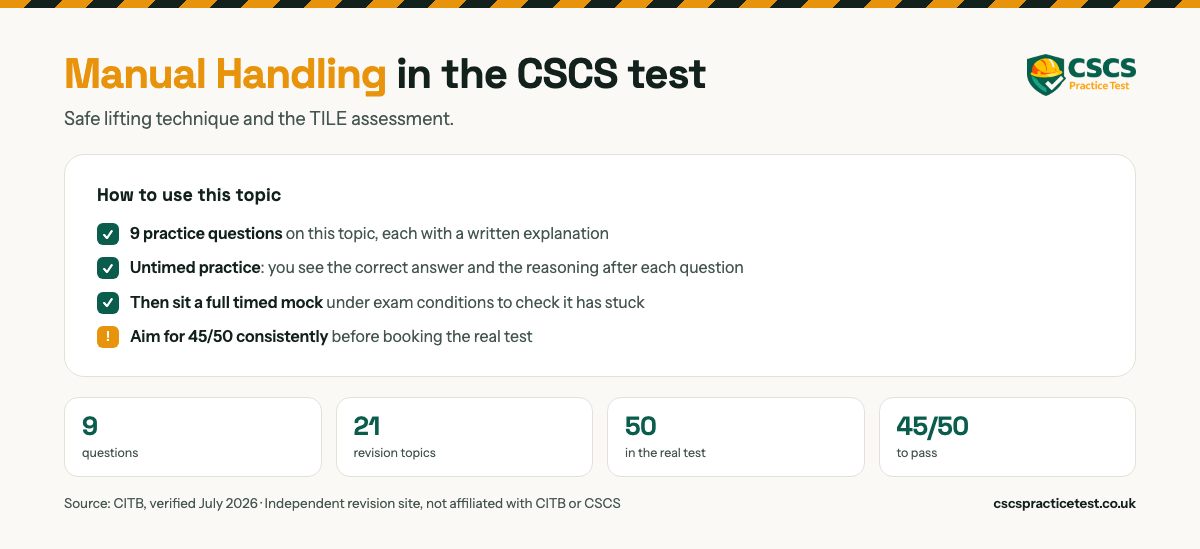
Safe lifting technique and the TILE assessment.
These questions cover manual handlingfor the CITB Health, Safety and Environment (HS&E) test, the exam UK construction workers pass to get a CSCS card.
Manual Handling: practice questions (untimed, instant feedback)
- 50 questions · pass mark 90%
- Untimed practice: you see the correct answer immediately after each question.
- Some questions need more than one answer, and these are clearly marked.
All 50 Manual Handling questions and answers
These are the same 50 questions as the practice test above, written out with the correct answer and the reasoning behind it. Read them through when you want to revise rather than test yourself.
1. Which of the following counts as a manual handling task?
Answer: Any task involving pushing, pulling, lowering or lifting by hand
- A) Any task involving pushing, pulling, lowering or lifting by hand (correct answer)
- B) Climbing up or down ladders and stairs while carrying nothing at all
- C) Getting into and out of a works vehicle at the start of the shift
- D) Lifting bundled materials into position using a crane and slings
Why: Manual handling is moving a load by bodily force: pushing, pulling, lifting or lowering.
2. You have to carry a load down a steep slope. What should you do?
Answer: Check whether you can still move the load safely
- A) Check whether you can still move the load safely (correct answer)
- B) Rest the load on your shoulder and keep walking down the slope
- C) Set the load down at the top and let it slide to the bottom
- D) Reverse down the slope so that you can keep your balance better
Why: A slope changes the risk, so reassess whether the load can still be carried safely.
3. Your task means moving the same load several times each minute. Could that be a problem?
Answer: Yes, repeating the movement adds extra strain on the body
- A) No, a light load never needs an assessment
- B) Not while the load stays under the recommended weight
- C) Only if you can't keep up the required rate
- D) Yes, repeating the movement adds extra strain on the body (correct answer)
Why: Frequent repetition adds strain even with lighter loads, so it must be assessed.
4. What is the best way to reduce the risk of injury during manual handling?
Answer: Using lifting aids safely
- A) Getting a trained person to carry it instead
- B) Levelling the ground
- C) Keeping heavy items off site altogether
- D) Using lifting aids safely (correct answer)
Why: Using mechanical lifting aids removes much of the manual effort and is the best control.
5. What does TILE stand for in a manual handling assessment?
Answer: Task, Individual, Load, Environment
- A) Task, Individual, Load, Environment (correct answer)
- B) Technique, Individual, Load, Environment
- C) Task, Inspection, Load, Environment
- D) Training, Individual, Load, Evaluation
Why: TILE = Task, Individual, Load and Environment: the four factors you weigh up.
6. What is the first step of a manual handling risk assessment?
Answer: Identify the task
- A) Identify who is at risk
- B) Identify the task (correct answer)
- C) Assess the load
- D) Plan the lift
Why: Start with the task; only then can you judge the load, the individual and the environment.
7. What is the maximum weight one person may legally lift alone?
Answer: There is no legal limit
- A) 25 kg
- B) There is no legal limit (correct answer)
- C) 50 kg
- D) 15 kg
Why: There is no legal maximum. The law requires you to assess and reduce the risk. HSE figures are screening guidance, not limits.
8. Which best reduces manual handling risk?
Answer: Using mechanical aids wherever possible
- A) Ignoring the set techniques and lifting whichever way feels easiest
- B) Using mechanical aids wherever possible (correct answer)
- C) Avoiding team lifts so that nobody has to coordinate the movement
- D) Carrying loads overhead so they are clear of obstacles on the route
Why: Mechanical aids such as trolleys and hoists are the most effective control.
9. How can poor lighting affect manual handling?
Answer: It raises the risk of slips and trips
- A) It makes the labels on the load much easier to read while lifting
- B) It raises the risk of slips and trips (correct answer)
- C) It improves coordination between the members of a lifting team
- D) It makes the load feel lighter
Why: Poor lighting hides trip hazards: the 'E' (environment) in TILE.
10. Which of these is NOT a manual handling operation under the Manual Handling Operations Regulations 1992?
Answer: Operating a tower crane from the cab to lift a bundle of rebar
- A) Pushing a loaded wheelbarrow of spoil across the site compound
- B) Carrying a bag of cement up a flight of temporary stairs
- C) Operating a tower crane from the cab to lift a bundle of rebar (correct answer)
- D) Lowering a paving slab into its bed by hand and by bodily force
Why: The regulations define manual handling as transporting or supporting a load by hand or by bodily force. A crane lifts the load by machine, so the operator is not manually handling it. Pushing, carrying and lowering by hand all count.
11. Under the regulations, can a person be a 'load'?
Answer: Yes. The definition of load expressly includes any person and any animal
- A) Yes. The definition of load expressly includes any person and any animal (correct answer)
- B) No. A load has to be an inanimate object such as a block or a bag
- C) Only if the person being moved is unconscious at the time of the move
- D) Only where the person being moved weighs more than the handler does
Why: The interpretation regulation states that load includes any person and any animal. Moving a casualty or handling a live animal is therefore manual handling.
12. A task involves a risk of injury from manual handling. What does the law require the employer to try FIRST?
Answer: Try to design out the need for that handling, so far as is reasonably practicable
- A) Issue gloves and back supports to everyone who will do the lifting
- B) Train every worker involved in a recognised safe lifting and lowering technique
- C) Write a method statement covering the lift and brief it to the gang
- D) Try to design out the need for that handling, so far as is reasonably practicable (correct answer)
Why: Regulation 4(1)(a) puts avoidance first. Assessing, training and equipment come later, and only where avoiding the handling is not reasonably practicable.
13. Avoiding the manual handling is not reasonably practicable. What must the employer then do?
Answer: Make a suitable and sufficient assessment and reduce the risk of injury
- A) Make a suitable and sufficient assessment and reduce the risk of injury (correct answer)
- B) Record the task in the accident book before the work is allowed to start
- C) Obtain written consent from each worker who will carry out the handling
- D) Limit the operation to workers who have passed a fitness medical first
Why: Regulation 4(1)(b) requires a suitable and sufficient assessment having regard to the Schedule 1 factors, then appropriate steps to reduce the risk.
14. When manual handling cannot be avoided, to what level must the risk of injury be reduced?
Answer: To the lowest level that is reasonably practicable in the circumstances
- A) To the lowest level that is reasonably practicable in the circumstances (correct answer)
- B) To a level the workers involved say they are comfortable working at
- C) To zero, because any residual risk of injury makes the task unlawful
- D) To whatever level the site manager records in the risk assessment form
Why: Regulation 4(1)(b)(ii) sets the standard as the lowest level reasonably practicable. It is not zero, and it is not simply what feels acceptable on the day.
15. What must the employer tell workers about the weight of loads they handle?
Answer: General indications of weight, and precise information where practicable
- A) Nothing, because judging the weight of a load is the handler's own job
- B) Only the total tonnage that will be moved across the whole work shift
- C) General indications of weight, and precise information where practicable (correct answer)
- D) Only whether the load exceeds the guideline figure shown in HSE charts
Why: Regulation 4(1)(b)(iii)(aa) requires general indications of the weight of each load, and precise information where it is reasonably practicable to give it.
16. A load's centre of gravity is not positioned centrally. What extra information must be given where practicable?
Answer: Which side of the load is the heaviest, so handlers can plan the lift
- A) The date on which the load was delivered to the site by the supplier
- B) The name of the supplier who packed and sealed the load for transport
- C) The maximum height to which that particular load may safely be raised
- D) Which side of the load is the heaviest, so handlers can plan the lift (correct answer)
Why: Regulation 4(1)(b)(iii)(bb) singles out the heaviest side of any load whose centre of gravity is off centre, because an unexpected weight bias is what causes the sudden movement.
17. What duty do the regulations place on the employee?
Answer: To make full and proper use of the system of work the employer provides
- A) To refuse any lift that the employee personally considers to be heavy
- B) To carry out a written manual handling assessment before each new lift
- C) To make full and proper use of the system of work the employer provides (correct answer)
- D) To report the weight of every load handled to the supervisor each shift
Why: Regulation 5 is short and specific: the employee must make full and proper use of any system of work provided under regulation 4(1)(b)(ii). Leaving the provided aid in the store is a breach of it.
18. Schedule 1 groups the assessment factors under how many headings?
Answer: Five headings, the fifth covering things such as PPE and clothing
- A) Four headings, which is where the TILE memory aid comes from directly
- B) Six headings, one of which deals only with the training of the handler
- C) Five headings, the fifth covering things such as PPE and clothing (correct answer)
- D) Three headings, covering the task, the load and the person doing it
Why: Schedule 1 lists five groups: the tasks, the loads, the working environment, individual capability, and other factors. TILE is a useful memory aid but it collapses the fifth group.
19. Poor lighting where a load is being carried falls under which Schedule 1 factor group?
Answer: The working environment, alongside floors, space and temperature
- A) The tasks, because lighting changes how the handling is carried out
- B) The working environment, alongside floors, space and temperature (correct answer)
- C) Individual capability, because eyesight differs from person to person
- D) Other factors, which is the group used for anything not listed above
Why: Schedule 1 puts poor lighting conditions in the working environment group, with space constraints, uneven or slippery floors, changes in floor level, temperature and ventilation.
20. Bulky PPE is stopping a worker from getting close to a load. Which Schedule 1 group covers that?
Answer: Other factors, which asks whether PPE or clothing hinders movement
- A) The loads, because the effective size of the load has been increased
- B) The tasks, because the handling method has to change to accommodate it
- C) Individual capability, because it is about this particular worker only
- D) Other factors, which asks whether PPE or clothing hinders movement (correct answer)
Why: Group 5, other factors, asks a single question: is movement or posture hindered by personal protective equipment or by clothing? It is the group people most often forget.
21. A task may create a hazard for someone who is pregnant or has a health problem. Which group covers this?
Answer: Individual capability, which also covers unusual strength or height
- A) Individual capability, which also covers unusual strength or height (correct answer)
- B) Other factors, because pregnancy is not mentioned elsewhere
- C) The tasks, because the task is what creates the hazard in the first place
- D) The working environment, because it concerns conditions on that site
Why: Group 4, individual capability, asks whether the job requires unusual strength or height, creates a hazard for those who might reasonably be considered pregnant or to have a health problem, or needs special information or training.
22. A drum is only part full, so the contents move when it is lifted. Which Schedule 1 group covers that?
Answer: The loads, which asks whether they are unstable or contents may shift
- A) The tasks, because it is the lifting action that makes contents shift
- B) The loads, which asks whether they are unstable or contents may shift (correct answer)
- C) Other factors, because a shifting load is an unpredictable situation
- D) The working environment, since the drum is stored on the work site
Why: Group 2, the loads, asks whether loads are heavy, bulky or unwieldy, difficult to grasp, unstable or with contents likely to shift, or sharp, hot or otherwise potentially damaging.
23. Twisting the trunk while handling a load falls under which Schedule 1 group?
Answer: The tasks, which lists twisting, stooping and reaching upwards
- A) The loads, because the shape of the load forces the body to twist
- B) Individual capability, because flexibility varies between handlers
- C) Other factors, because posture is not covered by the other groups
- D) The tasks, which lists twisting, stooping and reaching upwards (correct answer)
Why: Group 1, the tasks, expressly lists unsatisfactory bodily movement or posture, and gives twisting the trunk, stooping and reaching upwards as its examples.
24. When must a manual handling assessment be reviewed?
Answer: If there is reason to suspect it is no longer valid, or things change
- A) Every twelve months, on the anniversary of the date it was first made
- B) Only after an injury has actually happened during that handling task
- C) If there is reason to suspect it is no longer valid, or things change (correct answer)
- D) Whenever a new worker joins the gang that carries out the operation
Why: Regulation 4(2) requires review where there is reason to suspect the assessment is no longer valid, or there has been a significant change in the operations to which it relates.
25. A worker is burned by acid that has leaked from a drum being carried. Is that a manual handling 'injury' under these regulations?
Answer: No. Injury from a toxic or corrosive substance that leaked is excluded
- A) Yes, because the burn happened while the drum was being carried by hand
- B) Yes, because any harm arising during a handling operation is included
- C) No. Injury from a toxic or corrosive substance that leaked is excluded (correct answer)
- D) No, but only where the drum was labelled with a corrosive hazard sign
Why: The interpretation regulation excludes injury caused by a toxic or corrosive substance that has leaked or spilled from a load, is on its surface, or is a constituent part of it. That harm is dealt with under COSHH, not MHOR.
26. A load is hot enough to burn bare skin. Under Schedule 1 that is a feature of which group?
Answer: The loads, which lists sharp, hot or otherwise potentially damaging
- A) The working environment, because heat is a condition on the work site
- B) The loads, which lists sharp, hot or otherwise potentially damaging (correct answer)
- C) Individual capability, because tolerance of heat varies by individual
- D) The tasks, because a hot load changes the method used
Why: Sharp, hot or otherwise potentially damaging is one of the load questions in group 2. Extremes of temperature in group 3 are about the surroundings, not the load itself.
27. A conveyor sets the speed at which operatives must lift and stack. Which Schedule 1 group covers that?
Answer: The tasks, which asks about a rate of work imposed by a process
- A) The tasks, which asks about a rate of work imposed by a process (correct answer)
- B) The loads, because the items on the conveyor are the loads handled
- C) Other factors, because machinery is not named elsewhere
- D) The working environment, because the conveyor is part of the site
Why: Group 1, the tasks, ends with frequent or prolonged physical effort, insufficient rest or recovery periods, and a rate of work imposed by a process.
28. There is not enough room to stand square to a load, so handlers must reach across. Which group covers this?
Answer: The working environment, which asks about space constraints
- A) Individual capability, because a taller worker could reach it safely
- B) The tasks, because reaching across is part of the handling method
- C) The working environment, which asks about space constraints (correct answer)
- D) Other factors, because cramped working is not listed anywhere else
Why: Group 3 opens with space constraints preventing good posture. The cramped space is an environmental cause even though it shows up as a posture problem.
29. Do the manual handling duties apply to a relevant self-employed person?
Answer: Yes. Duties on an employer also apply to them in respect of themselves
- A) No. The regulations only ever bind employers in respect of employees
- B) Yes. Duties on an employer also apply to them in respect of themselves (correct answer)
- C) Only where they are working alongside directly employed operatives on the same site
- D) Only if they have signed up to the principal contractor's site rules
Why: Regulation 2(2) applies the employer's duties to a relevant self-employed person in respect of himself, as amended in 2015 to align with section 3(2) of the Health and Safety at Work etc. Act 1974.
30. A handling job can only be done safely by someone who has been shown a particular technique. Which Schedule 1 group flags that?
Answer: Individual capability, which asks about special information or training
- A) Other factors, because training is not part of the four main groups
- B) The tasks, because the technique needed is a feature of the task being carried out
- C) The working environment, because training is delivered on the site
- D) Individual capability, which asks about special information or training (correct answer)
Why: Group 4 asks whether the job requires special information or training for its safe performance. It sits with the questions about strength, height, pregnancy and health.
31. A mechanical aid is available for a heavy awkward load, but using it will take longer. What should you do?
Answer: Use the aid, because the employer provided it as the system of work
- A) Lift it by hand, because the aid is only needed for much heavier loads
- B) Lift it by hand but get a second person to help you take the weight
- C) Use the aid, because the employer provided it as the system of work (correct answer)
- D) Ask the supervisor to decide, and carry on by hand while you wait
Why: Regulation 5 requires full and proper use of the system of work provided. Taking longer is not a reason to set the aid aside, and the assessment that led to it assumed it would be used.
32. Four operatives are lifting a long steel section together. How should the lift be controlled?
Answer: One nominated person calls the lift so everyone moves at the same time
- A) Each person lifts as soon as they personally feel ready to take weight
- B) One nominated person calls the lift so everyone moves at the same time (correct answer)
- C) The strongest person lifts first and the others follow their movement
- D) The person at the heaviest end decides when the load should be raised
Why: A team lift only works if it is synchronised, so one person directs it. Unsynchronised lifting throws the whole weight onto whoever moves last.
33. What should you check before you pick up a load you intend to carry across the site?
Answer: That the route is clear, and that there is somewhere to set the load down
- A) That the load is lighter than the guideline figure for your body height
- B) That you have gloves on, which removes the need to check anything else
- C) That someone has signed off the permit covering that particular load movement
- D) That the route is clear, and that there is somewhere to set the load down (correct answer)
Why: Planning the route and the destination is part of reducing the risk. A blocked route or nowhere to put the load is what forces the twisting and the sudden drops.
34. You are asked to move a sealed container and nobody can tell you what is inside it. What should you do?
Answer: Do not handle it until the contents and the weight have been established
- A) Lift it carefully, keeping the load close and your back straight
- B) Do not handle it until the contents and the weight have been established (correct answer)
- C) Shake the container gently to work out roughly how heavy the contents feel inside
- D) Get a second person, because two people can handle any unknown load
Why: The employer has a duty to give at least general indications of weight. An unknown load cannot have been properly assessed, so the handling should stop until it has been.
35. Why is the weight of a load, on its own, a poor guide to whether the handling is safe?
Answer: Because shape, grip, posture, distance and surroundings all matter too
- A) Because weight is difficult to measure accurately on a working site
- B) Because the law sets a fixed maximum weight that applies to everyone
- C) Because shape, grip, posture, distance and surroundings all matter too (correct answer)
- D) Because loads under the guideline figure never cause any injury at all
Why: Schedule 1 weighs five groups of factors, and weight is only one question inside one of them. A light but bulky load handled at arm's length in a cramped space can be the higher risk.
36. Gusts of wind are catching sheet material being carried across an open deck. Which Schedule 1 group covers that?
Answer: The working environment, which asks about ventilation and gusts of wind
- A) The loads, because the sheets are behaving unpredictably when moved
- B) The working environment, which asks about ventilation and gusts of wind (correct answer)
- C) The tasks, because carrying sheets is what exposes them to the wind
- D) Other factors, because weather is outside the employer's own control
Why: Group 3 asks whether there are conditions causing ventilation problems or gusts of wind. Weather being outside the employer's control does not take it outside the assessment.
37. Carrying a load between areas means stepping up and down changes in floor level. Which group covers this?
Answer: The working environment, which lists variations in level of floors
- A) The working environment, which lists variations in level of floors (correct answer)
- B) The tasks, because the steps are part of how the carry is performed
- C) Individual capability, because step height suits some workers better
- D) Other factors, because uneven ground is not named in the schedule
Why: Group 3 lists uneven, slippery or unstable floors and variations in the level of floors or work surfaces as separate questions.
38. Handling that goes on for long stretches without a break is picked up by which Schedule 1 question?
Answer: The tasks, which asks about frequent or prolonged physical effort
- A) The loads, because repeated handling makes a load effectively heavier
- B) Individual capability, because stamina varies
- C) Other factors, because fatigue is not addressed in the other groups
- D) The tasks, which asks about frequent or prolonged physical effort (correct answer)
Why: Group 1 asks about frequent or prolonged physical effort and about insufficient rest or recovery periods. Both sit with the task, not with the individual.
39. A load is light but so bulky that you cannot see past it. Does that need assessing?
Answer: Yes. Bulky or unwieldy is a load question in its own right in Schedule 1
- A) No, because a light load cannot cause a manual handling injury at all
- B) No, provided you keep the load close to your body while carrying it
- C) Yes. Bulky or unwieldy is a load question in its own right in Schedule 1 (correct answer)
- D) Yes, but only if the carrying distance is more than about twenty metres
Why: Group 2 asks separately whether loads are heavy and whether they are bulky or unwieldy. A load can fail on shape while passing on weight.
40. How should the guideline weight figures published in HSE manual handling guidance be treated?
Answer: As screening guidance that helps decide which tasks need a closer look
- A) As legal limits, above which a lift becomes an offence under the law
- B) As screening guidance that helps decide which tasks need a closer look (correct answer)
- C) As targets that every employer must design their handling tasks around
- D) As figures that apply only to workers who have had no formal training
Why: The regulations set no maximum weight. The published figures are a filter for deciding which operations need a fuller assessment, not a threshold that makes a lift lawful or unlawful.
41. Which of these best describes 'by bodily force' in the definition of manual handling?
Answer: Using the body to push, pull or shove a load, not just to lift it
- A) Only lifting a load clear of the ground using the arms and the legs
- B) Only movements where the load is supported on the back or shoulders
- C) Any use of a machine that the worker operates using hands or feet
- D) Using the body to push, pull or shove a load, not just to lift it (correct answer)
Why: The definition covers transporting or supporting a load by hand or by bodily force, and expressly names pushing and pulling alongside lifting, putting down, carrying and moving.
42. Does putting a load down count as a manual handling operation?
Answer: Yes. Putting down is named in the definition alongside lifting
- A) Yes. Putting down is named in the definition alongside lifting (correct answer)
- B) No, because the risk of injury arises only when a load is raised
- C) No, unless the load is being lowered from above shoulder height
- D) Yes, but only where the load is lowered all the way to the ground
Why: The definition lists lifting, putting down, pushing, pulling, carrying and moving. Lowering a load badly injures as many people as raising one.
43. Thick gloves issued for a different hazard are making a load hard to grip. What is the right response?
Answer: Raise it, because Schedule 1 asks whether PPE hinders movement
- A) Take the gloves off for the lift, then put them back on afterwards
- B) Carry on, because PPE always takes priority over handling comfort
- C) Raise it, because Schedule 1 asks whether PPE hinders movement (correct answer)
- D) Grip harder and take shorter carries to compensate for the gloves
Why: Group 5 exists for exactly this. Removing PPE reintroduces the hazard it was issued for, so the conflict has to be resolved in the assessment rather than on the spot.
44. A manual handling assessment must have regard to what?
Answer: The factors in Schedule 1 column 1 and the questions in column 2
- A) The factors in Schedule 1 column 1 and the questions in column 2 (correct answer)
- B) The weight of the heaviest load handled anywhere on that work site
- C) The published guideline figures, which the assessment must not exceed
- D) The training records of every worker who may perform the operation
Why: Regulation 4(1)(b)(i) is explicit: have regard to the factors specified in column 1 of Schedule 1 and consider the questions in the corresponding entry in column 2.
45. A worker leaves the provided lifting trolley in the store and carries loads by hand instead. Which duty has been breached?
Answer: The employee's duty to make full and proper use of the system of work
- A) The employer's duty to avoid manual handling operations wherever practicable
- B) No duty, because using the provided equipment is always voluntary
- C) The employer's duty to give precise information about load weight
- D) The employee's duty to make full and proper use of the system of work (correct answer)
Why: Regulation 5 places that duty on the employee. The employer has done its part by assessing the task and providing the trolley as the system of work.
46. Two workers must move a load that is too heavy for one. What is the better first option?
Answer: Split the load or use an aid, before deciding to lift it as a pair
- A) Split the load or use an aid, before deciding to lift it as a pair (correct answer)
- B) Lift it as a pair straight away, since two people halve the weight
- C) Lift it in one go but move more slowly than a single person would
- D) Take turns lifting it alone so that neither worker gets over-tired
Why: The hierarchy in regulation 4 works down from avoiding the handling. Reducing the load or mechanising it comes before adding a second pair of hands, and a team lift is not simply half the risk each.
47. Why does Schedule 1 ask about holding or manipulating loads at a distance from the trunk?
Answer: Because reaching out puts far more strain on the back than holding close
- A) Because a load held away from the body is harder to see past safely
- B) Because reaching out puts far more strain on the back than holding close (correct answer)
- C) Because the regulations set a maximum reach distance for all handling
- D) Because loads held at arm's length are more likely to be dropped later
Why: It is the first question in group 1. The further the load is from the trunk, the greater the loading on the spine for the same weight, which is why keeping the load close is the standard advice.
48. Who is responsible for making the manual handling assessment?
Answer: The employer, on whom regulation 4 places the assessment duty directly
- A) The employee, who knows best how the handling actually feels in practice
- B) The client, as the party who commissioned the construction work itself
- C) The employer, on whom regulation 4 places the assessment duty directly (correct answer)
- D) The supplier of the load, who knows its weight and its centre of gravity
Why: Regulation 4 places the duty on the employer. Workers contribute their experience, and suppliers provide weight data, but the assessment itself is the employer's.
49. There has been a significant change in a handling operation. What does regulation 4(2) require?
Answer: That the employer who made the assessment reviews it in light of that
- A) That the operation stops until a new written method statement is issued
- B) That the workers are retrained before the operation may be restarted
- C) That the change is entered in the site diary and reported to the client
- D) That the employer who made the assessment reviews it in light of that (correct answer)
Why: Regulation 4(2) triggers review either where there is reason to suspect the assessment is no longer valid or where there has been a significant change in the operations it relates to.
50. A load is described as difficult to grasp. Under Schedule 1 that is a question about what?
Answer: The load, which asks directly whether loads are difficult to grasp
- A) The individual, because grip strength differs from one worker to another
- B) The environment, because grip is affected by wet or cold site conditions
- C) The task, because grip depends on how the handling is actually carried out
- D) The load, which asks directly whether loads are difficult to grasp (correct answer)
Why: Difficult to grasp sits in group 2 with heavy, bulky or unwieldy, unstable, and sharp or hot. Wet conditions and individual grip strength are separate questions in other groups.
What this topic covers in the CSCS test
Manual handling means transporting or supporting a load by hand or bodily force, which covers lifting, lowering, pushing, pulling and carrying. The injuries it causes build up quietly over months rather than arriving in one dramatic moment, which is why the law focuses on designing the task rather than on lifting technique. The test checks that you know the legal order of priority and the four factors you weigh up before you move anything.
- What counts as manual handling, and what counts as a load
- The avoid, assess, reduce hierarchy in the Manual Handling Operations Regulations 1992
- TILE: task, individual, load and environment
- HSE's guideline filter weights, and why they are screening tools rather than limits
- Mechanical aids, and why they are the strongest control available
- Repetition, carrying distance, team lifts, slopes and lighting
- Worker duties: following the system of work, using the aids provided, reporting symptoms early
Key facts worth memorising
- There is no legal weight limit
- The Manual Handling Operations Regulations 1992 set no maximum weight for one person. HSE's figures are screening filters used to sort low-risk tasks from ones needing a proper assessment.
- The legal order is avoid, assess, reduce
- Avoid hazardous manual handling so far as is reasonably practicable, assess what cannot be avoided, then reduce the risk to as low as reasonably practicable.
- The filter is a diagram, not a single number
- HSE's lifting and lowering filter gives a different value for each zone the hands pass through, and the value drops when the arms are extended or the load is high or low. If the hands cross more than one zone, the smallest value applies.
- TILE
- Task, Individual, Load and Environment are the four factors an assessment weighs up, and you start with the task because it decides everything else.
- When the simple filter stops working
- You need a fuller assessment if the handling involves torso twisting, happens more often than one lift every two minutes, is done by a team, or takes the hands outside the filter zones.
- The distances behind the filter
- The filter weights apply to carrying a load held against the body no further than about 10 metres without resting, or up to 20 metres if it rests on the shoulder without being lifted first. For pushing and pulling the distance is about 20 metres without a pause.
- Handling while seated
- HSE gives 5 kg for men and 3 kg for women when handling while seated, and only for two-handed lifting with the hands inside the zone shown in its diagram.
What people get wrong
There is a legal maximum weight one person may lift.
There is not. HSE states plainly that the law does not set specific weight limits and that its guidelines are not safe limits for lifting and carrying. They are broad screening values, and working outside them raises the risk rather than breaking a rule.
A light load does not need assessing.
Frequency and duration matter as much as weight. Handling more often than one lift every two minutes takes the task outside the simple filter no matter how light the load is.
Good lifting technique is the main control.
HSE is blunt about this. Training on its own cannot overcome a lack of mechanical aids, a badly designed task, an unsuitable load or a poor working environment. Designing the handling out comes first.
Once the lift is planned I can carry on regardless.
A change in conditions changes the risk. A steep slope, a wet surface or poor lighting means stopping and checking whether the load can still be moved safely.
Answering these questions in the test
The safest answer in this section is nearly always the one that takes the manual effort out of the job. If using a lifting aid or mechanical aid appears in the options, it is usually correct. Learn TILE as a phrase and remember that the T comes first, because more than one question turns on which factor you consider at the start. Treat any option that states a firm legal weight limit as wrong, because there is not one. When a question changes a single condition, such as adding a slope, a longer distance or more repetitions, it is testing whether you go back and reassess instead of pressing on.
Background reading
Drilling the questions tells you what you are getting wrong. It does not always tell you why. For this topic that is covered in Manual Handling TILE. What the four letters cover, and why the Regulations list five factor groups rather than four.
Sources
Written from the following. Where a figure could not be verified against one of these, it has been left out rather than approximated. Our sources and methodology explains how we date and re-check them. Spotted something wrong? Report an error and we will fix it.
Topics that come up alongside manual handling
Ready for the real thing?
When you are scoring 90% or better here, take a CSCS mock test for Operatives under exam conditions, then how to book the CSCS test.