CSCS PPE (Personal Protective Equipment) Questions
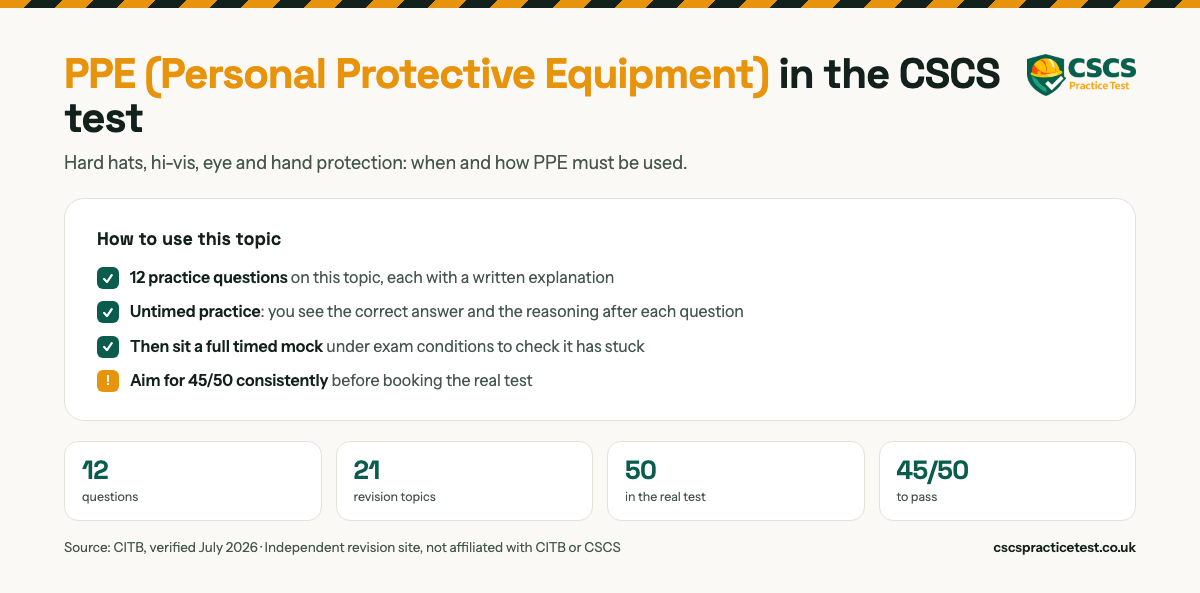
Hard hats, hi-vis, eye and hand protection: when and how PPE must be used.
These questions cover ppe (personal protective equipment)for the CITB Health, Safety and Environment (HS&E) test, the exam UK construction workers pass to get a CSCS card.
PPE (Personal Protective Equipment): practice questions (untimed, instant feedback)
- 50 questions · pass mark 90%
- Untimed practice: you see the correct answer immediately after each question.
- Some questions need more than one answer, and these are clearly marked.
All 50 PPE (Personal Protective Equipment) questions and answers
These are the same 50 questions as the practice test above, written out with the correct answer and the reasoning behind it. Read them through when you want to revise rather than test yourself.
1. At what point should barrier cream be put on the skin?
Answer: Before starting the task
- A) As a first-aid measure
- B) After finishing work
- C) As a substitute when gloves aren't available
- D) Before starting the task (correct answer)
Why: Barrier cream is applied before work to help protect the skin while you work.
2. You are about to use a grinder, cut-off saw, cartridge tool or nail gun. What eye protection is needed?
Answer: Impact-rated goggles or a full face shield
- A) Impact-rated goggles or a full face shield (correct answer)
- B) Basic safety glasses
- C) Everyday reading glasses or sunglasses
- D) Goggles designed for welding
Why: High-energy tools can throw fragments, so impact-resistant goggles or a full face shield are required.
3. What does safety footwear with a protective mid-sole guard against?
Answer: Sharp objects such as nails piercing up through the sole
- A) Blisters in warm, damp conditions
- B) Ankle sprains
- C) Spilt substances burning the sole
- D) Sharp objects such as nails piercing up through the sole (correct answer)
Why: A protective mid-sole stops nails and sharp objects penetrating up through the bottom of the boot.
4. How should a safety helmet be worn to give the most protection?
Answer: Fitted squarely on the head with the harness adjusted to fit
- A) Tipped back so it sits off the forehead
- B) Worn back to front
- C) Balanced loosely on top of the head
- D) Fitted squarely on the head with the harness adjusted to fit (correct answer)
Why: A helmet only protects if it sits squarely on the head with the harness correctly adjusted.
5. In which single situation do you not need to wear head protection on site?
Answer: When in a designated safe area such as the site office
- A) When in a designated safe area such as the site office (correct answer)
- B) When working on your own
- C) When you are self-employed
- D) When the weather is hot
Why: Head protection can be removed only in a designated safe area, such as inside the site office.
6. Which of these statements about personal protective equipment (PPE) is false?
Answer: You have to pay for any loss or damage yourself
- A) You have to pay for any loss or damage yourself (correct answer)
- B) You must tell your supervisor about any loss or damage
- C) You must store it properly when it is not in use
- D) You must use it in the way you were instructed during training
Why: Employers provide PPE free of charge, so paying for loss or damage is not a worker's duty; the others all are.
7. A briefing said an area needs hearing protection, but there is no sign when you arrive. What should you do?
Answer: Wear it as briefed and tell your supervisor the sign is missing
- A) Carry on without it
- B) Carry on without it if the noise seems bearable
- C) Wear the protection you were told to wear
- D) Wear it as briefed and tell your supervisor the sign is missing (correct answer)
Why: Follow the briefing and wear the protection, then report the missing sign.
8. Which of these is NOT personal protective equipment?
Answer: A first-aid kit
- A) A pair of safety goggles
- B) A high-visibility vest
- C) Disposable earplugs
- D) A first-aid kit (correct answer)
Why: A first-aid kit is not PPE: it does not protect the wearer from a hazard.
9. When should PPE be worn on site?
Answer: Whenever the risk assessment says it is needed
- A) Only when a hazard is immediate
- B) Whenever the risk assessment says it is needed (correct answer)
- C) Only in severe weather
- D) At the worker's discretion
Why: Wear PPE whenever the risk assessment identifies the need.
10. What should you do if your PPE is damaged?
Answer: Report it to your supervisor straight away
- A) Keep working until it is convenient to replace
- B) Report it to your supervisor straight away (correct answer)
- C) Repair it yourself with tape
- D) Ignore minor damage
Why: Damaged PPE may not protect you, so report it for replacement immediately.
11. Why must PPE fit properly?
Answer: To give the best protection
- A) To look smarter on the work site
- B) To give the best protection (correct answer)
- C) To make the equipment last longer
- D) To save the employer money on replacement items
Why: Poorly fitting PPE leaves gaps in protection.
12. What matters when choosing hearing protection?
Answer: It is comfortable enough to wear for as long as needed
- A) It matches the uniform
- B) It is comfortable enough to wear for as long as needed (correct answer)
- C) It lets you chat easily anywhere
- D) It is the cheapest option
Why: Hearing protection only works if it is comfortable enough to be worn throughout the exposure.
13. When must an employer provide PPE under regulation 4(1)?
Answer: Where a worker is exposed to risk not adequately controlled by other means
- A) Whenever a worker asks for it, regardless of the risk they are exposed to
- B) Only where the principal contractor has written it into the site rules
- C) Only where the risk assessment shows a risk of a fatal injury occurring
- D) Where a worker is exposed to risk not adequately controlled by other means (correct answer)
Why: Regulation 4(1) requires suitable PPE except where and to the extent the risk has been adequately controlled by other means which are equally or more effective. PPE fills the gap other controls leave.
14. Why is PPE described as the last line of defence?
Answer: Because it is required only where other equally effective means fall short
- A) Because it is the most expensive control measure available to an employer
- B) Because it is only issued once every other control has physically failed
- C) Because it protects the whole workforce rather than the individual wearer
- D) Because it is required only where other equally effective means fall short (correct answer)
Why: The exception in regulation 4(1) means PPE is not required where other means control the risk equally well or better. It protects the wearer only, and only if worn correctly.
15. PPE is not 'suitable' unless it meets certain tests. Which is one of them?
Answer: It is appropriate for the risks, the conditions and the period it is worn
- A) It is appropriate for the risks, the conditions and the period it is worn (correct answer)
- B) It has been bought from a supplier approved by the enforcing authority
- C) It carries a label showing the date on which it was first issued to use
- D) It is identical to the equipment issued to every other worker on the site
Why: Regulation 4(3)(a) requires PPE to be appropriate for the risk or risks involved, the conditions at the place where exposure may occur, and the period for which it is worn.
16. What else does the suitability test in regulation 4(3) take into account?
Answer: Ergonomic requirements and the state of health of the person wearing it
- A) The purchase cost of the equipment measured against the project budget
- B) The number of items that the employer holds in the site store at the time
- C) The preference of the supervisor who is responsible for that particular area
- D) Ergonomic requirements and the state of health of the person wearing it (correct answer)
Why: Regulation 4(3)(b) requires account to be taken of ergonomic requirements, the state of health of the wearer, and the characteristics of their workstation.
17. A hard hat is too large and moves when the wearer bends forward. Is it suitable?
Answer: No. PPE is not suitable unless it is capable of fitting the wearer correctly
- A) Yes, provided the hat itself is undamaged and within its service life
- B) Yes, as long as the wearer has been told to be careful whenever bending down
- C) No, but only if the wearer has previously reported the fit as a problem
- D) No. PPE is not suitable unless it is capable of fitting the wearer correctly (correct answer)
Why: Regulation 4(3)(c) requires PPE to be capable of fitting the wearer correctly, if necessary after adjustment. Fit is part of the legal definition of suitable, not a comfort preference.
18. A worker needs both a hard hat and ear defenders. What does regulation 5 require?
Answer: That the items are compatible and remain effective against both risks
- A) That the worker chooses which of the two items gives the better protection
- B) That the worker wears each item separately at different times of the shift
- C) That the two items are supplied by the same manufacturer as a matched set
- D) That the items are compatible and remain effective against both risks (correct answer)
Why: Regulation 5 requires that where more than one item must be worn at once, the equipment is compatible and continues to be effective against the risks in question.
19. Ear defenders break the seal of a hard hat when worn together. What is the correct response?
Answer: Find a compatible combination that stays effective against both risks
- A) Wear only the hard hat, since head injury is the more serious of the risks
- B) Wear only the defenders, since noise damage is permanent and cumulative
- C) Find a compatible combination that stays effective against both risks (correct answer)
- D) Wear both anyway and accept that each item will be slightly less effective
Why: Regulation 5 does not allow one risk to be traded against another. The duty is to provide a combination that continues to work against both, for example helmet-mounted defenders.
20. What must happen BEFORE an employer chooses any PPE?
Answer: An assessment to determine whether the intended equipment is suitable
- A) A trial period during which the workforce test several different items
- B) A briefing to the workforce about the equipment that will be purchased
- C) A written order placed with a supplier holding the relevant certification
- D) An assessment to determine whether the intended equipment is suitable (correct answer)
Why: Regulation 6(1) requires an assessment before choosing PPE, to determine whether the equipment the employer intends to provide is suitable for the risk.
21. What must the PPE assessment include?
Answer: An assessment of the risks that have not been avoided by other means
- A) An assessment of the risks that have not been avoided by other means (correct answer)
- B) A list of every worker who will be issued with the equipment concerned
- C) A calculation of the total cost of equipping the workforce for the job
- D) A record of the training each worker has already received previously
Why: Regulation 6(2)(a) starts with the risks not avoided by other means, which keeps PPE aimed at the residual risk rather than at every hazard on the site.
22. The PPE assessment must consider risks that the equipment itself may create. Why?
Answer: Because PPE can introduce new hazards such as restricted vision or heat
- A) Because the supplier will not accept liability for any such risks
- B) Because the enforcing authority inspects the assessment for completeness
- C) Because the regulations require every risk on the site to be listed in full
- D) Because PPE can introduce new hazards such as restricted vision or heat (correct answer)
Why: Regulation 6(2)(b) requires the characteristics PPE must have, taking into account any risks which the equipment itself may create. Goggles that mist up can cause the fall they were not aimed at.
23. What standard must PPE be maintained to?
Answer: An efficient state, in efficient working order, and in good repair
- A) An efficient state, in efficient working order, and in good repair (correct answer)
- B) The condition in which it was supplied when it was new from the maker
- C) A standard agreed between the employer and the safety representative
- D) Whatever standard the manufacturer states in the product instructions
Why: Regulation 7 uses the same wording as much of health and safety law: an efficient state, in efficient working order and in good repair, including replacing or cleaning as appropriate.
24. Does maintenance of PPE include cleaning and replacement?
Answer: Yes. Regulation 7 expressly covers replacing or cleaning as appropriate
- A) No, cleaning is always the personal responsibility of the individual wearer
- B) No, replacement only applies where the equipment has actually failed a test
- C) Yes. Regulation 7 expressly covers replacing or cleaning as appropriate (correct answer)
- D) Yes, but only for reusable items and never for disposable equipment
Why: The words including replaced or cleaned as appropriate sit inside the maintenance duty in regulation 7, so a dirty respirator or a worn harness is a maintenance failure.
25. What must a worker be told about the PPE they are given?
Answer: The risks it avoids or limits, and the purpose and manner of its use
- A) Only the price of the equipment and how to obtain a replacement item
- B) Only the name of the manufacturer and the relevant product standard
- C) The risks it avoids or limits, and the purpose and manner of its use (correct answer)
- D) Only the date by which the equipment must be returned to the store
Why: Regulation 9(1) requires information, instruction and training covering the risk or risks the PPE will avoid or limit, and the purpose for which and the manner in which it is to be used.
26. What third thing must the training under regulation 9 cover?
Answer: The action the worker must take to keep the equipment in good repair
- A) The action the worker must take to keep the equipment in good repair (correct answer)
- B) The disciplinary penalty for failing to wear the equipment that is provided
- C) The name of the first-aider responsible for that part of the work site
- D) The procedure for ordering additional equipment from the site store
Why: Regulation 9(1)(c) covers any action to be taken by the worker to ensure the PPE remains in an efficient state, in efficient working order and in good repair.
27. What duty does regulation 10(2) place on the worker?
Answer: To use the PPE in accordance with the training and the instructions given
- A) To use the PPE in accordance with the training and the instructions given (correct answer)
- B) To pay for any equipment that is lost or damaged through carelessness
- C) To inspect the equipment and record the results before every single use
- D) To supply their own equipment wherever the employer's stock has all run out
Why: Regulation 10(2) ties the worker's duty to the training received and the instructions provided under regulation 9. Wearing it wrongly is not compliance.
28. What must a worker do on finding an obvious defect in their PPE?
Answer: Report it to the employer forthwith, meaning without any delay
- A) Repair it themselves before continuing with the task they were given
- B) Continue using it until the end of the shift, then hand it back in
- C) Report it to the employer forthwith, meaning without any delay (correct answer)
- D) Record it in the site accident book at the end of the working week
Why: Regulation 11 requires a worker to report any loss of, or obvious defect in, their PPE forthwith. Forthwith means immediately, not at a convenient point later.
29. What is the employer's duty under regulation 10(1)?
Answer: To take all reasonable steps to ensure the PPE provided is properly used
- A) To take all reasonable steps to ensure the PPE provided is properly used (correct answer)
- B) To watch every worker continuously while the equipment is being worn
- C) To dismiss any worker who is found not to be wearing the equipment issued
- D) To provide a spare set of equipment for every single worker on the work site
Why: Regulation 10(1) requires all reasonable steps to ensure proper use. Issuing the kit and never checking whether it is worn does not meet that.
30. Since April 2022, who is covered by the PPE Regulations?
Answer: Workers, a wider group than employees, following a 2022 amendment
- A) Only directly employed employees with a contract of employment
- B) Workers, a wider group than employees, following a 2022 amendment (correct answer)
- C) Only those workers who have been on the site for more than one month
- D) Only employees and agency staff, but never the genuinely self-employed
Why: The Personal Protective Equipment at Work (Amendment) Regulations 2022 replaced employees with workers throughout, in force 6 April 2022, extending the duties to limb (b) workers.
31. Can an employer charge a worker for the PPE they are required to provide?
Answer: No. The duty is to ensure suitable PPE is provided to the worker
- A) Yes, provided the cost is deducted evenly across several pay periods
- B) Yes, where the worker has lost or damaged a previous set of equipment
- C) No. The duty is to ensure suitable PPE is provided to the worker (correct answer)
- D) No, unless the worker leaves the company within six months of issue
Why: Regulation 4 places the provision duty on the employer, and section 9 of the Health and Safety at Work etc. Act 1974 forbids charging for anything done to meet a statutory requirement.
32. Two risks are present and one item of PPE would control both. What does the law require?
Answer: That the item is suitable for both, and effective against both risks
- A) That two separate items are issued so that each risk has its own control
- B) That the item is suitable for both, and effective against both risks (correct answer)
- C) That the worker selects whichever risk they consider the more serious
- D) That the employer records which of the two risks the item addresses
Why: The suitability test in regulation 4(3) is risk-based, and regulation 5 governs compatibility where more than one item is needed. One item that genuinely covers both is acceptable.
33. Does regulation 4 apply to a relevant self-employed person?
Answer: Yes. They must ensure they are provided with suitable PPE themselves
- A) No, the duties fall only on employers in respect of their own workers
- B) Yes. They must ensure they are provided with suitable PPE themselves (correct answer)
- C) Only where they are working under the direction of a main contractor
- D) Only where they employ at least one other person on the same work
Why: Regulation 4(2) places the equivalent duty on a relevant self-employed person in respect of themselves, with the same exception where other means control the risk.
34. Must information provided under regulation 9 be kept available to workers?
Answer: Yes. The employer must ensure such information is kept available
- A) No, a single briefing at induction discharges the duty completely
- B) No, provided the information was given in writing when PPE was issued
- C) Yes. The employer must ensure such information is kept available (correct answer)
- D) Yes, but only for equipment that protects against a risk of death
Why: Regulation 9(1) requires the employer to ensure the information is kept available to workers, so it has to remain accessible rather than being given once and withdrawn.
35. Eye protection mists up constantly, so the wearer keeps lifting it. What has gone wrong?
Answer: The PPE is not suitable, because it is not effective in those conditions
- A) Nothing, provided that the wearer replaces it whenever they are cutting
- B) The wearer is at fault for not following the instructions given to them
- C) The PPE is not suitable, because it is not effective in those conditions (correct answer)
- D) The employer should issue a second pair so one can be cleaned in turn
Why: Regulation 4(3)(a) requires PPE appropriate for the conditions where exposure occurs, and regulation 6(2)(b) requires the risks the equipment itself creates to be considered. Unusable PPE is not suitable PPE.
36. What does the PPE assessment require in relation to available equipment?
Answer: A comparison of available equipment against the required characteristics
- A) A comparison of available equipment against the required characteristics (correct answer)
- B) A purchase of at least three different makes for the whole workforce to try
- C) A written quotation from three separate suppliers before any purchase
- D) A guarantee from the manufacturer that the equipment will last the whole job
Why: Regulation 6(2)(c) requires comparison of the characteristics of the PPE available with the characteristics the equipment needs to have to be effective.
37. A worker loses their safety glasses on site. What does regulation 11 require?
Answer: That they report the loss to their employer forthwith, without delay
- A) That they buy a replacement pair and reclaim the cost from the employer
- B) That they report the loss to their employer forthwith, without delay (correct answer)
- C) That they record the loss in the site diary at the end of the working shift
- D) That they borrow a spare pair from a colleague and carry on working
Why: Regulation 11 covers loss as well as obvious defect, and requires the report forthwith. The employer cannot replace equipment it does not know is missing.
38. What does 'capable of fitting the wearer correctly' allow for?
Answer: Fitting correctly, if necessary after adjustment has been carried out
- A) Fitting straight from the box with no adjustment of any kind permitted
- B) Fitting correctly, if necessary after adjustment has been carried out (correct answer)
- C) Fitting any adult wearer, since PPE is supplied in one universal size
- D) Fitting only after the wearer has been measured by a qualified fitter
Why: Regulation 4(3)(c) allows for adjustment, which is why harnesses and helmets have adjusters. It does not allow equipment that cannot be made to fit that person.
39. Dust extraction would control a risk as effectively as a mask. What does regulation 4 say?
Answer: PPE is not required to that extent, since other means control the risk
- A) PPE must still be issued in addition, because dust is always a risk
- B) The employer may simply choose whichever option costs the business less
- C) PPE is not required to that extent, since other means control the risk (correct answer)
- D) PPE must be issued first and the extraction fitted at a later stage
Why: Regulation 4(1) contains the exception where and to the extent that the risk has been adequately controlled by other means which are equally or more effective. Engineering control displaces PPE.
40. Whose responsibility is it to ensure PPE remains in good repair day to day?
Answer: The employer maintains it and the worker takes the action they are told
- A) The employer maintains it and the worker takes the action they are told (correct answer)
- B) The worker alone, since they are the only person who wears the equipment
- C) The employer alone, since the worker has no duties under these rules
- D) The supplier, under the warranty that came with the equipment supplied
Why: Regulation 7 places the maintenance duty on the employer, while regulation 9(1)(c) requires the worker to be told what action they must take to keep it serviceable. The duties interlock.
41. What happens to the PPE duty where a policing activity conflicts with it?
Answer: The duty applies so far as is reasonably practicable in that situation
- A) The duty falls away entirely for all police officers on any operation
- B) The duty applies so far as is reasonably practicable in that situation (correct answer)
- C) The duty is transferred to the individual officer rather than the force
- D) The duty is unaffected, since no exception exists in the Regulations
Why: Regulation 4(1A) provides that where compliance would lead to an inevitable conflict with the exercise of police powers or duties, the requirement applies so far as is reasonably practicable.
42. A worker has been trained on a respirator but wears it with the straps loose. Are they complying?
Answer: No. They must use it in accordance with the training they received
- A) Yes, as long as the respirator is on their face during the work
- B) Yes, provided they can still breathe through the filter while working
- C) No. They must use it in accordance with the training they received (correct answer)
- D) No, unless the employer has approved that method of wearing it
Why: Regulation 10(2) requires use in accordance with the training received and the instructions provided. A poor seal means the equipment is not doing the job it was assessed for.
43. Why does the law require PPE to be assessed rather than simply bought?
Answer: Because equipment must match the actual residual risk and the wearer
- A) Because suppliers cannot be trusted to describe their products honestly
- B) Because the assessment fixes the price the employer will pay for it
- C) Because equipment must match the actual residual risk and the wearer (correct answer)
- D) Because the enforcing authority must approve the choice in advance
Why: Regulation 6 links the choice to the risks not avoided by other means, the characteristics needed, and the equipment available. Buying by catalogue skips all three steps.
44. Gloves protect against a chemical but reduce grip when handling loads. What should happen?
Answer: Assess both risks together, since PPE must not create a new problem
- A) Issue the gloves and accept the reduced grip as an unavoidable trade
- B) Withdraw the gloves, because manual handling is the more common risk
- C) Assess both risks together, since PPE must not create a new problem (correct answer)
- D) Let each worker decide whether to wear the gloves for each task
Why: Regulation 6(2)(b) requires the risks the equipment itself may create to be taken into account, and the manual handling schedule asks whether PPE hinders movement. Both point the same way.
45. What does regulation 10(3) require of a relevant self-employed person?
Answer: To make full and proper use of the PPE provided under regulation 4(2)
- A) To make full and proper use of the PPE provided under regulation 4(2) (correct answer)
- B) To keep a written record of every occasion the equipment was worn
- C) To have their equipment inspected monthly by a competent person
- D) To provide equipment to any other worker present on the same work site
Why: Regulation 10(3) mirrors the employee duty, requiring the self-employed person to make full and proper use of PPE provided to them under regulation 4(2).
46. Head protection on construction sites is governed by which regulations now?
Answer: The PPE at Work Regulations, which absorbed head protection in 2013
- A) The Construction (Head Protection) Regulations, still in force today
- B) The PPE at Work Regulations, which absorbed head protection in 2013 (correct answer)
- C) The Work at Height Regulations, because most head injuries are falls
- D) The Management of Health and Safety at Work Regulations exclusively
Why: The Construction (Head Protection) Regulations 1989 were revoked in 2013 and head protection now sits within the general PPE at Work Regulations regime.
47. What is the effect of the 2022 amendment on an agency worker on site?
Answer: It brings them within the PPE duties as a worker rather than employee
- A) It removes them from the scope of the Regulations altogether
- B) It brings them within the PPE duties as a worker rather than employee (correct answer)
- C) It requires them to supply their own protective equipment for the job
- D) It applies only where they have worked more than twelve weeks there
Why: SI 2022/8 substituted worker for employee throughout, in force 6 April 2022, so the provision, maintenance, training and use duties reach limb (b) workers.
48. PPE is issued but no training is given on how to use it. Which duty is breached?
Answer: The duty to provide adequate and appropriate information and training
- A) None, because providing suitable equipment satisfies the Regulations
- B) Only the maintenance duty, since untrained use will damage the item
- C) The duty to provide adequate and appropriate information and training (correct answer)
- D) Only the assessment duty, since training forms part of the assessment
Why: Regulation 9(1) requires information, instruction and training adequate and appropriate to enable the worker to know the risks, the purpose and manner of use, and the upkeep action.
49. Which best summarises the relationship between PPE and other controls?
Answer: PPE covers the risk left over when other equally effective means cannot
- A) PPE and engineering controls are alternatives of equal standing in law
- B) PPE is required first and other controls are added if it proves unequal
- C) PPE covers the risk left over when other equally effective means cannot (correct answer)
- D) PPE is only required where the enforcing authority has demanded it
Why: The exception in regulation 4(1) is the whole relationship in one clause: PPE is required except where and to the extent the risk is adequately controlled by equally or more effective means.
50. A harness is found with a frayed webbing strap. What does the law require?
Answer: It must be reported and must not be used, as it is not in good repair
- A) It may be used for light work until a replacement can be ordered in
- B) It must be reported and must not be used, as it is not in good repair (correct answer)
- C) It may be repaired on site with tape and returned to service at once
- D) It may be used provided that a second harness is worn at the same time
Why: Regulation 7 requires PPE to be maintained in an efficient state and good repair, and regulation 11 requires the worker to report an obvious defect forthwith.
What this topic covers in the CSCS test
PPE is the last line of defence, not the first. It protects only the person wearing it, and only if it fits, is in good condition and is actually worn. The test checks that you know what your employer owes you, what you owe in return, and which type of protection matches which job.
- Where PPE sits in the hierarchy of control, and why it comes last
- Head protection on site, correct fit, and the turban-wearing Sikh exemption
- Eye and face protection for grinders, cut-off saws, cartridge tools and nail guns
- Safety footwear: steel toecaps against dropped objects, mid-sole plates against nails
- Hearing protection, high-visibility clothing and gloves, and why comfort and fit decide whether they work
- Who pays for PPE, and what to do when it is lost, damaged or does not fit
- Barrier cream and skin protection, and what PPE cannot do
Key facts worth memorising
- PPE is always free
- Section 9 of the Health and Safety at Work etc. Act 1974 bars an employer from charging an employee for anything provided to meet a legal requirement, and HSE confirms that includes PPE.
- The hierarchy of control
- HSE ranks controls as elimination, substitution, engineering controls, administrative controls, then PPE, so PPE is the least effective option and the last one to reach for.
- Limb (b) workers since 6 April 2022
- The Personal Protective Equipment at Work (Amendment) Regulations 2022 extended PPE duties to casual and contract-for-service workers, though the change does not cover the genuinely self-employed.
- Toecap and mid-sole do different jobs
- The steel toecap protects against something dropped on the foot; the mid-sole plate stops a nail penetrating up through the sole.
- Head protection law changed in 2013
- The Construction (Head Protection) Regulations 1989 were revoked on 6 April 2013, and head protection on construction sites now falls under the Personal Protective Equipment at Work Regulations 1992.
- The turban exemption
- Section 11 of the Employment Act 1989, as amended by the Deregulation Act 2015, exempts turban-wearing Sikhs from any legal requirement to wear a safety helmet in any workplace. It covers head protection only, and all other PPE still applies.
What people get wrong
If I lose or damage my PPE I pay for the replacement.
You do not. The employer provides, maintains and replaces PPE free of charge. Your duties are to use it as instructed, store it properly and report loss or damage straight away.
Wearing PPE makes a dangerous job safe.
PPE only reduces the harm if everything else fails. It does nothing to the hazard itself, which is why HSE puts it below elimination, substitution and engineering controls.
Safety glasses are enough for a grinder or cut-off saw.
High-energy tools throw fragments at speed. Those tasks need impact-rated goggles or a full face shield.
A first-aid kit is a type of PPE.
PPE is equipment worn or held by a person at work that protects that person against a risk. A first-aid kit treats an injury after it has happened and protects nobody, so it is not PPE.
Answering these questions in the test
PPE questions usually offer one answer that puts a cost or a judgement call on the worker and three that describe genuine duties. The cost answer is the wrong one, because the employer pays. Where a question names a specific tool, match the protection to the energy involved rather than to what people usually wear. If a briefing told you to wear something and there is no sign when you arrive, the right answer is to wear it as briefed and report the missing sign, because the risk assessment sets the requirement and the sign only advertises it. Answers that let you judge whether the hazard feels bad enough today are always wrong.
Background reading
Drilling the questions tells you what you are getting wrong. It does not always tell you why. For this topic that is covered in Types of PPE. What each type protects against, and why PPE sits at the bottom of the hierarchy of controls rather than the top.
Sources
Written from the following. Where a figure could not be verified against one of these, it has been left out rather than approximated. Our sources and methodology explains how we date and re-check them. Spotted something wrong? Report an error and we will fix it.
Topics that come up alongside ppe (personal protective equipment)
Ready for the real thing?
When you are scoring 90% or better here, take a CSCS mock test for Operatives under exam conditions, then how to book the CSCS test.