
CSCS Noise & Vibration (HAVS) Questions
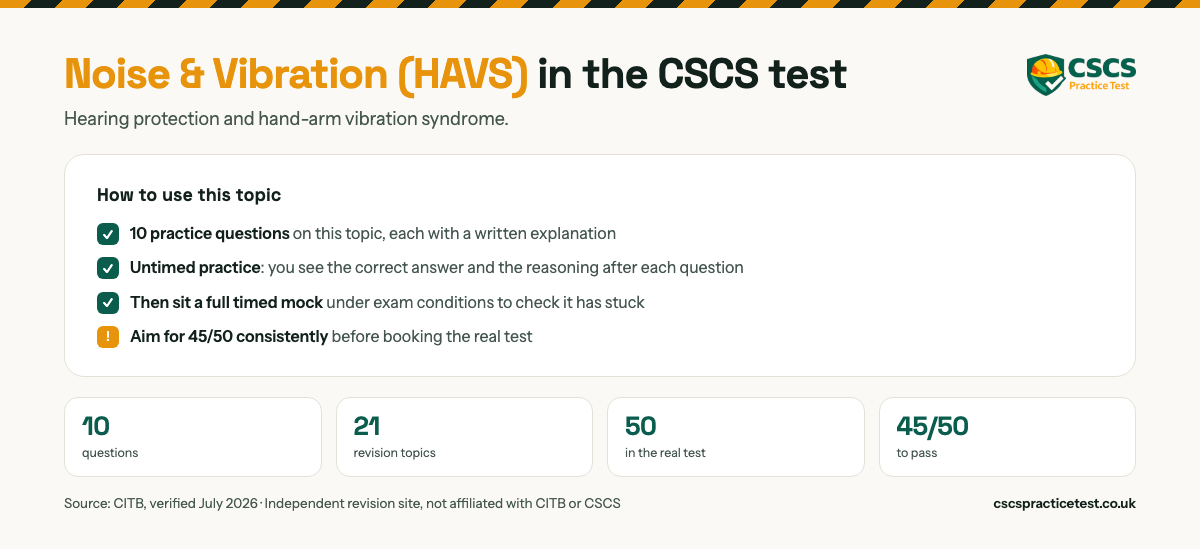
Hearing protection and hand-arm vibration syndrome.
These questions cover noise & vibration (havs)for the CITB Health, Safety and Environment (HS&E) test, the exam UK construction workers pass to get a CSCS card.
Noise & Vibration (HAVS): practice questions (untimed, instant feedback)
- 50 questions · pass mark 90%
- Untimed practice: you see the correct answer immediately after each question.
- Some questions need more than one answer, and these are clearly marked.
All 50 Noise & Vibration (HAVS) questions and answers
These are the same 50 questions as the practice test above, written out with the correct answer and the reasoning behind it. Read them through when you want to revise rather than test yourself.
1. You have been using a vibrating tool and your fingertips start to tingle. What does this tell you?
Answer: You should report the symptoms before they develop further
- A) It is fine; just grip the tool more firmly and carry on with the job
- B) It is fine; loosen your grip and carry on
- C) You can never use a vibrating tool of any kind on the site again
- D) You should report the symptoms before they develop further (correct answer)
Why: Tingling fingertips are an early sign of hand-arm vibration syndrome (HAVS). Report it before permanent damage sets in.
2. If you must use a vibrating tool, even briefly, how can you reduce the risk of hand-arm vibration?
Answer: Avoid gripping the tool too tightly
- A) Apply extra force to the tool as you work
- B) Hold it out at arm's length
- C) Grip it as firmly as you possibly can
- D) Avoid gripping the tool too tightly (correct answer)
Why: A relaxed grip lets the tool do the work and reduces the vibration passing into your hands.
3. How can you lessen the effects of hand-arm vibration when using a vibrating tool?
Answer: Break the work into short spells
- A) Complete the work in one continuous session
- B) Use only one hand at a time
- C) Keep a tight grip on the tool throughout
- D) Break the work into short spells (correct answer)
Why: Working in short spells with breaks limits how long your hands are exposed to vibration.
4. Noise-induced hearing loss usually develops:
Answer: Gradually, over a period of time
- A) Straight away, on the very first exposure
- B) Never
- C) Only in people who already have ear problems
- D) Gradually, over a period of time (correct answer)
Why: Noise damage builds up gradually and is often unnoticed until it is permanent.
5. What two steps help limit the risk of HAVS when using hand-held tools? (Choose two)
Answers: Exercise your hands during breaks and Ease your grip and let the tool do the work
- A) Exercise your hands during breaks (correct answer)
- B) Ease your grip and let the tool do the work (correct answer)
- C) Rest your hands during breaks
- D) Grip harder to dampen the vibration
Why: Keeping the hands warm and moving and easing your grip both help cut HAVS risk.
6. What is the main purpose of ear defenders on site?
Answer: To reduce exposure to harmful noise
- A) To improve hearing
- B) To block out all sound from around the worker
- C) To reduce exposure to harmful noise (correct answer)
- D) To help you chat to other workers nearby
Why: Ear defenders cut exposure to damaging noise levels.
7. Which tool is most likely to cause hand-arm vibration syndrome if misused?
Answer: A power drill
- A) A hammer
- B) A screwdriver
- C) A power drill (correct answer)
- D) A paintbrush
Why: Vibrating power tools such as drills can cause HAVS with prolonged use.
8. At what daily noise level must hearing protection be provided and worn?
Answer: 85 dB
- A) 70 dB
- B) 80 dB
- C) 85 dB (correct answer)
- D) 90 dB
Why: 85 dB is the upper action value at which hearing protection is required.
9. Under the Control of Vibration at Work Regulations 2005, what is the daily exposure action value for hand-arm vibration?
Answer: 2.5 m/s2 A(8), the point at which the employer has to act on the exposure
- A) 2.5 m/s2 A(8), the point at which the employer has to act on the exposure (correct answer)
- B) 5 m/s2 A(8), which is the level that exposure must not be allowed to go above
- C) 1 m/s2 A(8), averaged across all the tools used over the whole working week
- D) 7.5 m/s2 A(8), which applies only to tools held for more than four hours a day
Why: Regulation 4(1)(b) sets the daily exposure action value at 2.5 m/s2 A(8) and regulation 4(1)(a) sets the daily exposure limit value at 5 m/s2 A(8). Option B states the limit value, which is a real figure but answers a different question. A(8) means the exposure averaged over an eight hour day, which is why hand-arm vibration is managed as a daily figure rather than a weekly or annual one.
10. Which of these does NOT help reduce noise exposure?
Answer: Increasing how long workers are exposed
- A) Using quieter, more modern equipment on site
- B) Increasing how long workers are exposed (correct answer)
- C) Fitting barriers or screens around the work
- D) Providing hearing protection
Why: Longer exposure increases risk, the opposite of a control.
11. What is the lower exposure action value for daily personal noise exposure?
Answer: 80 dB A-weighted, the point at which duties begin to apply
- A) 90 dB A-weighted, an older figure no longer used in law
- B) 85 dB A-weighted, which is the upper exposure action value
- C) 87 dB A-weighted, which is the exposure limit value itself
- D) 80 dB A-weighted, the point at which duties begin to apply (correct answer)
Why: Regulation 4(1) sets the lower exposure action values as 80 dB(A) daily or weekly personal noise exposure and 135 dB(C) peak sound pressure.
12. What is the upper exposure action value for daily personal noise exposure?
Answer: 85 dB A-weighted, above which a control programme is required
- A) 80 dB A-weighted, which is the lower exposure action value
- B) 140 dB C-weighted, which is a peak sound pressure figure
- C) 87 dB A-weighted, which is the exposure limit value in law
- D) 85 dB A-weighted, above which a control programme is required (correct answer)
Why: Regulation 4(2) sets the upper exposure action values as 85 dB(A) daily or weekly and 137 dB(C) peak sound pressure.
13. What is the exposure limit value for daily personal noise exposure?
Answer: 87 dB A-weighted, which must not be exceeded by any employee
- A) 80 dB A-weighted, at which protectors must be made available
- B) 85 dB A-weighted, at which a hearing protection zone is needed
- C) 87 dB A-weighted, which must not be exceeded by any employee (correct answer)
- D) 135 dB C-weighted, which is a peak sound pressure figure
Why: Regulation 4(3) sets the exposure limit values as 87 dB(A) daily or weekly and 140 dB(C) peak sound pressure.
14. What is the peak sound pressure figure for the lower exposure action value?
Answer: 135 dB C-weighted, paired with the 80 dB A-weighted figure
- A) 135 dB C-weighted, paired with the 80 dB A-weighted figure (correct answer)
- B) 137 dB C-weighted, which belongs to the upper action value
- C) 140 dB C-weighted, which is the peak exposure limit value
- D) 80 dB C-weighted, matching the A-weighted daily figure
Why: Regulation 4(1)(b) pairs a peak sound pressure of 135 dB(C) with the 80 dB(A) daily or weekly figure at the lower action value.
15. When must hearing protection be made available on request?
Answer: Where exposure is likely to be at or above the lower action value
- A) Where exposure is likely to be at or above the lower action value (correct answer)
- B) Where exposure is likely to be at or above the upper action value
- C) Only where the exposure limit value has already been exceeded
- D) On every construction site, regardless of the noise levels present
Why: Regulation 7(1) requires personal hearing protectors to be made available upon request to employees likely to be exposed at or above a lower exposure action value.
16. When must the employer actually provide hearing protection rather than offer it?
Answer: Where the employer cannot reduce noise below the upper action value
- A) Where any employee asks for it, at any noise level at all
- B) Only during work that lasts longer than four hours in a shift
- C) Only after the exposure limit value has been exceeded on site
- D) Where the employer cannot reduce noise below the upper action value (correct answer)
Why: Regulation 7(2) requires provision where the employer is unable by other means to reduce exposure below an upper exposure action value.
17. When must an area be designated a Hearing Protection Zone?
Answer: Where exposure is likely to be at or above the upper action value
- A) Where exposure is likely to be at or above the upper action value (correct answer)
- B) Where exposure is likely to be at or above the lower action value
- C) Wherever any powered tool is being used anywhere on the site
- D) Only where the exposure limit value is exceeded in that area
Why: Regulation 7(3) requires the employer to designate the area a Hearing Protection Zone where an employee is likely to be exposed at or above an upper exposure action value.
18. Does hearing protection count towards compliance with the exposure action values?
Answer: No. It counts for the limit values but not for the action values
- A) Yes, protection is taken into account at every level in the Regulations
- B) No, protection is never taken into account anywhere in the Regulations
- C) Yes, but only where the protectors have been face fit tested
- D) No. It counts for the limit values but not for the action values (correct answer)
Why: Regulation 4(5) allows account to be taken of hearing protectors when applying the exposure limit values, but expressly not when applying the lower and upper action values.
19. Why does that distinction in regulation 4(5) matter in practice?
Answer: Because it stops protectors being used to argue the duties do not apply
- A) Because it means protectors can be used instead of reducing noise
- B) Because action values are measured on the noise reaching the ear itself
- C) Because it stops protectors being used to argue the duties do not apply (correct answer)
- D) Because it makes the exposure limit value impossible to exceed at all
Why: The action values are assessed on the noise the worker is exposed to, not on what gets through the protector. Otherwise issuing muffs would switch off the duty to control noise.
20. What is the first duty in regulation 6 of the Noise Regulations?
Answer: To eliminate the risk at source, or reduce it as low as practicable
- A) To issue hearing protection to everyone working in the area
- B) To measure the noise level at the start of every working shift
- C) To eliminate the risk at source, or reduce it as low as practicable (correct answer)
- D) To designate the whole site as a hearing protection zone
Why: Regulation 6(1) requires risk from noise exposure to be either eliminated at source or, where that is not reasonably practicable, reduced to as low a level as is reasonably practicable.
21. Above the upper action value, what must the control programme exclude?
Answer: The provision of personal hearing protectors as a measure
- A) Job rotation between noisy and quieter tasks during the shift
- B) Any change to the working hours of the employees involved
- C) Any measure that would require capital expenditure by the employer
- D) The provision of personal hearing protectors as a measure (correct answer)
Why: Regulation 6(2) requires a programme of organisational and technical measures excluding the provision of personal hearing protectors. Protection is not a substitute for control.
22. What must the employer's noise control actions be based on?
Answer: The general principles of prevention in the Management Regulations
- A) The general principles of prevention in the Management Regulations (correct answer)
- B) The manufacturer's published noise data for each tool used on the site
- C) The preference of the workforce for particular control methods
- D) The cost of each measure compared against the project budget
Why: Regulation 6(3) requires the actions taken under paragraphs (1) and (2) to be based on the general principles of prevention set out in Schedule 1 to the Management Regulations.
23. When may weekly rather than daily personal noise exposure be used?
Answer: Where exposure varies markedly from one day to the next
- A) Whenever the employer finds it more convenient to calculate
- B) Only where the exposure limit value has never been exceeded
- C) Only where the employees work fewer than five days a week
- D) Where exposure varies markedly from one day to the next (correct answer)
Why: Regulation 4(4) permits weekly personal noise exposure in place of daily where the exposure of an employee to noise varies markedly from day to day.
24. What is the daily exposure action value for hand-arm vibration?
Answer: 2.5 metres per second squared A(8), where the duties begin
- A) 2.5 metres per second squared A(8), where the duties begin (correct answer)
- B) 5 metres per second squared A(8), which is the limit value
- C) 0.5 metres per second squared A(8), a whole body figure
- D) 1.15 metres per second squared A(8), a whole body figure
Why: Regulation 4(1)(b) of the Vibration Regulations sets the hand-arm daily exposure action value at 2.5 m/s squared A(8).
25. What is the daily exposure limit value for hand-arm vibration?
Answer: 5 metres per second squared A(8), which must not be exceeded
- A) 2.5 metres per second squared A(8), the action value figure
- B) 1.15 metres per second squared A(8), a whole body figure
- C) 0.5 metres per second squared A(8), which is a whole body figure
- D) 5 metres per second squared A(8), which must not be exceeded (correct answer)
Why: Regulation 4(1)(a) sets the hand-arm daily exposure limit value at 5 m/s squared A(8).
26. What is the daily exposure action value for whole body vibration?
Answer: 0.5 metres per second squared A(8), where duties begin
- A) 0.5 metres per second squared A(8), where duties begin (correct answer)
- B) 1.15 metres per second squared A(8), the limit value figure
- C) 2.5 metres per second squared A(8), which is a hand-arm figure
- D) 5 metres per second squared A(8), which is a hand-arm figure
Why: Regulation 4(2)(b) sets the whole body daily exposure action value at 0.5 m/s squared A(8).
27. What is the daily exposure limit value for whole body vibration?
Answer: 1.15 metres per second squared A(8), which must not be exceeded
- A) 0.5 metres per second squared A(8), the action value figure
- B) 5 metres per second squared A(8), a hand-arm figure
- C) 2.5 metres per second squared A(8), a hand-arm figure
- D) 1.15 metres per second squared A(8), which must not be exceeded (correct answer)
Why: Regulation 4(2)(a) sets the whole body daily exposure limit value at 1.15 m/s squared A(8).
28. What is the first duty in regulation 6 of the Vibration Regulations?
Answer: To eliminate risk at source, or reduce it as low as practicable
- A) To issue anti-vibration gloves to every operator on the site
- B) To limit each operator to two hours of tool use each shift
- C) To eliminate risk at source, or reduce it as low as practicable (correct answer)
- D) To measure the vibration output of every tool before it is used
Why: Regulation 6(1) mirrors the noise duty: eliminate risk at source or, where that is not reasonably practicable, reduce it to as low a level as is reasonably practicable.
29. When must a programme of measures be established under the Vibration Regulations?
Answer: Where an exposure action value is likely to be reached or exceeded
- A) Where an exposure action value is likely to be reached or exceeded (correct answer)
- B) Only once the exposure limit value has actually been exceeded
- C) On every site where any powered hand tool is being used at all
- D) Only where an operator has reported symptoms in their hands
Why: Regulation 6(2) requires the programme where elimination at source is not reasonably practicable and an exposure action value is likely to be reached or exceeded.
30. What condition is caused by long term exposure to hand-arm vibration?
Answer: Hand-arm vibration syndrome, affecting nerves, blood vessels and joints
- A) Occupational asthma, which affects the airways and the lungs
- B) Occupational dermatitis, which affects the skin of the hands
- C) Hand-arm vibration syndrome, affecting nerves, blood vessels and joints (correct answer)
- D) Noise induced hearing loss, which affects the inner ear only
Why: HAVS covers vibration white finger and nerve and joint damage. It is progressive and, once established, permanent, which is why the action value triggers duties early.
31. Which of these is the best way to reduce hand-arm vibration exposure?
Answer: Use a lower vibration tool or a method that avoids the tool
- A) Issue anti-vibration gloves to everyone using powered tools
- B) Tell operators to grip the tool as tightly as they possibly can
- C) Use a lower vibration tool or a method that avoids the tool (correct answer)
- D) Rotate operators so each one uses the tool for a longer period
Why: Regulation 6(1) puts elimination at source first. Selecting lower vibration equipment or a different method reduces the exposure itself rather than managing its effects.
32. Anti-vibration gloves are issued. Do they solve the problem?
Answer: No. Elimination and reduction at source come first in the hierarchy
- A) Yes, gloves are the recognised control measure for vibration
- B) Yes, provided they carry a marking showing the standard met
- C) No. Elimination and reduction at source come first in the hierarchy (correct answer)
- D) No, unless they are worn together with hearing protection too
Why: Regulation 6 requires elimination or reduction at source, then a programme of organisational and technical measures. Gloves do not reliably reduce the vibration reaching the hand.
33. Noise levels mean people must shout to be heard two metres apart. What does that suggest?
Answer: That noise is around the lower action value and needs assessing
- A) That noise is around the lower action value and needs assessing (correct answer)
- B) That noise is definitely below any of the action values
- C) That hearing protection alone will bring the site into compliance
- D) That the exposure limit value has certainly been exceeded
Why: Difficulty holding a conversation is the classic rule of thumb that noise may be approaching the action values, which triggers assessment under the Regulations.
34. Which of these is an organisational measure for controlling noise?
Answer: Limiting the time employees spend in the noisy area each day
- A) Fitting a silencer to the exhaust of a compressor on the site
- B) Issuing ear defenders to everyone entering the work area
- C) Limiting the time employees spend in the noisy area each day (correct answer)
- D) Enclosing a noisy machine within an acoustic housing unit
Why: Regulation 6(2) calls for organisational and technical measures. Limiting duration is organisational; silencers and enclosures are technical; hearing protectors are excluded from the programme.
35. What does A-weighted mean in the noise exposure values?
Answer: A measurement adjusted to reflect how human hearing responds
- A) A measurement adjusted to reflect how human hearing responds (correct answer)
- B) A measurement taken at the start of the working shift only
- C) A measurement of the highest sound pressure in the shift
- D) A measurement taken with hearing protection actually being worn
Why: The A-weighting adjusts the measurement to the sensitivity of human hearing. C-weighting is used for peak sound pressure, which is why the two figures differ.
36. What does the peak sound pressure value protect against?
Answer: Instant damage from a single very loud impulsive sound
- A) Gradual hearing loss built up over many years of exposure
- B) The cumulative effect of noise across a whole working week
- C) Instant damage from a single very loud impulsive sound (correct answer)
- D) The discomfort caused by working near a continuous noise
Why: The C-weighted peak figures at 135, 137 and 140 dB address sudden impulsive noise such as cartridge tools, which can damage hearing in a single event.
37. A hearing protection zone has been designated. What follows?
Answer: The zone must be marked and protection worn within it
- A) Entry is restricted to those who have had a hearing test
- B) The zone must be marked and protection worn within it (correct answer)
- C) The zone must be closed to all workers during quiet periods
- D) The zone must be re-measured at the start of every shift
Why: Regulation 7(3) requires the area to be designated a Hearing Protection Zone, demarcated and identified, with hearing protection worn by those entering it.
38. Whole body vibration is most commonly a risk for which workers?
Answer: Drivers and operators of plant and site vehicles
- A) Operatives using breakers, grinders and other hand tools
- B) Drivers and operators of plant and site vehicles (correct answer)
- C) Workers using cartridge operated fixing tools indoors
- D) Workers who spend most of the shift on foot on the site
Why: Whole body vibration is transmitted through a seat or floor, so it affects plant and vehicle operators. Hand tools transmit hand-arm vibration instead.
39. The Noise Regulations and the Vibration Regulations were both made in 2005. Which statement about when they came into force is correct?
Answer: The Vibration Regulations came into force in July 2005, the Noise Regulations in April 2006
- A) Both of them came into force on the very same day in July 2005, six months after being made
- B) The Vibration Regulations came into force in July 2005, the Noise Regulations in April 2006 (correct answer)
- C) Both of them came into force together in April 2006, a full twelve months after being made
- D) The Noise Regulations came into force in July 2005 and the Vibration Regulations in April 2006
Why: Regulation 1 of the Control of Vibration at Work Regulations 2005 sets commencement at 6 July 2005. Regulation 1 of the Control of Noise at Work Regulations 2005 sets it at 6 April 2006, and at 6 April 2008 for the music and entertainment sectors. Both instruments were made in 2005, but only the vibration duties began in that year. Being made and coming into force are different dates.
40. Which noise control measure is highest in the hierarchy?
Answer: Choosing a quieter work method or quieter equipment
- A) Providing ear defenders rated for the noise level present
- B) Designating the area as a hearing protection zone
- C) Choosing a quieter work method or quieter equipment (correct answer)
- D) Rotating staff so exposure is shared between more people
Why: Regulation 6(1) requires elimination at source first. Choosing a quieter method removes the noise rather than managing exposure to it.
41. Exposure is measured at 84 dB(A) daily. Which duties are triggered?
Answer: Those at the lower action value, since 84 exceeds 80 dB(A)
- A) None, because the figure is below the lower action value
- B) Those at the lower action value, since 84 exceeds 80 dB(A) (correct answer)
- C) Those at the upper action value, since 84 is close to 85
- D) Those at the exposure limit value, since 84 is already above 80
Why: At 84 dB(A) the lower action value of 80 dB(A) is exceeded but the upper value of 85 dB(A) is not, so protectors must be made available on request.
42. Exposure is measured at 88 dB(A) daily with no protection worn. What is the position?
Answer: The exposure limit value is exceeded and action is required
- A) It is acceptable provided ear defenders are available on request
- B) The exposure limit value is exceeded and action is required (correct answer)
- C) It is acceptable because the limit applies only to peak noise
- D) It is acceptable provided the exposure lasts under four hours
Why: The exposure limit value is 87 dB(A). Regulation 4(5) allows protectors to be taken into account for the limit values, so protection worn correctly may bring it within the limit.
43. Why does the law set action values below the limit value?
Answer: So that control action starts before the limit is reached
- A) Because the limit value applies only to peak sound pressure
- B) So that control action starts before the limit is reached (correct answer)
- C) Because measurement equipment cannot read above the limit
- D) Because the limit value applies only to whole body vibration
Why: The staged structure means duties begin at 80 dB(A), strengthen at 85 dB(A), and the 87 dB(A) limit must not be exceeded at all. Control is preventive rather than reactive.
44. Which tool is most likely to create a hand-arm vibration risk?
Answer: A handheld breaker used for concrete demolition work
- A) A hand held brush used for sweeping the working area clean
- B) A handheld breaker used for concrete demolition work (correct answer)
- C) A tape measure used for setting out the edges of the work area
- D) A spirit level used for checking that surfaces are true
Why: Breakers, grinders, needle guns and hammer drills are the classic hand-arm vibration sources. Regulation 4 sets the action value at 2.5 and the limit at 5 m/s squared A(8).
45. What does A(8) mean in the vibration exposure values?
Answer: The vibration measured over an eight hour reference period
- A) The vibration measured over an eight hour reference period (correct answer)
- B) The vibration measured at eight different points on the tool
- C) The average vibration across eight separate working days
- D) The vibration measured with eight operators using the tool
Why: A(8) is the daily exposure normalised to an eight hour reference period, which allows short bursts on a high vibration tool to be compared with longer use of a lower one.
46. Exposure to a high vibration tool is short. Does that remove the risk?
Answer: No. A high magnitude tool can reach the action value quickly
- A) Yes, short exposures never reach the daily action value
- B) No. A high magnitude tool can reach the action value quickly (correct answer)
- C) Yes, provided the operator takes a break after each use
- D) No, but only in those cases where the operator has existing symptoms
Why: Because A(8) combines magnitude and duration, a very high vibration tool can reach the 2.5 action value in a short time, so duration alone is not a safeguard.
47. Which statement about hearing protection is correct?
Answer: It sits below elimination and reduction at source in the hierarchy
- A) It is the primary control measure required by the Regulations
- B) It sits below elimination and reduction at source in the hierarchy (correct answer)
- C) It removes the need to assess noise levels in the workplace
- D) It is only required once the exposure limit value is exceeded
Why: Regulation 6(2) expressly excludes protectors from the control programme required above the upper action value, which places them below engineering and organisational control.
48. Two workers share a noisy task by taking turns. What kind of measure is that?
Answer: An organisational measure, because it changes how work is arranged
- A) A technical measure, because it changes the equipment used
- B) An organisational measure, because it changes how work is arranged (correct answer)
- C) Personal protection, because it protects the individual worker
- D) Elimination at source, because the noise itself is removed
Why: Job rotation changes the organisation of the work rather than the noise, so it is an organisational measure within the regulation 6(2) programme.
49. What should happen if an operator reports tingling or numbness in the fingers?
Answer: The symptoms should be acted on as possible early HAVS
- A) Nothing, since these symptoms resolve on their own with rest
- B) The symptoms should be acted on as possible early HAVS (correct answer)
- C) The operator should be issued with thicker gloves to wear
- D) The operator should be moved to a higher vibration tool
Why: Early symptoms are the point at which damage can still be limited. Regulation 6 requires exposure to be reduced as low as reasonably practicable, and health surveillance duties also apply.
50. Which is the correct order of noise exposure values, lowest to highest?
Answer: 80 dB(A), then 85 dB(A), then 87 dB(A) as the limit
- A) 80 dB(A), then 85 dB(A), then 87 dB(A) as the limit (correct answer)
- B) 85 dB(A), then 87 dB(A), then 90 dB(A) as the limit
- C) 87 dB(A), then 85 dB(A), then 80 dB(A) as the limit
- D) 80 dB(A), then 87 dB(A), then 135 dB(A) as the limit
Why: Lower action value 80 dB(A), upper action value 85 dB(A), exposure limit value 87 dB(A). The C-weighted peaks run 135, 137 and 140 dB alongside them.
What this topic covers in the CSCS test
Noise and vibration both cause damage that builds slowly and cannot be undone. You will not feel your hearing going, and the first signs of hand-arm vibration syndrome (HAVS) are easy to dismiss as cold hands. Two sets of regulations from 2005 set the numbers, and the test expects you to know them and to know what to do when a symptom appears.
- The two noise action values and the exposure limit value
- When hearing protection must be offered, when it must be worn, and how hearing protection zones are signed
- How noise-induced hearing loss and tinnitus develop
- The exposure action value and limit value for hand-arm vibration
- Early symptoms of HAVS and your duty to report them
- Cutting exposure: quieter tools, less trigger time, breaks, warm hands, a relaxed grip
- Health surveillance, and why a confirmed case of HAVS is reportable
Key facts worth memorising
- Lower action value: 80 dB(A)
- At 80 dB(A) daily or weekly, or a peak of 135 dB(C), your employer must assess the risk, train you, and provide hearing protection to anyone who asks.
- Upper action value: 85 dB(A)
- At 85 dB(A), or a peak of 137 dB(C), hearing protection must be provided and worn, and hearing protection zones must be marked with signs.
- Exposure limit value: 87 dB(A)
- 87 dB(A), or a peak of 140 dB(C), must not be exceeded, and it is the only one of the three measured taking account of the protection your protectors give.
- The two metre rule of thumb
- HSE says you probably have a noise problem if people must raise their voices to talk about 2 metres apart, or use noisy powered tools for more than half an hour a day.
- HAVS values: 2.5 and 5.0 m/s2 A(8)
- The exposure action value is 2.5 m/s2 A(8), at which controls must be brought in, and the exposure limit value of 5.0 m/s2 A(8) must not be exceeded.
- Early HAVS symptoms
- Tingling and numbness in the fingers, losing the feel of things, weaker grip, and fingers going white then turning red and painful as they recover.
What people get wrong
Ear defenders deal with the noise problem.
Hearing protection is a last resort. Noise must be reduced by other means first, and HSE warns that taking protectors off for even a few minutes in a noisy area considerably lowers the protection you get.
Anti-vibration gloves protect you from HAVS.
HSE says gloves can be used to keep hands warm, which helps circulation, but should not be relied on for protection from vibration. Less trigger time and a lower-vibration tool are what cut exposure.
Tingling fingers after using a breaker are normal and wear off.
That is an early sign of HAVS. Report it. Symptoms usually worsen with continued exposure and may become permanent, and a confirmed case must be reported to the enforcing authority.
85 dB is the legal limit for noise.
85 dB(A) is the upper action value, where protection must be worn. The ceiling is the exposure limit value of 87 dB(A), and there is a lower action value at 80 dB(A).
Answering these questions in the test
Learn 80, 85 and 87 as a sequence: assess and offer protection at 80, enforce it at 85, never exceed 87. Behaviour questions describe a symptom or a task, and the right answer is the one that cuts the exposure or reports the problem, never the one that carries on. Do not let the two halves of the topic blur together. Noise damages hearing and is measured in decibels; vibration damages hands and is controlled by trigger time.
Sources
Written from the following. Where a figure could not be verified against one of these, it has been left out rather than approximated. Our sources and methodology explains how we date and re-check them. Spotted something wrong? Report an error and we will fix it.
- hse.gov.uk/noise/regulations.htm
- hse.gov.uk/noise/employers.htm
- hse.gov.uk/noise/advice-overview.htm
- hse.gov.uk/noise/hearingprotection.htm
- legislation.gov.uk/uksi/2005/1643/regulation/4/made
- hse.gov.uk/vibration/hav/regulations.htm
- hse.gov.uk/vibration/hav/advice-to-employers.htm
- hse.gov.uk/vibration/hav/protect.htm
- legislation.gov.uk/uksi/2005/1093/contents/made
Topics that come up alongside noise & vibration (havs)
Ready for the real thing?
When you are scoring 90% or better here, take a CSCS mock test for Operatives under exam conditions, then how to book the CSCS test.