
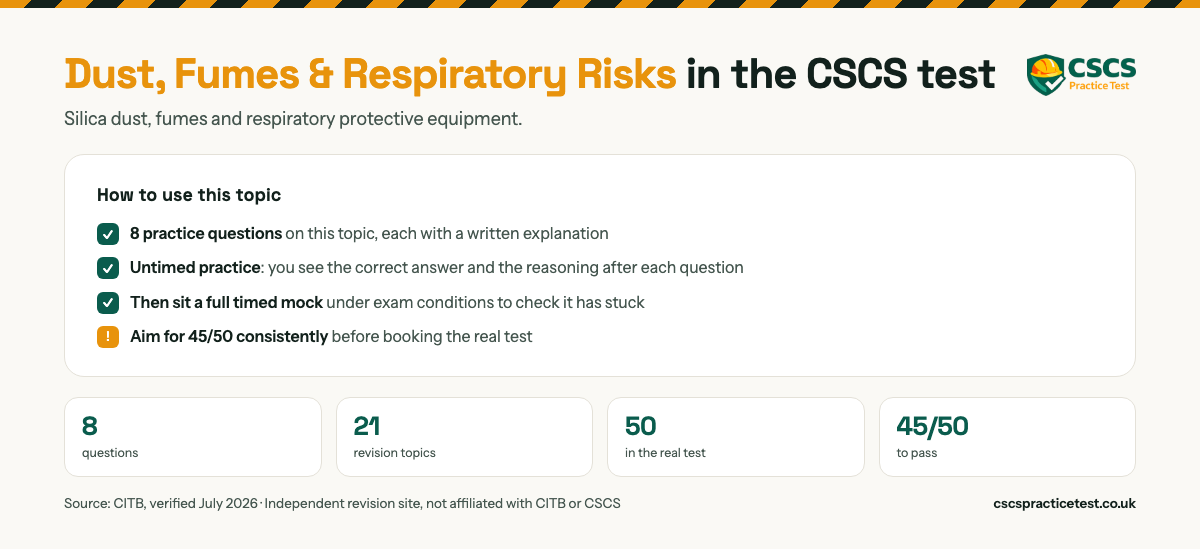
CSCS Dust, Fumes & Respiratory Risks Questions
Silica dust, fumes and respiratory protective equipment.
These questions cover dust, fumes & respiratory risksfor the CITB Health, Safety and Environment (HS&E) test, the exam UK construction workers pass to get a CSCS card.
Dust, Fumes & Respiratory Risks: practice questions (untimed, instant feedback)
- 50 questions · pass mark 90%
- Untimed practice: you see the correct answer immediately after each question.
- Some questions need more than one answer, and these are clearly marked.
All 50 Dust, Fumes & Respiratory Risks questions and answers
These are the same 50 questions as the practice test above, written out with the correct answer and the reasoning behind it. Read them through when you want to revise rather than test yourself.
1. When cutting or grinding with a power tool, why must the dust be captured rather than left to enter the air?
Answer: Most such dust is harmful if it is breathed in
- A) Most such dust is harmful if it is breathed in (correct answer)
- B) The tool runs faster and cooler with dust extraction
- C) To save time on cleaning up the working area afterwards
- D) It removes the need for a machine guard
Why: Construction dusts such as silica are harmful to breathe, so they must be collected at source.
2. What can bring on occupational asthma?
Answer: Inhaling harmful dust, fumes or vapours
- A) Inhaling harmful dust, fumes or vapours (correct answer)
- B) Being exposed to loud noise over a long period
- C) Contact with rat urine
- D) Skin contact with a hazardous substance
Why: Occupational asthma is caused by breathing in respiratory sensitisers: harmful dust, fumes or vapours.
3. Which of these best describes a 'respiratory sensitiser'?
Answer: A type of harmful dust or fume
- A) A type of harmful dust or fume (correct answer)
- B) An item of respiratory protective equipment
- C) A prescribed medical device for breathing problems
- D) The person responsible for protecting respiratory health
Why: A respiratory sensitiser is a harmful dust or fume that can trigger asthma when breathed in.
4. What is the main purpose of respiratory protective equipment (RPE)?
Answer: To stop the wearer breathing in harmful substances
- A) To improve visibility
- B) To add comfort for the wearer during a long working shift
- C) To keep dust out of the wearer's eyes and off the face
- D) To stop the wearer breathing in harmful substances (correct answer)
Why: RPE protects the wearer from inhaling harmful dust, fumes and vapours.
5. When should a disposable dust mask be replaced?
Answer: When it is damaged or hard to breathe through
- A) After two weeks
- B) When it is damaged or hard to breathe through (correct answer)
- C) Once a month, whatever condition the mask is actually in
- D) After each shift regardless of how it has been used
Why: Replace a disposable mask once it is damaged or breathing through it becomes difficult.
6. What is a limitation of a dust mask as RPE?
Answer: It cannot filter gases or vapours
- A) It protects the eyes but not the lungs
- B) It cannot filter gases or vapours (correct answer)
- C) It is reusable for as long as it stays clean
- D) It is expensive
Why: Dust masks stop particles only. They do not filter gases or vapours.
7. What can happen if you don't wear RPE when working with asbestos?
Answer: Lung diseases such as asbestosis
- A) Hearing loss
- B) Skin cancer affecting the hands and arms
- C) Lung diseases such as asbestosis (correct answer)
- D) Digestive problems such as stomach pain
Why: Breathing asbestos fibres can cause asbestosis and mesothelioma.
8. An RPE with a P3 filter protects against what?
Answer: High levels of fine dust and mist
- A) High levels of fine dust and mist (correct answer)
- B) Only large particles
- C) Gases and vapours
- D) Noise
Why: A P3 filter handles high levels of fine, including toxic, dust and mist.
9. How often must local exhaust ventilation plant be thoroughly examined and tested?
Answer: At least once every fourteen months, unless Schedule 4 sets shorter
- A) Once every twelve months, on the anniversary of installation
- B) Only when the operator notices that extraction has weakened
- C) Once every three years, or whenever a fault is first reported
- D) At least once every fourteen months, unless Schedule 4 sets shorter (correct answer)
Why: Regulation 9(2)(a) sets at least once every 14 months for LEV, with shorter intervals for the processes specified in Schedule 4.
10. What condition must engineering controls and PPE be maintained in under COSHH?
Answer: Efficient state, efficient working order, good repair and clean
- A) Efficient state, efficient working order, good repair and clean (correct answer)
- B) The same condition as when the equipment was first purchased
- C) Whatever condition the manufacturer's handbook specifies for it
- D) A condition agreed between the employer and the safety representative
Why: Regulation 9(1)(a) adds in a clean condition to the usual formula, which matters for respirators and filters where contamination is the failure mode.
11. What does COSHH require for non-disposable respiratory protective equipment?
Answer: That it is thoroughly examined and, where appropriate, tested
- A) That it is replaced with a new item every six months without fail
- B) That it is stored in the site office between each period of use
- C) That it is issued only to workers who have passed a lung function test
- D) That it is thoroughly examined and, where appropriate, tested (correct answer)
Why: Regulation 9(3) requires thorough examination and, where appropriate, testing of RPE other than disposable RPE, at suitable intervals.
12. What records must be kept about examinations of control measures?
Answer: A suitable record of the examinations, tests and any repairs
- A) Only the date on which each item of equipment was purchased
- B) Only a note in the site diary that the check was completed
- C) Only the name of the person who carried out the examination
- D) A suitable record of the examinations, tests and any repairs (correct answer)
Why: Regulation 9(4) requires a suitable record of the examinations and tests under paragraphs (2) and (3), and of repairs carried out as a result of them.
13. When must exposure monitoring be carried out under regulation 10?
Answer: Where the risk assessment shows it is needed to maintain control
- A) On every site where any dust at all is generated by the work
- B) Only where the enforcing authority has served a notice requiring it
- C) Only after a worker has reported breathing difficulties at the workplace
- D) Where the risk assessment shows it is needed to maintain control (correct answer)
Why: Regulation 10(1) triggers monitoring where the risk assessment indicates it is requisite for maintaining adequate control or otherwise for protecting health.
14. How often must monitoring under regulation 10 take place?
Answer: At regular intervals, and when any change may affect exposure
- A) Once at the start of the project and once at the end of it
- B) Only when a new substance is introduced onto the work site
- C) At regular intervals, and when any change may affect exposure (correct answer)
- D) Every calendar month for the whole duration of the project
Why: Regulation 10(3) requires monitoring at regular intervals and when any change occurs which may affect the exposure.
15. What duty does regulation 8 place on the employee?
Answer: To make full and proper use of the control measures provided
- A) To buy replacement filters for the respirator they have been issued
- B) To monitor their personal exposure and record it at each shift end
- C) To carry out their own assessment of the dust risk before starting
- D) To make full and proper use of the control measures provided (correct answer)
Why: Regulation 8(2) requires full and proper use, returning the item to any accommodation provided for it, and reporting any defect forthwith.
16. A worker finds a split in the hose of an extraction unit. What does COSHH require?
Answer: Report the defect to the employer forthwith, without delay
- A) Continue working and mention it at the next toolbox talk
- B) Tape the split and carry on until the job has been finished
- C) Report the defect to the employer forthwith, without delay (correct answer)
- D) Switch the unit off and work without extraction for that day
Why: Regulation 8(2)(b) requires the employee to report a discovered defect forthwith. Regulation 9(1)(a) then requires the employer to restore it to efficient working order.
17. Why is cutting paving with a disc a serious respiratory risk?
Answer: Because it produces respirable crystalline silica from the material
- A) Because the noise of the disc masks the sound of approaching plant
- B) Because the dust settles and makes the working surface slippery
- C) Because the disc can shatter and send fragments into the eyes
- D) Because it produces respirable crystalline silica from the material (correct answer)
Why: Silica is present in concrete, stone, brick and mortar, and cutting releases the respirable fraction that reaches deep into the lung. COSHH applies because it is a substance hazardous to health.
18. What is the first control an employer should consider for construction dust?
Answer: Preventing the dust, for example by ordering materials cut to size
- A) Issuing a disposable dust mask to everyone who is working in the area
- B) Rotating workers so that nobody is exposed for a full shift
- C) Preventing the dust, for example by ordering materials cut to size (correct answer)
- D) Monitoring the airborne concentration during the work activity
Why: Regulation 7(1) requires prevention first, and regulation 7(2) makes substitution the preferred route. Buying material cut to size removes the cutting entirely.
19. Water suppression is used on a cut-off saw. Where does that sit in the hierarchy?
Answer: It is control of exposure at source under regulation 7(3)(b)
- A) It is personal protective equipment and therefore the last resort
- B) It is health surveillance and sits outside the control hierarchy
- C) It is substitution, because water replaces the hazardous substance
- D) It is control of exposure at source under regulation 7(3)(b) (correct answer)
Why: Water suppression damps the dust where it is generated, which is control at source. It comes above RPE and below preventing the dust altogether.
20. Why must a tight-fitting respirator be face fit tested?
Answer: Because a poor seal lets contaminated air bypass the filter
- A) Because the Regulations set out a specific test for every worker
- B) Because the test records the worker's lung capacity for the file
- C) Because the test measures how long the filter will last in use
- D) Because a poor seal lets contaminated air bypass the filter (correct answer)
Why: Suitability under regulation 7 and the maintenance duty in regulation 9 both depend on the equipment actually working. A respirator that does not seal is not adequate control.
21. A worker has a beard and is issued a tight-fitting mask. What is the problem?
Answer: Facial hair prevents a reliable seal, so the mask may not protect
- A) Facial hair prevents a reliable seal, so the mask may not protect (correct answer)
- B) Facial hair blocks the filter and shortens its working life
- C) Facial hair is prohibited on construction sites by the Regulations
- D) There is no problem provided the straps are pulled tight enough
Why: Where a seal cannot be achieved, a loose-fitting powered hood or other equipment is needed. Issuing equipment that cannot seal does not meet the adequate control duty.
22. What is a workplace exposure limit?
Answer: A concentration limit that must not be exceeded, and a ceiling not a target
- A) A legal maximum below which no control measures are needed at all
- B) The maximum quantity of a substance that may be stored on a site
- C) The maximum time that a worker may spend inside a dusty area each shift
- D) A concentration limit that must not be exceeded, and a ceiling not a target (correct answer)
Why: Regulation 6(2)(f) makes any relevant WEL a consideration in the assessment. Regulation 7 still requires prevention or the priority control measures regardless.
23. Dust levels are below the exposure limit. Does that end the employer's duty?
Answer: No. Regulation 7 still requires prevention or the priority measures
- A) Yes, the substance is adequately controlled once it is below the limit
- B) Yes, provided the monitoring result is recorded in the site file
- C) No. Regulation 7 still requires prevention or the priority measures (correct answer)
- D) No, but only where the substance is a recognised carcinogen
Why: A WEL is a ceiling. The duty in regulation 7(1) is to prevent exposure, or where that is not reasonably practicable, adequately control it using the priority order.
24. On-tool extraction is fitted to a drill. What kind of control is that?
Answer: Control of exposure at source, capturing dust as it is created
- A) Personal protective equipment, worn by the individual operator
- B) Substitution, because the drill replaces a more hazardous tool
- C) Control of exposure at source, capturing dust as it is created (correct answer)
- D) Health surveillance, because it monitors the worker's exposure
Why: Capturing the dust at the point of generation is control at source under regulation 7(3)(b), which ranks above providing RPE.
25. Why is RPE alone rarely enough for dusty construction work?
Answer: Because RPE protects only the wearer and only while worn correctly
- A) Because RPE is more expensive than fitting extraction to the tool itself
- B) Because RPE cannot filter any particles that are smaller than visible dust
- C) Because RPE is prohibited under COSHH except in a genuine emergency
- D) Because RPE protects only the wearer and only while worn correctly (correct answer)
Why: Regulation 7(3)(c) allows PPE only where adequate control cannot be achieved by other means, and requires it in addition to those means rather than instead of them.
26. When is health surveillance appropriate for a worker exposed to dust?
Answer: Where an identifiable disease may be linked and is reasonably likely
- A) Whenever any dust at all is present anywhere on the construction site
- B) Only after the worker has already developed breathing symptoms
- C) Where an identifiable disease may be linked and is reasonably likely (correct answer)
- D) Only where the employer chooses to provide it as a staff benefit
Why: Regulation 11(2) sets the test: a Schedule 6 substance and process combination, or an identifiable disease or adverse health effect reasonably likely under the conditions of the work.
27. What must workers be told about the dust they are exposed to?
Answer: The names, the risk to health, any exposure limit and the data sheet
- A) Only which mask to wear and where they can collect it from the store
- B) Only the name of the supervisor responsible for that work area
- C) Only the number of hours they may work in the dusty area each day
- D) The names, the risk to health, any exposure limit and the data sheet (correct answer)
Why: Regulation 12(2)(a) requires the names of the substances and the risk they present, any relevant workplace exposure limit, access to any relevant safety data sheet, and other legislative provisions.
28. Wood dust from hardwood is being generated by a bench saw. Does COSHH apply?
Answer: Yes. Wood dust is a substance hazardous to health under COSHH
- A) No, wood is a natural material and is outside the scope of COSHH
- B) No, unless the wood has been treated with a chemical preservative
- C) Yes. Wood dust is a substance hazardous to health under COSHH (correct answer)
- D) Yes, but only the training duty applies and not the control duties
Why: Wood dust is a recognised respiratory hazard and hardwood dust is linked to nasal cancer, so the full COSHH scheme of assessment, prevention and control applies.
29. What does regulation 9(1)(b) require for systems of work and supervision?
Answer: That they are reviewed at suitable intervals and revised if needed
- A) That they are reviewed at suitable intervals and revised if needed (correct answer)
- B) That they are recorded in writing and then signed by every worker
- C) That they are approved by the enforcing authority before use
- D) That they are replaced entirely at the start of every new project
Why: Regulation 9(1)(b) treats systems of work, supervision and other measures differently from plant: they are reviewed at suitable intervals and revised if necessary.
30. An LEV unit was examined sixteen months ago. Is that compliant?
Answer: No. LEV requires thorough examination at least every fourteen months
- A) Yes, provided that the unit appears to be working normally on site
- B) Yes, provided the operator checks the airflow indicator daily
- C) No. LEV requires thorough examination at least every fourteen months (correct answer)
- D) No, unless the unit is used for fewer than ten hours each week
Why: Regulation 9(2)(a) sets a maximum of 14 months for LEV, and shorter intervals apply for the processes in Schedule 4. Sixteen months is outside the interval.
31. Where must an employee return control equipment after use?
Answer: To any accommodation that has been provided for that equipment
- A) To any accommodation that has been provided for that equipment (correct answer)
- B) To the site office, regardless of where it is normally kept
- C) To the supervisor personally at the end of every work shift
- D) To the hire company that had originally supplied the equipment
Why: Regulation 8(2)(a) requires the employee to take all reasonable steps to ensure the item is returned after use to any accommodation provided for it.
32. What is the employer's duty under regulation 8(1)?
Answer: To take all reasonable steps to ensure controls are properly used
- A) To take all reasonable steps to ensure controls are properly used (correct answer)
- B) To supervise every worker continuously while the controls are in use
- C) To replace any control measure that a worker simply refuses to use
- D) To record each occasion on which a control measure was used
Why: Regulation 8(1) requires all reasonable steps to ensure any control measure, thing or facility provided under the Regulations is properly used or applied.
33. Why does COSHH require control equipment to be kept in a clean condition?
Answer: Because contamination can itself become a source of exposure
- A) Because dirty equipment looks unprofessional to visiting clients
- B) Because contamination can itself become a source of exposure (correct answer)
- C) Because cleaning is required before equipment can be sold on
- D) Because the Regulations require a cleaning record to be kept
Why: Regulation 9(1)(a) adds clean condition specifically. A clogged filter, a contaminated mask or a dust-caked hose stops the control working and can expose the user directly.
34. Monitoring is not carried out because the employer can show control another way. Is that allowed?
Answer: Yes, if another method of evaluation demonstrates compliance
- A) No, monitoring is always required where any dust is generated
- B) No, unless the enforcing authority has agreed the alternative
- C) Yes, if another method of evaluation demonstrates compliance (correct answer)
- D) Yes, provided the workers agree that the air seems clean enough
Why: Regulation 10(2) disapplies the monitoring duty where the employer can demonstrate by another method of evaluation that regulation 7(1) has been complied with.
35. Which of these best describes respirable dust?
Answer: Dust fine enough to reach deep into the lungs when breathed in
- A) Dust large enough to be seen quite clearly in a beam of sunlight
- B) Dust fine enough to reach deep into the lungs when breathed in (correct answer)
- C) Dust that settles on nearby surfaces within minutes of being created
- D) Dust that only causes irritation to the eyes and to the skin
Why: The respirable fraction is the part small enough to penetrate to the gas exchange region of the lung, which is why the visible cloud is a poor guide to the real risk.
36. Why is the visible dust cloud a poor guide to risk?
Answer: Because the finest and most harmful particles are not visible
- A) Because the finest and most harmful particles are not visible (correct answer)
- B) Because dust is only harmful once it has settled on a surface
- C) Because the cloud disperses before it can be breathed in
- D) Because visible dust is always coarser than the exposure limit
Why: The particles that reach deepest into the lung are too small to see. Work that looks clean can still be generating a substantial respirable exposure.
37. Schedule 5 of COSHH is relevant to which duty?
Answer: The frequency at which monitoring must be carried out
- A) The frequency at which monitoring must be carried out (correct answer)
- B) The list of substances that are banned from use entirely
- C) The principles of good practice for controlling exposure
- D) The requirements for information, instruction and training
Why: Regulation 10(4) requires monitoring at least at the frequency specified in Schedule 5 where a substance or process is listed in column 1 of that Schedule.
38. Schedule 4 of COSHH is relevant to which duty?
Answer: The frequency of thorough examination for certain LEV plant
- A) The frequency of thorough examination for certain LEV plant (correct answer)
- B) The list of the substances that require health surveillance
- C) The information that must be given to exposed employees
- D) The circumstances in which PPE may be used on its own
Why: Regulation 9(2)(a) refers to Schedule 4, which sets shorter maximum intervals than 14 months for LEV used with certain specified processes.
39. Schedule 6 of COSHH is relevant to which duty?
Answer: Health surveillance, listing substances and processes
- A) Health surveillance, listing substances and processes (correct answer)
- B) Monitoring, listing the required sampling frequencies
- C) Training, listing the topics that must be covered
- D) Labelling, listing the required hazard pictograms
Why: Regulation 11(2)(a) treats health surveillance as appropriate where an employee is exposed to a Schedule 6 substance and engaged in the corresponding Schedule 6 process.
40. Dry sweeping is used to clear dust from a floor. What is wrong with that?
Answer: It puts settled dust back into the air where it can be breathed
- A) Nothing, provided the sweeper is wearing a disposable dust mask
- B) It puts settled dust back into the air where it can be breathed (correct answer)
- C) It is prohibited by name in the COSHH Regulations themselves
- D) It damages the floor surface and creates a slipping hazard
Why: Principle (a) requires processes to be designed and operated to minimise emission, release and spread. Dry sweeping does the opposite, which is why vacuuming or wet methods are used.
41. What does the COSHH assessment have to consider about the duration of exposure?
Answer: The duration of the exposure, together with its level and its type
- A) Only the total number of shifts worked on the whole project
- B) The duration of the exposure, together with its level and its type (correct answer)
- C) Only whether the exposure lasts more than four hours in a shift
- D) Only the number of workers present during the exposure period
Why: Regulation 6(2)(c) requires the level, type and duration of exposure to be considered together. Short intense bursts and long low exposures create different risks.
42. A disposable respirator is being reused across several days. Is that acceptable?
Answer: It depends on the manufacturer's instructions and its condition
- A) Yes, provided that it is stored in a sealed bag between each use
- B) Yes, disposable equipment may be used until it becomes damaged
- C) It depends on the manufacturer's instructions and its condition (correct answer)
- D) No, disposable respirators may never be worn more than once
Why: Regulation 9(1)(a) requires equipment to be maintained in an efficient state and clean condition, and regulation 9(3) exempts disposables from thorough examination rather than from that standard.
43. Why does COSHH treat skin absorption alongside inhalation?
Answer: Because some substances pass through skin as well as being inhaled
- A) Because gloves and respirators are always issued as a single set
- B) Because some substances pass through skin as well as being inhaled (correct answer)
- C) Because the exposure limit covers both routes in a single figure
- D) Because skin exposure is the only route that requires surveillance
Why: Principle (b) requires all relevant routes of exposure to be taken into account when developing control measures, naming inhalation, skin absorption and ingestion.
44. What should happen if extraction equipment reduces in effectiveness over time?
Answer: It should be maintained and examined so control is restored
- A) Workers should be told to work faster to reduce exposure time
- B) It should be maintained and examined so control is restored (correct answer)
- C) Extra disposable masks should be issued to compensate for it
- D) The work should continue until the next scheduled examination
Why: Regulation 9(1)(a) requires maintenance in efficient working order, and principle (f) requires all elements of control to be checked and reviewed regularly for continuing effectiveness.
45. Which statement about COSHH and dust is correct?
Answer: Dust is covered whether or not a specific exposure limit is set
- A) Dust is only covered where a workplace exposure limit exists
- B) Dust is covered whether or not a specific exposure limit is set (correct answer)
- C) Dust is covered only in enclosed spaces and never out of doors
- D) Dust is covered only where the work lasts longer than a week
Why: The duty in regulation 7(1) attaches to substances hazardous to health. A WEL is one consideration in the assessment under regulation 6(2)(f), not the trigger for the Regulations.
46. Cutting indoors rather than outdoors changes the risk how?
Answer: It increases it, because dust concentration builds in enclosed air
- A) It reduces it, because there is no wind to spread dust around
- B) It increases it, because dust concentration builds in enclosed air (correct answer)
- C) It makes no difference, since the same amount of dust is created
- D) It reduces it, because indoor air is generally cleaner to start with
Why: Regulation 6(2)(d) requires the circumstances of the work to be considered. The same task in an enclosed space produces a far higher concentration for the same dust generation.
47. Which is the correct order for controlling silica dust from cutting?
Answer: Avoid the cutting, then control at source, then RPE in addition
- A) Mask first, then extraction, then consider avoiding the cutting
- B) Extraction first, then mask, then consider avoiding the cutting
- C) Avoid the cutting, then control at source, then RPE in addition (correct answer)
- D) Monitor first, then decide whether any control is needed at all
Why: Regulation 7 runs prevention and substitution, then process and engineering controls, then control at source, then PPE in addition to those measures.
48. What does 'thorough examination and testing' of LEV involve, in law?
Answer: A formal examination on an interval set by regulation 9(2)
- A) A visual check by the operator at the start of every shift
- B) A formal examination on an interval set by regulation 9(2) (correct answer)
- C) A replacement of the filter and nothing more than that
- D) A test carried out only after the equipment has failed
Why: Regulation 9(2) sets the requirement and the interval. The daily user check is good practice but it is not the thorough examination the Regulations require.
49. An employer provides extraction but nobody is trained to use it. Which duty is breached?
Answer: The duty to provide information, instruction and training
- A) Only the duty to examine the equipment every fourteen months
- B) The duty to provide information, instruction and training (correct answer)
- C) Only the duty to monitor exposure at regular intervals
- D) No duty, because providing the equipment is what matters
Why: Regulation 12(1) requires suitable and sufficient information, instruction and training, and principle (g) requires training on the use of the control measures developed.
50. Why must the assessment consider maintenance activities for dusty plant?
Answer: Because maintenance can produce a high level of exposure
- A) Because maintenance is always done by an external contractor
- B) Because maintenance can produce a high level of exposure (correct answer)
- C) Because maintenance is excluded from the main assessment
- D) Because maintenance workers need no protective equipment
Why: Regulation 6(2)(e) singles out activities such as maintenance where there is potential for a high level of exposure. Emptying a filter can expose someone far more than the process itself.
What this topic covers in the CSCS test
Construction dust is not a nuisance, it is a cause of lung cancer, silicosis, chronic obstructive pulmonary disease and asthma. HSE believes over 500 construction workers die from exposure to silica dust every year, which makes it the biggest risk to construction workers after asbestos. These diseases build up slowly, so by the time you notice the damage it is usually permanent.
- The three groups of construction dust: silica dust, wood dust and other general dust such as gypsum and limestone
- The diseases: silicosis, COPD, occupational asthma and lung cancer
- Respiratory sensitisers and how repeated exposure triggers occupational asthma
- Stopping dust at source using water suppression and on-tool extraction
- The difference between local exhaust ventilation and respiratory protective equipment
- Choosing RPE: assigned protection factors, FFP3 masks and P3 filters
- Face fit testing, working clean shaven, and checking and replacing masks
Key facts worth memorising
- Silica exposure limit
- Respirable crystalline silica has a workplace exposure limit of 0.1 mg per cubic metre as an 8 hour time weighted average, listed in HSE's EH40.
- Silica is in almost everything you cut
- Sandstone is more than 70% silica and granite is 15 to 30%, and silica is a major constituent of bricks, tiles, concrete and mortar.
- RPE for construction dust is APF 20
- The general level is an assigned protection factor of 20, for example an FFP3 disposable mask or a half mask with a P3 filter, meaning the wearer breathes one twentieth of the dust in the air.
- Fit tested and clean shaven
- Tight-fitting masks rely on a seal against the skin, so they must be face fit tested on the individual wearer and the wearer must be clean shaven.
- LEV protects everyone, RPE protects one person
- Local exhaust ventilation, including on-tool extraction, removes dust from the air at source, while RPE only protects the person wearing it and only while it is worn correctly.
- Extraction needs testing every 14 months
- An on-tool extraction system must have a thorough examination and test at least every 14 months, and filters must be changed as the supplier recommends.
What people get wrong
Wetting the material before you start is enough.
HSE says plainly that just wetting the material beforehand does not work. Water has to be supplied at the right rate for the whole time the cutting or grinding is going on.
A mask is the answer to dust.
RPE is the last line of protection. Stop or reduce the dust first by using a different material, a less powerful tool or a different method, then capture it with water or on-tool extraction, and be ready to justify relying on RPE alone.
If you cannot see dust there is none.
Respirable crystalline silica is too fine to see in normal lighting. The particles that travel deepest into your lungs are exactly the ones you cannot see.
A dust mask will protect you from fumes and vapours.
Particle filters stop dusts and mists only. Gases, solvent vapours and welding fume need the right filter type or air-fed equipment, so check what your RPE is rated for before you rely on it.
Answering these questions in the test
Dust and fume questions are usually about the order of controls, not about masks. The best answer stops the dust being created, the next best captures it at source with water or on-tool extraction, and RPE comes last. If two answers both mention a mask, the better one adds something about fit testing, being clean shaven, or checking the mask before use. Remember what a filter can and cannot do: particle filters stop dust and mist, not gases and vapours. And remember the timescale. If a question asks what happens after years of exposure, expect silicosis, COPD, asthma or cancer rather than an immediate injury, which is also why questions about reporting early symptoms and attending health surveillance have a correct answer of yes.
Background reading
Drilling the questions tells you what you are getting wrong. It does not always tell you why. For this topic that is covered in Asbestos Awareness. The dust that does the most damage on UK sites, the diseases it causes, and why any building from before 2000 is suspect.
Sources
Written from the following. Where a figure could not be verified against one of these, it has been left out rather than approximated. Our sources and methodology explains how we date and re-check them. Spotted something wrong? Report an error and we will fix it.
- hse.gov.uk/construction/healthrisks/hazardous-substances/construction-dust.htm
- hse.gov.uk/pubns/cis36.pdf
- hse.gov.uk/construction/healthrisks/cancer-and-construction/silica-dust.htm
- hse.gov.uk/pubns/priced/eh40.pdf
- hse.gov.uk/respiratory-protective-equipment/fit-testing-basics.htm
- hse.gov.uk/lev/index.htm
Topics that come up alongside dust, fumes & respiratory risks
Ready for the real thing?
When you are scoring 90% or better here, take a CSCS mock test for Operatives under exam conditions, then how to book the CSCS test.