
CSCS Hazardous Substances (COSHH) Questions
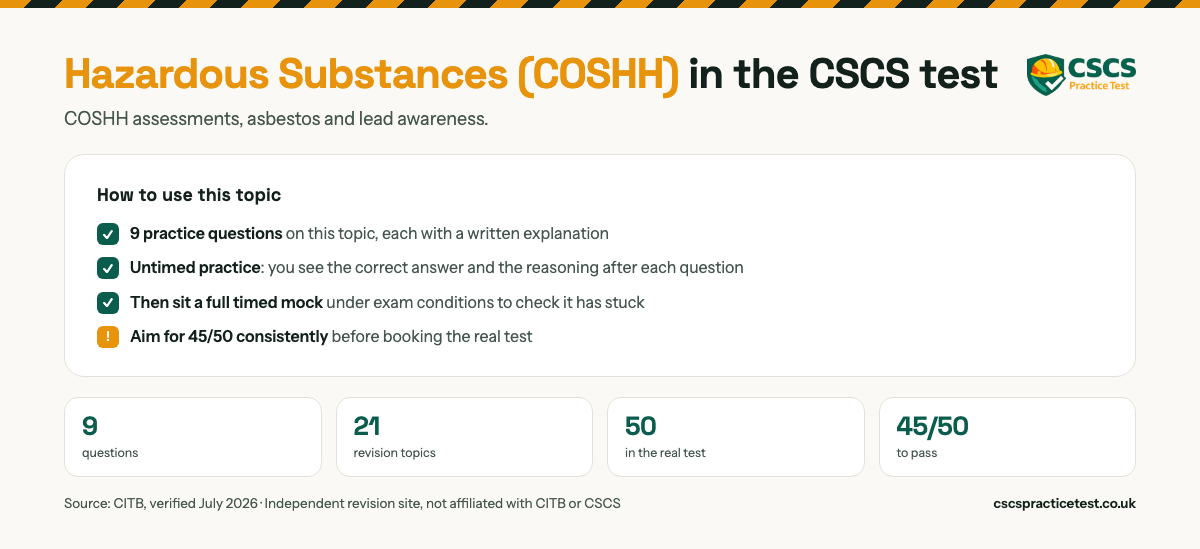
COSHH assessments, asbestos and lead awareness.
These questions cover hazardous substances (coshh)for the CITB Health, Safety and Environment (HS&E) test, the exam UK construction workers pass to get a CSCS card.
Hazardous Substances (COSHH): practice questions (untimed, instant feedback)
- 50 questions · pass mark 90%
- Untimed practice: you see the correct answer immediately after each question.
- Some questions need more than one answer, and these are clearly marked.
All 50 Hazardous Substances (COSHH) questions and answers
These are the same 50 questions as the practice test above, written out with the correct answer and the reasoning behind it. Read them through when you want to revise rather than test yourself.
1. How can asbestos be reliably identified?
Answer: By having a sample tested in a laboratory
- A) By having a sample tested in a laboratory (correct answer)
- B) By seeing whether it dissolves in water
- C) From the colour of the dust
- D) By its strong smell
Why: Asbestos can only be confirmed by laboratory analysis of a sample. You cannot tell by sight or smell.
2. Before you use a hazardous substance, who should explain the health risks and the safe method of work (the COSHH assessment)?
Answer: Your supervisor or employer
- A) A Health and Safety Executive inspector
- B) The site's appointed first aider
- C) Site security staff on the main gate
- D) Your supervisor or employer (correct answer)
Why: Your employer or supervisor must brief you on the COSHH assessment before you start work with the substance.
3. A product carries a hazardous-substance label. How should you dispose of the container or any leftover residue?
Answer: Follow the instructions on the label or in your method statement
- A) Follow the instructions on the label or in your method statement (correct answer)
- B) Pour it down a drain if it is under a litre of liquid
- C) Leave it for someone else to sort out
- D) Drop it in any skip or bin
Why: Dispose of hazardous products as directed on the label or in your work instructions.
4. Working with which of these materials may need a COSHH assessment? (Choose all that apply)
Answers: Asbestos, Tile (for example, the dust from cutting it) and Wood (for example, wood dust)
- A) Asbestos (correct answer)
- B) Metal
- C) Plastic
- D) Tile (for example, the dust from cutting it) (correct answer)
- E) Wood (for example, wood dust) (correct answer)
Why: Asbestos, and the dust from cutting tile or wood, can all require a COSHH assessment.
5. What should you do first if a hazardous substance contacts your skin?
Answer: Wash the affected area thoroughly
- A) Drink water
- B) Carry on working and check it at the end of the shift
- C) Sit down and rest until the stinging stops
- D) Wash the affected area thoroughly (correct answer)
Why: Wash the area at once to remove the substance and limit exposure.
6. What is the main purpose of the COSHH regulations?
Answer: To control substances hazardous to health
- A) To prevent pollution
- B) To ensure the right equipment is used
- C) To set fire-safety rules
- D) To control substances hazardous to health (correct answer)
Why: COSHH controls substances that are hazardous to health to prevent harm.
7. Which is a possible effect of exposure to a hazardous substance?
Answer: Skin irritation
- A) Better concentration
- B) Increased strength
- C) A stronger immune system
- D) Skin irritation (correct answer)
Why: Skin irritation is one of many possible health effects of exposure.
8. Under COSHH, who must assess the risk from hazardous substances?
Answer: The employer
- A) The employees themselves
- B) The Health and Safety Executive
- C) Visitors to the site
- D) The employer (correct answer)
Why: The employer is responsible for the COSHH risk assessment and controls.
9. Which hazard symbol indicates a toxic substance?
Answer: A skull and crossbones
- A) A green cross
- B) A leaf
- C) A flame
- D) A skull and crossbones (correct answer)
Why: The skull-and-crossbones symbol marks a toxic substance.
10. Under COSHH, what must an employer do before work liable to expose employees begins?
Answer: Make a suitable and sufficient assessment and implement the steps found
- A) Issue respiratory protective equipment to everyone who will be present
- B) Obtain written consent from each employee who will handle the substance
- C) Notify the Health and Safety Executive of the substances being used
- D) Make a suitable and sufficient assessment and implement the steps found (correct answer)
Why: Regulation 6(1) bars the work unless the employer has both made a suitable and sufficient assessment and implemented the steps it identified. Assessing without acting does not satisfy it.
11. What is the first duty in the COSHH control hierarchy?
Answer: Prevent exposure, and only control it where prevention is not practicable
- A) Prevent exposure, and only control it where prevention is not practicable (correct answer)
- B) Provide personal protective equipment to everyone entering the work area
- C) Measure exposure against the workplace exposure limit for the substance
- D) Place employees under health surveillance before the work is allowed
Why: Regulation 7(1) requires exposure to be prevented, or adequately controlled where prevention is not reasonably practicable. Control is the fallback, not the starting point.
12. How does COSHH say prevention should preferably be achieved?
Answer: By substitution, replacing the substance or process with a safer one
- A) By reducing the number of hours each employee spends on the task
- B) By fitting local exhaust ventilation over the point of release
- C) By issuing respiratory protective equipment with a high protection factor
- D) By substitution, replacing the substance or process with a safer one (correct answer)
Why: Regulation 7(2) states that substitution shall by preference be undertaken, avoiding the use of the hazardous substance by replacing it with a substance or process that eliminates or reduces the risk.
13. Where exposure cannot be prevented, what comes FIRST in the order of priority?
Answer: Work processes, systems, engineering controls and suitable equipment
- A) Suitable personal protective equipment issued to each exposed worker
- B) Health surveillance for everyone who works with the substance
- C) Signage warning of the hazardous substance at the area entrance
- D) Work processes, systems, engineering controls and suitable equipment (correct answer)
Why: Regulation 7(3)(a) puts the design and use of appropriate work processes, systems and engineering controls, and suitable work equipment and materials, at the top of the priority order.
14. Where does personal protective equipment sit in the COSHH order of priority?
Answer: Last, and it is provided in addition to the other measures, not instead
- A) First, because it protects the individual worker most directly of them all
- B) It sits outside the priority order because it is governed by other rules
- C) Second, immediately after engineering controls have been considered
- D) Last, and it is provided in addition to the other measures, not instead (correct answer)
Why: Regulation 7(3)(c) allows PPE only where adequate control cannot be achieved by other means, and expressly requires it in addition to the measures in (a) and (b).
15. A dust extraction system is fitted but masks are also issued. Is that correct under COSHH?
Answer: Yes. PPE is required in addition to the other control measures
- A) Yes. PPE is required in addition to the other control measures (correct answer)
- B) No, because a mask may only be used where no extraction is fitted
- C) No, issuing both is duplication and the mask should be withdrawn
- D) Yes, but only if the extraction system has failed its annual test
Why: The words in regulation 7(3)(c) are in addition to the measures required by sub-paragraphs (a) and (b). PPE tops up engineering control, it does not replace it.
16. Which of these must a COSHH risk assessment consider?
Answer: The hazardous properties and the supplier's safety data sheet information
- A) The hazardous properties and the supplier's safety data sheet information (correct answer)
- B) Only whether a workplace exposure limit has been set for the substance
- C) Only the quantity of the substance that is kept in the site store
- D) Only the number of employees who will be present in the work area
Why: Regulation 6(2) lists hazardous properties and information on health effects provided by the supplier, including any relevant safety data sheet, as the first two considerations.
17. Why does the assessment have to look at maintenance activities specifically?
Answer: Because maintenance work can produce a high level of exposure
- A) Because maintenance is always carried out by contractors, not employees
- B) Because maintenance work can produce a high level of exposure (correct answer)
- C) Because maintenance is excluded from the main risk assessment
- D) Because maintenance workers are exempt from health surveillance
Why: Regulation 6(2)(e) singles out activities, such as maintenance, where there is the potential for a high level of exposure. Routine running exposure can be low while a strip-down is not.
18. Work involves exposure to more than one hazardous substance. What does COSHH require?
Answer: The risk presented by the substances in combination must be considered
- A) The risk presented by the substances in combination must be considered (correct answer)
- B) Only the substance with the lowest exposure limit needs assessing
- C) Each substance is assessed separately and the results are not combined
- D) The work must stop until only one substance is in use at a time
Why: Regulation 6(2) requires consideration of the risk presented where work involves exposure to more than one substance hazardous to health, not just each in isolation.
19. Under the principles of good practice, which routes of exposure must be taken into account?
Answer: Inhalation, skin absorption and ingestion, all three routes together
- A) Inhalation, skin absorption and ingestion, all three routes together (correct answer)
- B) Inhalation and ingestion, but skin contact is dealt with separately
- C) Inhalation only, since breathing in is how most site exposure occurs
- D) Whichever single route the safety data sheet identifies as the main one
Why: Schedule 2A principle (b) requires all relevant routes of exposure to be taken into account when developing control measures, and names inhalation, skin absorption and ingestion.
20. What does principle (h) of the principles of good practice require?
Answer: That control measures do not increase the overall risk to health and safety
- A) That control measures are reviewed by an external consultant each year
- B) That control measures do not increase the overall risk to health and safety (correct answer)
- C) That control measures are chosen by the employees who will use them
- D) That control measures are recorded in writing before work commences
Why: Principle (h) guards against solving one problem by creating another, for example sealing an area for dust control and creating an oxygen-deficient or heat-stress hazard.
21. How often must control measures be checked under the principles of good practice?
Answer: Regularly, reviewing all elements for their continuing effectiveness
- A) Once, when they are first installed and commissioned for use
- B) Only after an incident involving the substance has been reported
- C) Only when the substance being used on the site is changed
- D) Regularly, reviewing all elements for their continuing effectiveness (correct answer)
Why: Principle (f) requires all elements of the control measures to be checked and reviewed regularly for their continuing effectiveness. Controls degrade quietly.
22. When is health surveillance appropriate under COSHH?
Answer: Where an identifiable disease may be related to the exposure and is likely
- A) Whenever any hazardous substance is present anywhere on the site
- B) Where an identifiable disease may be related to the exposure and is likely (correct answer)
- C) Only for employees who have already reported symptoms to their employer
- D) Only where the employer chooses to offer it as a workplace benefit
Why: Regulation 11(2) treats surveillance as appropriate for Schedule 6 substance and process combinations, or where an identifiable disease or adverse health effect may be related to exposure and is reasonably likely to occur.
23. What information must workers be given about the substances they work with?
Answer: The names, the risks to health, any exposure limit and the data sheet
- A) The names, the risks to health, any exposure limit and the data sheet (correct answer)
- B) Only the emergency telephone number for the substance supplier
- C) Only the trade name that is printed on the outside of the container label
- D) Only the personal protective equipment they are required to wear
Why: Regulation 12(2)(a) lists the names of the substances and the risk they present, any relevant workplace exposure limit, access to any relevant safety data sheet, and other legislative provisions.
24. What is a safety data sheet used for on site?
Answer: It gives supplier information on hazards, health effects and handling
- A) It records which employees have handled the substance, and on what dates
- B) It gives supplier information on hazards, health effects and handling (correct answer)
- C) It is the employer's written COSHH assessment for that substance
- D) It certifies that the substance has been approved for use in the UK
Why: Regulation 6(2)(b) treats the safety data sheet as supplier information feeding the assessment. It is an input to the COSHH assessment, not the assessment itself.
25. A worker says the safety data sheet is the same thing as the COSHH assessment. Are they right?
Answer: No. The sheet is supplier information that feeds the site assessment
- A) No. The sheet is supplier information that feeds the site assessment (correct answer)
- B) Yes, provided the employer has signed and dated the supplier's sheet
- C) Yes, because the data sheet already lists the control measures needed
- D) No, but only where more than one substance is in use on the same site
Why: The data sheet describes the substance generally. The COSHH assessment applies it to this work, this quantity, this duration and these people, which the supplier cannot know.
26. What does the assessment have to consider about exposure itself?
Answer: The level, the type and the duration of the exposure involved
- A) Only the peak concentration recorded during the working day itself
- B) The level, the type and the duration of the exposure involved (correct answer)
- C) Only whether exposure exceeds the workplace exposure limit for the substance
- D) Only the total quantity of substance purchased for the project
Why: Regulation 6(2)(c) requires the level, type and duration of exposure to be considered. A short high peak and a long low exposure are different problems.
27. Which of these is one of the measures required alongside the control hierarchy?
Answer: Arrangements for safe handling, storage and transport, including waste
- A) Arrangements for safe handling, storage and transport, including waste (correct answer)
- B) A weekly medical examination for every single employee on the project site
- C) Written permission from the client before any substance is used
- D) A separate insurance policy covering exposure to that substance
Why: Regulation 7(4)(a) requires arrangements for the safe handling, storage and transport of hazardous substances and of waste containing them.
28. COSHH requires the number of employees exposed to be what?
Answer: Reduced to the minimum required for the work being carried out
- A) Recorded in a register that is kept for forty years after the work
- B) Reported to the enforcing authority before the work is started
- C) Reduced to the minimum required for the work being carried out (correct answer)
- D) Increased so that each individual spends less time on the task
Why: Regulation 7(4)(c) requires reducing to the minimum required for the work the number of employees subject to exposure, along with the level and duration of exposure.
29. What does principle (c) of the principles of good practice say about control?
Answer: Control exposure by measures proportionate to the health risk
- A) Control every substance to the same standard regardless of its hazard
- B) Control exposure by measures proportionate to the health risk (correct answer)
- C) Control exposure only where a workplace exposure limit has been set
- D) Control exposure using the cheapest method that is available on site
Why: Principle (c) requires control measures proportionate to the health risk, so effort is matched to hazard rather than applied uniformly.
30. Which control option should be chosen under principle (d)?
Answer: The most effective and reliable option minimising escape and spread
- A) The one that the workforce finds least intrusive to work with
- B) The one that the supplier of the substance recommends in the data sheet
- C) The most effective and reliable option minimising escape and spread (correct answer)
- D) The one that requires the least maintenance over the project lifetime
Why: Principle (d) requires the most effective and reliable control options that minimise the escape and spread of substances hazardous to health.
31. Local exhaust ventilation is fitted. Under regulation 7(3), which level of the hierarchy is that?
Answer: It is control of exposure at source, the second priority level
- A) It is personal protective equipment and therefore the last resort
- B) It is control of exposure at source, the second priority level (correct answer)
- C) It is health surveillance and sits outside the control hierarchy
- D) It is substitution, because it replaces the hazardous process
Why: Regulation 7(3)(b) covers control of exposure at source, including adequate ventilation systems and appropriate organisational measures.
32. Silica dust is created by cutting paving. Which COSHH duty applies first?
Answer: Prevent the exposure if reasonably practicable, for example by ordering to size
- A) Issue every operative with a disposable dust mask before any cutting starts
- B) Place all cutting operatives under immediate health surveillance
- C) Prevent the exposure if reasonably practicable, for example by ordering to size (correct answer)
- D) Measure the airborne concentration before any cutting is carried out
Why: Regulation 7(1) and 7(2) put prevention and substitution first. Buying units cut to size, or using a different material or process, removes the exposure rather than managing it.
33. What does the assessment have to take into account about control measures?
Answer: The effect of the preventive and control measures taken under reg 7
- A) Only their purchase cost against the project budget for the works
- B) Only whether they have been installed by a competent contractor
- C) The effect of the preventive and control measures taken under reg 7 (correct answer)
- D) Only the manufacturer's stated efficiency under laboratory conditions
Why: Regulation 6(2)(g) requires consideration of the effect of preventive and control measures which have been or will be taken in accordance with regulation 7.
34. Results of exposure monitoring feed into what, under COSHH?
Answer: The risk assessment, which must consider monitoring results under reg 10
- A) Nothing, because monitoring is only carried out for enforcement purposes
- B) Only the employee's personal health record held by the appointed doctor
- C) The risk assessment, which must consider monitoring results under reg 10 (correct answer)
- D) Only the annual report submitted by the employer to its insurers
Why: Regulation 6(2)(i) requires the assessment to consider the results of monitoring of exposure carried out under regulation 10. Assessment and monitoring are a loop, not separate exercises.
35. Health surveillance results feed into what?
Answer: The risk assessment, which must consider relevant surveillance results
- A) The risk assessment, which must consider relevant surveillance results (correct answer)
- B) Only the individual worker's own medical file, kept confidentially
- C) Only a report to the enforcing authority at the end of the project
- D) Nothing, because surveillance happens after the assessment is complete
Why: Regulation 6(2)(h) requires the assessment to consider the results of relevant health surveillance, so a detected effect must feed back into the controls.
36. What must training under regulation 12 cover in addition to the substance names?
Answer: The risk to health, any exposure limit, and access to the data sheet
- A) Only how to put on and take off the protective equipment provided
- B) The risk to health, any exposure limit, and access to the data sheet (correct answer)
- C) Only the location of the nearest first-aid post anywhere on the work site
- D) Only the disciplinary consequences of not following the site rules
Why: Regulation 12(2)(a) requires the names of the substances and the risk they present, any relevant workplace exposure limit, access to any relevant safety data sheet and other relevant legislative provisions.
37. Under principle (g), who must be informed and trained?
Answer: All employees, on the hazards and risks and on the control measures
- A) Only those supervisors who directly manage work with hazardous substances
- B) Only new starters during their first full week on the construction site
- C) All employees, on the hazards and risks and on the control measures (correct answer)
- D) Only those employees who are under health surveillance already
Why: Principle (g) requires all employees to be informed and trained on the hazards and risks from the substances they work with and on the use of the control measures.
38. What does principle (a) require about process design?
Answer: Design and operate processes to minimise emission, release and spread
- A) Design and operate processes to minimise emission, release and spread (correct answer)
- B) Design processes so that they can be operated by a single person alone
- C) Design processes to use the smallest possible quantity of substance
- D) Design processes so that they can be shut down quickly in an emergency
Why: Principle (a) is about designing the emission out of the process in the first place, which is the most reliable form of control.
39. A substance has no workplace exposure limit. Does COSHH still apply?
Answer: Yes. The duties to prevent or adequately control exposure still apply
- A) No, because without a limit there is nothing to measure exposure against
- B) No, unless the substance is listed in Schedule 6 to the COSHH Regulations
- C) Yes. The duties to prevent or adequately control exposure still apply (correct answer)
- D) Yes, but only the training duty applies and not the control duties themselves
Why: A workplace exposure limit is one consideration in regulation 6(2)(f), not the trigger for the Regulations. The duty in regulation 7(1) applies to substances hazardous to health generally.
40. Who must the COSHH risk assessment be carried out by, in law?
Answer: The employer, who must not carry out the work without one
- A) The supplier of the substance being used at the workplace
- B) The employer, who must not carry out the work without one (correct answer)
- C) The client, as the party commissioning the construction work
- D) An external consultant holding a recognised COSHH qualification
Why: Regulation 6(1) places the duty on the employer. Competent help may be used, but the legal duty does not transfer to a consultant or a supplier.
41. Waste containing a hazardous substance is produced. What does COSHH require?
Answer: Arrangements for its safe handling, storage and transport are required
- A) It may be disposed of with general site waste once it has dried out
- B) Arrangements for its safe handling, storage and transport are required (correct answer)
- C) It must be returned to the supplier who provided the original substance
- D) It falls outside COSHH because waste is covered by other regulations
Why: Regulation 7(4)(a) expressly extends the safe handling, storage and transport arrangements to waste containing substances hazardous to health.
42. What are suitable maintenance procedures required for under regulation 7(4)?
Answer: As one of the measures supporting prevention and control of exposure
- A) Only for the personal protective equipment issued to the site workforce
- B) Only for plant that is used for more than four hours in any single shift
- C) As one of the measures supporting prevention and control of exposure (correct answer)
- D) Only where the enforcing authority has already served an improvement notice
Why: Regulation 7(4)(b) lists the adoption of suitable maintenance procedures among the measures that the control hierarchy must include. An unmaintained extraction unit is not control.
43. An employer decides masks alone will control a dust risk, without considering extraction. Is that compliant?
Answer: No. PPE is only allowed where control cannot be achieved by other means
- A) Yes, provided the masks are face-fit tested for each individual wearer beforehand
- B) Yes, if the workers all agree that the masks are comfortable enough to wear
- C) No. PPE is only allowed where control cannot be achieved by other means (correct answer)
- D) No, unless the dust concerned has no workplace exposure limit set
Why: Regulation 7(3)(c) conditions PPE on adequate control not being achievable by other means. Skipping straight to masks bypasses the priority order.
44. The COSHH assessment must consider the circumstances of the work, including what?
Answer: The amount of the hazardous substance that is involved in the work
- A) The names of every worker who will be present during the whole activity
- B) The amount of the hazardous substance that is involved in the work (correct answer)
- C) The insurance cover held by the main contractor carrying out the work
- D) The programme dates on which the activity is currently due to take place
Why: Regulation 6(2)(d) requires the circumstances of the work, including the amount of the substance involved, to be considered. Quantity changes the risk.
45. What does 'adequately controlled' mean in relation to a workplace exposure limit?
Answer: That exposure is reduced as low as reasonably practicable within the limit
- A) That exposure has been eliminated entirely from the work activity
- B) That every worker on the job has been issued with respiratory protection kit
- C) That exposure is reduced as low as reasonably practicable within the limit (correct answer)
- D) That the substance has been substituted for a less hazardous one
Why: Control is the fallback where prevention is not reasonably practicable, and the exposure limit is a ceiling rather than a target. Regulation 7 requires the priority measures to be applied regardless.
46. Which statement about substitution is correct under regulation 7(2)?
Answer: It may replace either the substance or the process, to cut the risk
- A) It may replace a substance but never a process used at the workplace
- B) It applies only where the substance has a workplace exposure limit
- C) It may replace either the substance or the process, to cut the risk (correct answer)
- D) It is optional and sits below personal protective equipment in priority
Why: Regulation 7(2) refers to replacing the substance with a substance or a process which eliminates or reduces the risk, so changing the method counts as substitution.
47. When does a COSHH assessment need to be reviewed?
Answer: When it is no longer valid or there has been a significant change
- A) Never, once it has been signed off by the employer at the very outset
- B) Only when a new substance is introduced onto the construction site
- C) When it is no longer valid or there has been a significant change (correct answer)
- D) Only when an employee reports symptoms related to the exposure at work
Why: COSHH follows the same review logic as the other risk assessment duties: an assessment that no longer reflects the work is not suitable and sufficient.
48. Why is skin absorption specifically named in the principles of good practice?
Answer: Because it is a relevant route of exposure that controls must address
- A) Because it is the only exposure route that respiratory protection misses
- B) Because it is a relevant route of exposure that controls must address (correct answer)
- C) Because skin exposure is the only route covered by health surveillance
- D) Because gloves are the only control measure permitted under COSHH
Why: Principle (b) names inhalation, skin absorption and ingestion. Controls designed only around breathing in will miss substances that pass through the skin.
49. An employer provides PPE but gives no training on its use. Which duty is breached?
Answer: The duty to provide suitable and sufficient information and training
- A) None, because providing the equipment satisfies the COSHH duties
- B) Only the duty to keep records of the equipment that has been issued
- C) The duty to provide suitable and sufficient information and training (correct answer)
- D) Only the duty to carry out health surveillance on all of those exposed
Why: Regulation 12(1) requires suitable and sufficient information, instruction and training, and principle (g) requires training on the use of the control measures developed.
50. What is the overall structure of the COSHH duty in regulation 7(1)?
Answer: Prevent exposure, or adequately control it where prevention is impracticable
- A) Control exposure first, and prevent it only if control proves ineffective
- B) Prevent exposure, or adequately control it where prevention is impracticable (correct answer)
- C) Provide protective equipment first, then consider engineering controls
- D) Monitor the exposure first, then decide whether any control is necessary at all
Why: Regulation 7(1) is the whole scheme in one sentence: prevent, or where that is not reasonably practicable, adequately control.
What this topic covers in the CSCS test
COSHH is the Control of Substances Hazardous to Health Regulations 2002. It covers chemicals, products containing chemicals, dusts, fumes, vapours, mists, gases and biological agents, and its objective is to prevent exposure or, where that is not reasonably practicable, to control it adequately. Most construction sites use dozens of substances that fall under it, from cement and resins to solvents and cutting dust.
- What counts as a substance hazardous to health, and which substances have their own separate regulations
- The routes by which a substance gets into your body
- Who must carry out the COSHH assessment and who must brief you on it before you start
- GB CLP hazard pictograms, product labels and safety data sheets
- Workplace exposure limits and where they are published
- Asbestos: where it is found, why it cannot be identified by eye, and the categories of work
- Control measures in order, from enclosure and extraction down to PPE, plus safe disposal of residues and containers
Key facts worth memorising
- Four routes of entry
- HSE describes exposure as uptake into the body by breathing in fume, dust, gas or mist, by skin contact, by injection into the skin, and by swallowing.
- Lead, asbestos and radioactive substances sit outside COSHH
- HSE states these three have their own specific regulations, so asbestos work is governed by the Control of Asbestos Regulations 2012 rather than by COSHH itself.
- Asbestos control limit
- The Control of Asbestos Regulations 2012 define the control limit as 0.1 fibres per cubic centimetre of air averaged over a continuous period of 4 hours.
- Licensed asbestos work
- Higher-risk work such as removing sprayed coatings, disturbing pipe lagging or handling loose fill insulation must be done by an HSE-licensed contractor and notified to the enforcing authority at least 14 days before it starts.
- Asbestos is still the biggest killer
- HSE says asbestos can be found in any building built before the year 2000, and 2,146 people died of mesothelioma in Great Britain in 2024 through past asbestos exposure.
- Workplace exposure limits
- Only about 500 substances have a workplace exposure limit; they are listed in HSE publication EH40 and that list is legally binding under COSHH.
What people get wrong
You can tell asbestos by looking at it.
You cannot. It is confirmed only by laboratory analysis of a sample. Treat any suspect material in a building built before 2000 as asbestos until it has been checked, and stop work and report it.
If you can buy it in a shop it does not need a COSHH assessment.
If the packaging carries a GB CLP hazard pictogram, a diamond with a red border on a white background, the product is classed as hazardous. Cement, resins, adhesives and solvents are everyday examples.
PPE is the main COSHH control.
PPE and RPE are the last line. COSHH expects you to prevent exposure first, then use control equipment such as enclosure or local exhaust ventilation, then good working procedures, and only then personal protection.
Leftover product and empty containers can go in the general skip.
Dispose of hazardous products and their residues as the label or your work instructions direct. Getting this wrong is both a health risk and an environmental offence.
Answering these questions in the test
COSHH questions reward two habits. First, look at the label: if a question mentions a hazard symbol or a data sheet, the correct answer almost always involves reading it, or asking for the COSHH assessment, before you start work. Second, remember who does what. The employer assesses the risk, provides the controls and briefs you on the safe method; you use the controls provided, follow the hygiene rules and report anything that looks wrong. Asbestos questions have a fixed shape: the right answer is to stop work, leave the area and report it, and never to sweep it up, break it, or take clothing home. Any option suggesting you can identify asbestos by sight or smell is wrong.
Background reading
Drilling the questions tells you what you are getting wrong. It does not always tell you why. For this topic that is covered in COSHH Symbols. All nine of them, what each one warns you about, and why they are not really COSHH symbols at all.
Sources
Written from the following. Where a figure could not be verified against one of these, it has been left out rather than approximated. Our sources and methodology explains how we date and re-check them. Spotted something wrong? Report an error and we will fix it.
- hse.gov.uk/coshh/index.htm
- hse.gov.uk/coshh/basics/substance.htm
- hse.gov.uk/coshh/basics/control.htm
- hse.gov.uk/coshh/basics/exposurelimits.htm
- hse.gov.uk/chemical-classification/labelling-packaging/hazard-symbols-hazard-pictograms.htm
- hse.gov.uk/asbestos/index.htm
- hse.gov.uk/asbestos/licensing/licensed-contractor.htm
- legislation.gov.uk/uksi/2012/632/regulation/2/made
- hse.gov.uk/statistics/overview.htm
Topics that come up alongside hazardous substances (coshh)
Ready for the real thing?
When you are scoring 90% or better here, take a CSCS mock test for Operatives under exam conditions, then how to book the CSCS test.