
CSCS Environmental Awareness & Waste Questions
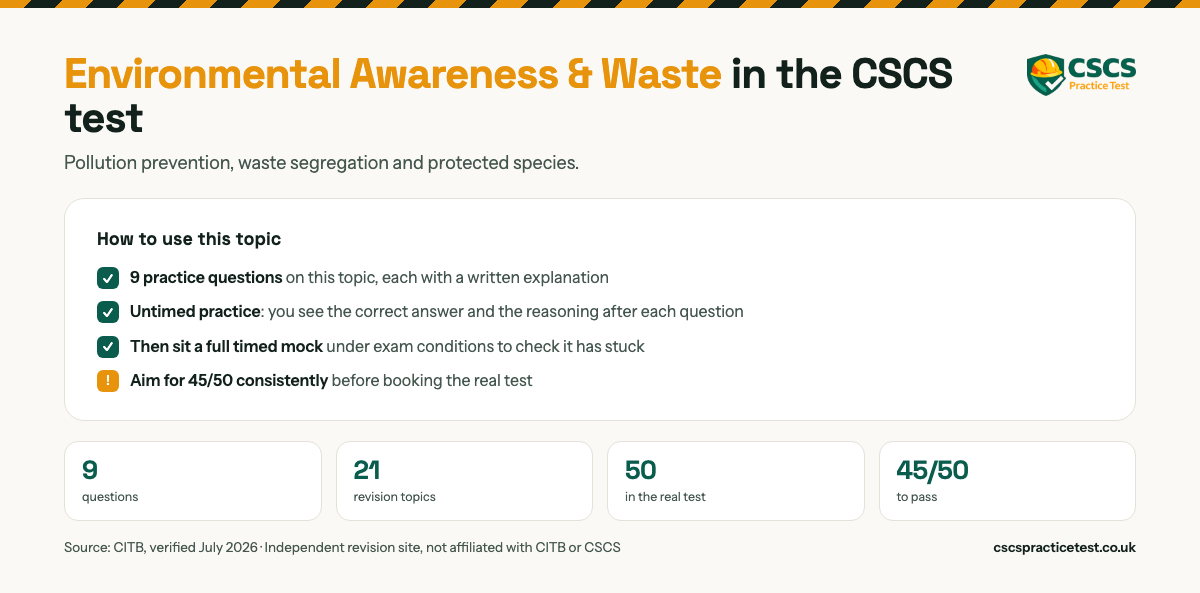
Pollution prevention, waste segregation and protected species.
These questions cover environmental awareness & wastefor the CITB Health, Safety and Environment (HS&E) test, the exam UK construction workers pass to get a CSCS card.
Environmental Awareness & Waste: practice questions (untimed, instant feedback)
- 50 questions · pass mark 90%
- Untimed practice: you see the correct answer immediately after each question.
- Some questions need more than one answer, and these are clearly marked.
All 50 Environmental Awareness & Waste questions and answers
These are the same 50 questions as the practice test above, written out with the correct answer and the reasoning behind it. Read them through when you want to revise rather than test yourself.
1. Do you have any responsibility for cutting down the amount of waste created?
Answer: Yes, everyone on site shares this responsibility
- A) No, that is down to the site management team alone
- B) Only during the end-of-project clean-up at handover
- C) Only if your site induction specifically told you to
- D) Yes, everyone on site shares this responsibility (correct answer)
Why: Reducing waste is everyone's responsibility, not just management's.
2. Which of these is NOT good practice on site?
Answer: Burning waste on site
- A) Burning waste on site (correct answer)
- B) Refuelling carefully to prevent spills
- C) Storing materials safely
- D) Turning off plant and equipment when it is idle
Why: Burning waste causes pollution and is not acceptable practice.
3. Which two of the following are classed as hazardous waste? (Choose two)
Answers: Fluorescent tubes and Used spill-kit pads soaked in oil
- A) Broken tiles or bricks
- B) Fluorescent tubes (correct answer)
- C) Glass
- D) Polythene and shrink-wrap
- E) Used spill-kit pads soaked in oil (correct answer)
Why: Fluorescent tubes and oil-soaked spill pads are hazardous waste; the others are inert or general waste.
4. There is an oil or diesel spill on site. What should you do?
Answer: Stop work, contain the spill, tell your supervisor and then clean up
- A) Phone the local council environment department at once and wait for them
- B) Ignore it, because spills of this kind do no lasting harm to the ground
- C) Stop work, contain the spill, tell your supervisor and then clean up (correct answer)
- D) Clean it up with a spill kit at some point before the end of the working day
Why: Stop, contain the spill, report it, then clean up. Prompt action limits the pollution.
5. Which of these can typically be recycled on site?
Answer: Concrete
- A) Asbestos
- B) Paint
- C) Concrete (correct answer)
- D) Solvents
Why: Crushed concrete is commonly recycled as aggregate or fill.
6. What is the most effective way to cut waste on site?
Answer: Reuse materials and off-cuts where possible
- A) Only buy materials that can be recycled afterwards
- B) Reuse materials and off-cuts where possible (correct answer)
- C) Send everything straight to landfill in one skip
- D) Avoid sorting the waste into separate skips on site
Why: Reusing materials and off-cuts prevents waste at source.
7. What does the waste hierarchy prioritise?
Answer: Prevention, reuse and recycling before disposal
- A) Landfill, because it is the cheapest option available
- B) Recycling above all else, ahead of preventing waste
- C) Prevention, reuse and recycling before disposal (correct answer)
- D) Incineration, on the grounds that it is the safest route
Why: The waste hierarchy puts prevention first, then reuse and recycling, then disposal last.
8. Which document explains how environmental impacts will be managed on a project?
Answer: The Environmental Management Plan
- A) The construction drawings and specifications
- B) The Environmental Management Plan (correct answer)
- C) The site health and safety policy document
- D) The project budget and cost forecast
Why: The Environmental Management Plan sets out how impacts are controlled.
9. Why segregate waste on site?
Answer: To improve recycling and reduce contamination
- A) To raise the amount of landfill tax that is paid
- B) To discourage the recycling of any materials on site
- C) To improve recycling and reduce contamination (correct answer)
- D) To make more work for the labourers clearing the site
Why: Separating waste streams boosts recycling and cuts contamination.
10. Regulation 12 of the Waste (England and Wales) Regulations 2011 sets a priority order. Which option sits at the very top of it?
Answer: Prevention, which means stopping the material becoming waste at all
- A) Disposal, once the load has been segregated properly into skips
- B) Other recovery, for example burning the material to generate energy
- C) Recycling, which reprocesses the material into a new usable product
- D) Prevention, which means stopping the material becoming waste at all (correct answer)
Why: Regulation 12(1) lists the hierarchy as prevention, preparing for re-use, recycling, other recovery, then disposal. Prevention comes first because waste that is never created needs no further management. Recycling and other recovery sit lower down, and disposal is the last resort.
11. Which sequence correctly states the five steps of the waste hierarchy in the priority order set by regulation 12?
Answer: Prevention, preparing for re-use, recycling, other recovery, disposal
- A) Recycling, prevention, preparing for re-use, disposal, other recovery
- B) Preparing for re-use, prevention, recycling, disposal, other recovery
- C) Prevention, recycling, preparing for re-use, disposal, other recovery
- D) Prevention, preparing for re-use, recycling, other recovery, disposal (correct answer)
Why: Regulation 12(1) sets the order as (a) prevention, (b) preparing for re-use, (c) recycling, (d) other recovery such as energy recovery, and (e) disposal. Preparing for re-use is placed above recycling because re-using an item keeps more of its value than breaking it down for reprocessing.
12. When is a site allowed to depart from the priority order set out in the waste hierarchy?
Answer: Where life-cycle thinking justifies a better overall environmental result
- A) Whenever the site manager happens to decide the priority order is unhelpful
- B) Where life-cycle thinking justifies a better overall environmental result (correct answer)
- C) Never, because the priority order admits of no exceptions at all
- D) Whenever a skip supplier says a mixed load is cheaper than sorting
Why: Regulation 12(2) permits departure from the priority order to achieve the best overall environmental outcome where that is justified by life-cycle thinking about the overall impacts of generating and managing the waste. Cost or convenience on their own are not a justification, and the order is not absolute.
13. Which factor must be taken into account when weighing the overall impacts that might justify departing from the waste hierarchy?
Answer: Technical feasibility and economic viability of the option being chosen
- A) The preference of the quantity surveyor for the cheapest skip on offer
- B) Whether the principal contractor has hit its monthly tonnage target
- C) Technical feasibility and economic viability of the option being chosen (correct answer)
- D) The distance from the site gate to the nearest household waste centre
Why: Regulation 12(3) lists the considerations: the general environmental protection principles of precaution and sustainability, technical feasibility and economic viability, protection of resources, and the overall environmental, human health, economic and social impacts. Distance to a tip and internal tonnage targets are not listed.
14. Section 34(1) of the Environmental Protection Act 1990 places the duty of care on which people?
Answer: Anyone who imports, produces, carries, keeps or disposes of controlled waste
- A) Only the principal contractor named on the project notification form
- B) Only the landfill operator receiving the controlled waste at the end of it all
- C) Anyone who imports, produces, carries, keeps or disposes of controlled waste (correct answer)
- D) Only the registered waste carrier who physically removes the loaded skip
Why: The duty in section 34(1) binds any person who imports, produces, carries, keeps, treats or disposes of controlled waste, and any dealer or broker who has control of it. It is a shared duty running along the whole chain, so it is wrong to pin it on one link such as the carrier or the landfill.
15. One limb of the section 34 duty of care deals with waste escaping. What does it actually require?
Answer: Reasonable measures to stop the waste escaping from anyone's control
- A) That waste is stored at least ten metres from any boundary fence
- B) That each skip carries a printed hazard warning data sheet on it
- C) That every skip standing on the site is emptied before the end of each shift
- D) Reasonable measures to stop the waste escaping from anyone's control (correct answer)
Why: Section 34(1)(b) requires reasonable measures to prevent the escape of the waste from the holder's control or that of any other person. In practice that means covering and securing skips, but the Act sets a duty to take reasonable measures rather than any fixed emptying time or set-back distance.
16. On transferring waste, section 34(1)(c) requires the holder to secure that the transfer is made to whom?
Answer: An authorised person, or a person acting for authorised transport purposes
- A) Any haulier who holds a valid operator licence for the vehicle actually in use
- B) Any firm that has signed the site environmental policy statement
- C) An authorised person, or a person acting for authorised transport purposes (correct answer)
- D) Any driver who can show a current skills card at the weighbridge
Why: Section 34(1)(c)(i) requires the transfer to be only to an authorised person or to a person for authorised transport purposes. Section 34(3) defines authorised persons, including registered carriers of controlled waste. An operator licence or a skills card says nothing about waste authorisation.
17. Besides transferring the waste itself, what does section 34(1)(c)(ii) require to be handed over?
Answer: A written description letting others avoid an offence and stop escapes
- A) A written description letting others avoid an offence and stop escapes (correct answer)
- B) A photograph of the fully loaded skip taken just before it leaves the site
- C) A signed copy of the site waste management plan for the whole job
- D) A weighbridge ticket showing both the gross and the tare weight
Why: Section 34(1)(c)(ii) requires a written description of the waste good enough to let the people receiving it avoid breaching section 33 or the permitting rules and to comply with the duty about escape of waste. Photographs and weighbridge tickets do not describe the nature of the waste.
18. Who is excluded from the section 34(1) duty of care in respect of their own household waste?
Answer: The occupier of domestic property, for household waste made there
- A) The skip hire firm collecting from a residential street on a Sunday
- B) The self-employed bricklayer clearing rubble from a new building site
- C) The demolition contractor stripping out a privately owned house
- D) The occupier of domestic property, for household waste made there (correct answer)
Why: Section 34(2) disapplies the subsection (1) duty for an occupier of domestic property as respects household waste produced on that property. Everyone working in the course of a business stays inside the duty, even when the job happens to be at somebody's home.
19. What is the legal status of the statutory code of practice issued under section 34(7)?
Answer: It is admissible in evidence and courts must weigh any relevant part
- A) It replaces the duty of care for any firm that has signed up to it
- B) It has no legal effect at all and cannot be mentioned in court proceedings
- C) It is admissible in evidence and courts must weigh any relevant part (correct answer)
- D) It binds local authorities only and never binds a private building firm
Why: Section 34(10) makes the code admissible in evidence and requires a court to take any relevant provision into account when deciding a question in proceedings. The code guides how to discharge the duty; it does not displace the duty and it is not limited to public bodies.
20. How long must the transferor and the transferee keep the written waste transfer information?
Answer: At least two years from the date the transfer of the waste took place
- A) At least two years from the date the transfer of the waste took place (correct answer)
- B) At least five years from the date the transfer of the waste took place
- C) At least six months from the date the transfer of the waste took place
- D) Only until the skip has been emptied at the receiving waste facility
Why: Regulation 35(6) of the 2011 Regulations requires both parties to keep the written information, or a copy, for at least two years. Note that the two year rule is for ordinary transfer notes; hazardous waste records under the 2005 Regulations run for a different period.
21. An enforcement officer demands sight of your waste transfer notes. What is the deadline for producing them?
Answer: They must be produced within seven days of the demand being made
- A) They need only be produced once a formal court summons is issued
- B) They must be produced within seven days of the demand being made (correct answer)
- C) They must be produced by the end of the current calendar quarter
- D) They must be produced within twenty eight days of the demand made
Why: Regulation 35(6) requires the notes to be produced on demand within seven days to an officer of the appropriate body or of a waste collection authority. There is no need for a summons first, and the duty is not tied to any quarterly reporting cycle.
22. Which detail must appear on the written information accompanying a waste transfer?
Answer: The appropriate List of Wastes code identifying the waste transferred
- A) The name of the supervisor who signed the daily site briefing sheet
- B) The insurance policy number covering the vehicle carrying the load
- C) The appropriate List of Wastes code identifying the waste transferred (correct answer)
- D) The current retail value of any scrap metal contained within the load moved
Why: Regulation 35(2)(a) requires the waste to be identified by the appropriate codes in the List of Wastes, together with a description, the quantity, whether it is loose or containerised, the time and place of transfer and the transferor's SIC code. Load value and insurance details are not required.
23. Regulation 35(2)(d) requires the written information to confirm one specific thing. What is it?
Answer: That the transferor has discharged the waste hierarchy duty in reg 12
- A) That the transferor has told the local authority about the movement
- B) That the transferor has paid the landfill tax due on the whole load
- C) That the transferor has discharged the waste hierarchy duty in reg 12 (correct answer)
- D) That the transferor has insured the load against theft while moving
Why: Regulation 35(2)(d) requires the note to confirm that the transferor has discharged the duty in regulation 12, the waste hierarchy duty. This ties the paperwork to the hierarchy so that the transfer note evidences that the priority order was actually applied.
24. In which situation does the waste transfer note requirement in regulation 35 not apply?
Answer: Where the waste is hazardous and a consignment note is properly used
- A) Where the waste moves between two sites owned by the same client
- B) Where the load weighs less than a single tonne on the weighbridge ticket
- C) Where carrier and producer both belong to the same trade body
- D) Where the waste is hazardous and a consignment note is properly used (correct answer)
Why: Regulation 35(7) switches off the transfer note rules where the waste is hazardous waste and the consignment note, plus any schedule of carriers, is completed and dealt with under the Hazardous Waste Regulations. Load weight and common ownership make no difference at all.
25. Under the Control of Pollution (Amendment) Act 1989, when does transporting controlled waste become an offence?
Answer: When an unregistered carrier moves it in business or for profit
- A) When the vehicle used exceeds seven and a half tonnes gross weight
- B) When an unregistered carrier moves it in business or for profit (correct answer)
- C) When the waste is moved on a Sunday or a recognised bank holiday
- D) When the waste is carried further than fifty miles from its origin
Why: Section 1(1) makes it an offence for a person who is not a registered carrier of controlled waste to transport it to or from any place in Great Britain in the course of a business or otherwise with a view to profit. Distance, vehicle weight and the day of the week are irrelevant.
26. What penalty may a court impose for transporting controlled waste without being a registered carrier?
Answer: A fine not exceeding level 5 on the standard scale, on summary conviction
- A) A mandatory prison sentence of not less than six months in every case
- B) A fine not exceeding level 5 on the standard scale, on summary conviction (correct answer)
- C) A written caution only, since the offence carries no financial penalty
- D) A fixed penalty notice issued at the roadside by any police constable
Why: Section 1(5) makes the offence punishable on summary conviction by a fine not exceeding level 5 on the standard scale. It is a fine based offence rather than one carrying mandatory custody, and it is dealt with by prosecution rather than a roadside fixed penalty.
27. An officer reasonably believes waste is being carried unlawfully. What power does section 5 give?
Answer: Power to search the vehicle and to seize it along with its contents
- A) Power to search the vehicle and to seize it along with its contents (correct answer)
- B) Power to close the site the waste came from until an appeal is heard
- C) Power to fine the driver on the spot and take the money in cash
- D) Power to disqualify the driver from driving for a period of one year
Why: Section 5(2) lets an authorised officer or constable require production of the carrier's authority, search the vehicle, carry out tests on anything found, and seize the vehicle and its contents. It does not create a roadside fine, a driving ban, or a power to shut down the producing site.
28. What does regulation 19 of the Hazardous Waste (England and Wales) Regulations 2005 prohibit?
Answer: Mixing hazardous waste, unless a waste permit authorises the mixing
- A) Storing hazardous waste anywhere on a construction site after dusk falls
- B) Producing hazardous waste at any premises not owned by the client
- C) Mixing hazardous waste, unless a waste permit authorises the mixing (correct answer)
- D) Carrying hazardous waste in a road vehicle over seven and a half tonnes
Why: Regulation 19(1) stops an establishment or undertaking that disposes of, recovers, produces, collects or transports hazardous waste from mixing it. Mixing dilutes the hazard and defeats proper treatment, so it is barred unless the mixing is authorised by a waste permit.
29. In which circumstance does the ban on mixing hazardous waste not apply?
Answer: Where mixing forms part of a recovery operation covered by a permit
- A) Where mixing would cut the number of skips needed on the site
- B) Where the site manager records the mixing in the site diary
- C) Where the two wastes concerned were both produced on the very same day
- D) Where mixing forms part of a recovery operation covered by a permit (correct answer)
Why: Regulation 19(3) disapplies the ban where the mixing is part of a disposal or recovery operation, is authorised by a waste permit, and is done in accordance with that permit. Recording it in a diary or saving on skips gives no lawful basis for mixing.
30. Hazardous wastes have been mixed without a permit. What does regulation 20 require of the holder?
Answer: Arranging separation under a permit as soon as reasonably practicable
- A) Arranging for the mixed load to be diluted with clean inert material
- B) Arranging immediate disposal of the whole load to the nearest landfill
- C) Arranging for a written apology to be sent to the environmental regulator
- D) Arranging separation under a permit as soon as reasonably practicable (correct answer)
Why: Where waste has been mixed outside a permit and separation is technically feasible and needed to meet the Waste Directive conditions, regulation 20(2) requires the holder to arrange separation under a permit or registered exemption as soon as reasonably practicable. Diluting it makes the problem worse.
31. Under the standard consignment procedure, which parts of the consignment note does the producer complete first?
Answer: Parts A and B, on every copy, before handing them to the carrier
- A) Parts A and B, on every copy, before handing them to the carrier (correct answer)
- B) Part E only, once the consignee has accepted the load at the gate
- C) Parts C and D, on every copy, before handing them to the carrier
- D) Every part of the note, since only one person may ever fill it in
Why: Regulation 36(2)(a) requires the hazardous waste producer or holder to prepare a copy for each party, complete Parts A and B on each copy, and give every copy to the carrier. The carrier then completes Part C and the consignor completes Part D, so the note is built up in stages.
32. Who completes Part E of a hazardous waste consignment note, and at what point?
Answer: The consignee, on receiving the consignment at its destination
- A) The consignee, on receiving the consignment at its destination (correct answer)
- B) The carrier, the moment the vehicle leaves the producer's site
- C) The producer, in advance of the vehicle arriving to collect it
- D) The regulator's officer, who inspects the load while in transit
Why: Regulation 36(4) requires the consignee, on receiving the consignment, to complete Part E on both copies and give one copy to the carrier. Part E is the receiving end of the paper trail, which is why it cannot be filled in before the load has actually arrived.
33. How long must a hazardous waste producer preserve the record of the waste after transferring it on?
Answer: For three years after the waste is transferred to another person
- A) Only until the consignee quarterly return has been received
- B) For twelve months after the waste is transferred to another person
- C) For three years after the waste is transferred to another person (correct answer)
- D) For six weeks after the waste is transferred to another person
Why: Regulation 49(3) requires the record to be preserved while the person holds or controls the waste and for three years after it is transferred to another person. That is longer than the two year period that applies to ordinary waste transfer notes.
34. How long must a carrier of hazardous waste keep its records of the waste it has transported?
Answer: At least twelve months from delivery of the waste to its destination
- A) At least twelve months from delivery of the waste to its destination (correct answer)
- B) At least twelve weeks from delivery of the waste to its destination
- C) At least seven years from delivery of the waste to its destination
- D) Only for as long as the vehicle stays in that carrier's own fleet
Why: Regulation 50(2) requires the carrier to keep the records for at least twelve months beginning on the date of delivery of the waste to its destination, entered chronologically in a register at the carrier's principal place of business. Producers face a longer three year period.
35. Under section 33(1)(a) of the Environmental Protection Act 1990, what conduct is prohibited?
Answer: Depositing controlled waste on land without an environmental permit
- A) Moving controlled waste between two points inside the same site premises
- B) Depositing controlled waste on land without an environmental permit (correct answer)
- C) Storing controlled waste in a locked skip inside the site compound
- D) Sorting controlled waste into separate containers before collection
Why: Section 33(1)(a) bars depositing controlled waste, or knowingly causing or permitting its deposit, in or on land unless an environmental permit authorises the deposit and the deposit accords with it. This is the core fly tipping offence. Lawful storage and segregation on site are not caught.
36. Section 33(1)(c) makes it an offence to treat, keep or dispose of controlled waste in what manner?
Answer: In a manner likely to pollute the environment or harm human health
- A) In a manner likely to pollute the environment or harm human health (correct answer)
- B) In a manner that has not first been costed by the commercial team
- C) In a manner differing from the method shown on the tender drawing
- D) In a manner that the site's own waste contractor has not approved
Why: Section 33(1)(c) prohibits treating, keeping or disposing of controlled waste in a manner likely to cause pollution of the environment or harm to human health. The test is the risk created, not whether some internal commercial or design procedure was followed.
37. Waste is tipped illegally from a van. Under section 33(5), who is treated as knowingly causing the deposit?
Answer: The person who controls, or is able to control, the use of the vehicle
- A) The person who controls, or is able to control, the use of the vehicle (correct answer)
- B) Only the labourer who physically shovelled the waste off the vehicle
- C) Only the client who commissioned the building work being carried out
- D) Nobody, unless a written instruction to tip the waste can be produced
Why: Section 33(5) provides that where controlled waste is carried in and deposited from a motor vehicle, the person who controls or is in a position to control the use of the vehicle is treated as knowingly causing the deposit, whether or not they gave any instruction for it.
38. Which defence is open to a person charged with an offence under section 33?
Answer: That all reasonable precautions and all due diligence were exercised
- A) That the waste was worth far less than the cost of lawful disposal of it
- B) That this was a first offence by an otherwise well run business
- C) That all reasonable precautions and all due diligence were exercised (correct answer)
- D) That the landowner had failed to fence the access track properly
Why: Section 33(7)(a) gives a defence where the accused proves they took all reasonable precautions and exercised all due diligence to avoid committing the offence. Section 33(7)(c) adds a narrow emergency defence. Cost and clean record are mitigation at most, not defences.
39. Waste has been fly tipped on land. What may a waste collection authority require of an occupier who caused it?
Answer: Removal of the waste within a stated period of at least twenty one days
- A) Removal of the waste within a stated period of at least twenty one days (correct answer)
- B) Immediate surrender of the land in question to the planning authority
- C) Removal of the waste within a stated period of at least forty eight hours
- D) Payment of a fixed penalty instead of removing any of the waste from the land
Why: Section 59(1) lets the authority serve notice requiring the occupier to remove the waste within a specified period of not less than twenty one days, and to take steps to reduce the consequences of the deposit. Section 59(2) gives a right of appeal to a magistrates court in that same period.
40. Silty water from a site excavation is pumped straight into a nearby stream. Which requirement is breached?
Answer: The need for a permit before causing or permitting a water discharge
- A) The need to tell the water company before any pumping work starts
- B) The need for a permit before causing or permitting a water discharge (correct answer)
- C) The need to fit a flow meter to every pump kept in use on the site
- D) The need to log the pumping hours in the plant maintenance record
Why: Regulation 12(1)(b) of the Environmental Permitting Regulations 2016 bars a person from causing or knowingly permitting a water discharge activity except as authorised by an environmental permit. Pumping silty water to a stream is such an activity unless it is an exempt facility.
41. Which of these falls within the meaning of a water discharge activity under the 2016 Regulations?
Answer: Entry of polluting matter to inland freshwaters or coastal waters
- A) Entry of dust from a cutting operation into the surrounding air
- B) Entry of clean rainwater into a lined attenuation tank on the site
- C) Entry of stored diesel into a properly built and sealed concrete bund
- D) Entry of polluting matter to inland freshwaters or coastal waters (correct answer)
Why: Schedule 21 paragraph 3(1)(a) defines a water discharge activity as including the discharge or entry to inland freshwaters, coastal waters or relevant territorial waters of poisonous, noxious or polluting matter, waste matter, or trade or sewage effluent. Air emissions and contained liquids fall outside it.
42. Concrete washout from a mixer is allowed to run into a watercourse. What is the maximum sentence on indictment?
Answer: An unlimited fine, or up to five years in prison, or both together
- A) An unlimited fine, or a prison term of up to six months, or both together
- B) An unlimited fine, or up to five years in prison, or both together (correct answer)
- C) A community order only, since no custodial sentence is available
- D) A fine capped at level 3 on the standard scale, with no prison term
Why: Regulation 38(1)(a) makes contravening regulation 12(1) an offence, and regulation 39(1)(b) sets the maximum on conviction on indictment at a fine or imprisonment for up to five years, or both. Concrete washout is strongly alkaline, which is why it is treated as polluting matter.
43. What defence does regulation 40 of the Environmental Permitting Regulations 2016 provide?
Answer: Acting in an emergency to avoid danger to human health, with notice given
- A) Acting without knowing that the receiving ditch fed into a live river
- B) Acting in a way that was cheaper than the fully compliant alternative
- C) Acting on a verbal instruction given by the client's own project manager
- D) Acting in an emergency to avoid danger to human health, with notice given (correct answer)
Why: Regulation 40(1) gives a defence where the acts were done in an emergency to avoid danger to human health, the person took all reasonably practicable steps to minimise pollution, and particulars were furnished to the regulator as soon as reasonably practicable afterwards. Ignorance and cost are not defences.
44. A single oil storage container sits outside on a site. What capacity must its secondary containment have?
Answer: Not less than 110 per cent of the container's own storage capacity
- A) Not less than 25 per cent of the container's own storage capacity
- B) Not less than 110 per cent of the container's own storage capacity (correct answer)
- C) Not less than 50 per cent of the container's own storage capacity
- D) Not less than 200 litres, whatever the container's own capacity
Why: Regulation 3(2)(a) of the Oil Storage Regulations 2001 requires a secondary containment system of at least 110 per cent of the container's storage capacity. Where several containers share a bund it must hold 110 per cent of the largest or 25 per cent of the aggregate, whichever is greater.
45. An oil tank on site has its fill pipe positioned outside the bund. What does regulation 3 then require?
Answer: A drip tray to catch oil spilled while the container is being filled
- A) A drip tray to catch oil spilled while the container is being filled (correct answer)
- B) A second operative to stand by holding a fire extinguisher throughout
- C) A written permit to work signed off by the site's environmental adviser
- D) A daily test of the tank's automatic overfill prevention device fitted
Why: Regulation 3(4) requires that where a fill pipe is not within the secondary containment system, a drip tray must be used to catch any oil spilled during filling. The bund only protects what sits inside it, so the vulnerable point outside needs its own containment.
46. What may a local authority specify in a notice served under section 60 of the Control of Pollution Act 1974?
Answer: The hours during which the works in question may be carried out
- A) The insurance cover the principal contractor is required to hold
- B) The hours during which the works in question may be carried out (correct answer)
- C) The wages that must be paid to the operatives working on the site
- D) The parking arrangements for site vehicles on the nearby streets
Why: Section 60(3) lets the notice specify the plant or machinery to be used or avoided, the hours during which works may be carried out, permitted noise levels at specified points and times, and provision for changes of circumstance. Wages and parking are outside its scope.
47. A firm is served with a section 60 noise notice. What is the appeal route and the time limit?
Answer: Appeal to a magistrates court within twenty one days of the service
- A) Appeal to the Secretary of State within three months of the service
- B) There is no right of appeal against a section 60 notice at any point
- C) Appeal to a magistrates court within twenty one days of the service (correct answer)
- D) Appeal to the environmental regulator within forty two days of service
Why: Section 60(7) allows a person served with the notice to appeal to a magistrates court within twenty one days from service. Contravening a requirement of the notice without reasonable excuse is itself an offence under section 60(8), so the appeal window matters.
48. Within what period must a local authority tell an applicant its decision on a section 61 prior consent?
Answer: Within twenty eight days beginning with receipt of the application
- A) There is no time limit binding the authority on these applications
- B) Within seven days beginning with receipt of the same application
- C) Within six months beginning with receipt of the same application
- D) Within twenty eight days beginning with receipt of the application (correct answer)
Why: Section 61(6) requires the authority to inform the applicant of its decision within twenty eight days of receiving the application. Section 61(7) then gives a right of appeal to a magistrates court within twenty one days if no consent is given or if conditions are attached.
49. What use is a section 61 prior consent if the contractor is later prosecuted under section 60(8)?
Answer: It is a defence to prove the works matched the consent that was given
- A) It is a defence to prove the works matched the consent that was given (correct answer)
- B) It shifts all liability for the noise onto the local authority
- C) It halves any fine that the magistrates court eventually decides to impose
- D) It has no effect at all on any noise proceedings that follow
Why: Section 61(8) makes it a defence in proceedings for a section 60(8) offence to prove that the alleged contravention amounted to carrying out the works in accordance with a section 61 consent. Section 61(9) warns that the consent is no defence to a statutory nuisance action.
50. Japanese knotweed is listed in Part II of Schedule 9 to the Wildlife and Countryside Act 1981. What follows from that?
Answer: Planting it or otherwise causing it to grow in the wild is an offence
- A) It is classed as clean inert material for waste transfer purposes
- B) Planting it or otherwise causing it to grow in the wild is an offence (correct answer)
- C) It may be moved freely to any other part of the same site owned
- D) It must be cut back to ground level before any site work begins
Why: Section 14(2) makes it an offence to plant or otherwise cause to grow in the wild any plant listed in Part II of Schedule 9, and Japanese knotweed is listed there. Spreading contaminated soil around a site is the classic way this offence is committed on construction work.
What this topic covers in the CSCS test
Construction, demolition and excavation produce a large share of the UK's waste, and the law makes everyone who produces, carries or holds it responsible for where it ends up. The test covers the waste hierarchy, segregation, hazardous waste and spills. Most questions come back to one idea: waste stays your responsibility from the moment you create it until it is legally disposed of.
- The waste hierarchy and what sits at the top of it
- The duty of care, and checking your waste carrier is registered
- Waste transfer notes, hazardous waste consignment notes and how long each is kept
- What counts as hazardous waste on a construction site
- Segregating waste streams and reducing waste at source
- Fuel and oil storage, spill response and protecting drains and watercourses
- Reporting pollution incidents, and why burning waste on site is not an option
Key facts worth memorising
- The waste hierarchy in order
- The Waste (England and Wales) Regulations 2011 set the priority order as prevention, preparing for re-use, recycling, other recovery (for example energy recovery), then disposal.
- Duty of care
- Under section 34 of the Environmental Protection Act 1990, anyone who produces, carries, keeps, treats or disposes of controlled waste must take all reasonable measures to stop it escaping and transfer it only to an authorised person, with a written description.
- Waste transfer note, kept 2 years
- Every load of non-hazardous waste leaving site needs a waste transfer note (or a document with the same information), signed by both businesses, with a copy kept for 2 years.
- Hazardous waste, kept 3 years
- Hazardous waste moves on a consignment note, the producer keeps one copy and gives two to the carrier, and the register is kept for 3 years at the premises that produced or stored the waste.
- What counts as hazardous
- The Environment Agency lists asbestos, chemicals such as brake fluid or print toner, batteries, solvents, pesticides, oils other than edible ones, fridges and other equipment containing ozone depleting substances, and hazardous waste containers.
- The incident hotline
- The Environment Agency runs a 24 hour incident hotline on 0800 80 70 60 for pollution and waste crime in England.
- Digital waste tracking is coming, not here
- Defra's digital waste tracking service becomes mandatory for permitted waste receiving sites in England, Wales and Northern Ireland from October 2026, and for waste carriers, brokers and dealers from October 2027. It does not replace transfer notes or consignment notes, which continue alongside it.
What people get wrong
Once the skip leaves site, it is the carrier's problem.
The duty of care follows the waste. You must check the carrier is registered, describe the waste accurately, keep the transfer note and not let it be disposed of illegally.
Recycling is the top of the waste hierarchy.
Prevention comes first, then preparing for re-use, then recycling. Ordering the right quantity and reusing an off-cut both rank above sending material away to be recycled.
A small diesel or oil spill will soak away and do no lasting harm.
Fuel and oil travel through soil and drains into groundwater and watercourses. Stop, contain, tell your supervisor, then clean up. The used spill pads are then hazardous waste in their own right.
Cutting waste is management's job, not mine.
Everyone on site shares it. The ordering, storing, cutting and sorting decisions are made by the people doing the work.
Answering these questions in the test
Environmental questions reward the answer that keeps material out of the ground, the air and the water. Where options are ranked, 'use less in the first place' beats 'recycle it', which beats 'send it to landfill'. Anything involving burning waste on site, burying it, pouring it away or letting it reach a drain is wrong every time. For a spill the sequence is stop, contain, report, then clean up. And when a question asks whose responsibility something is, assume the answer includes you.
Sources
Written from the following. Where a figure could not be verified against one of these, it has been left out rather than approximated. Our sources and methodology explains how we date and re-check them. Spotted something wrong? Report an error and we will fix it.
- legislation.gov.uk/uksi/2011/988/regulation/12/made
- legislation.gov.uk/ukpga/1990/43/section/34
- gov.uk/dispose-business-commercial-waste
- gov.uk/dispose-business-commercial-waste/waste-transfer-notes
- gov.uk/dispose-hazardous-waste
- gov.uk/dispose-hazardous-waste/producers-and-holders
- gov.uk/report-environmental-problem
- gov.uk/government/publications/digital-waste-tracking-service/digital-waste-tracking-service
Topics that come up alongside environmental awareness & waste
Ready for the real thing?
When you are scoring 90% or better here, take a CSCS mock test for Operatives under exam conditions, then how to book the CSCS test.