
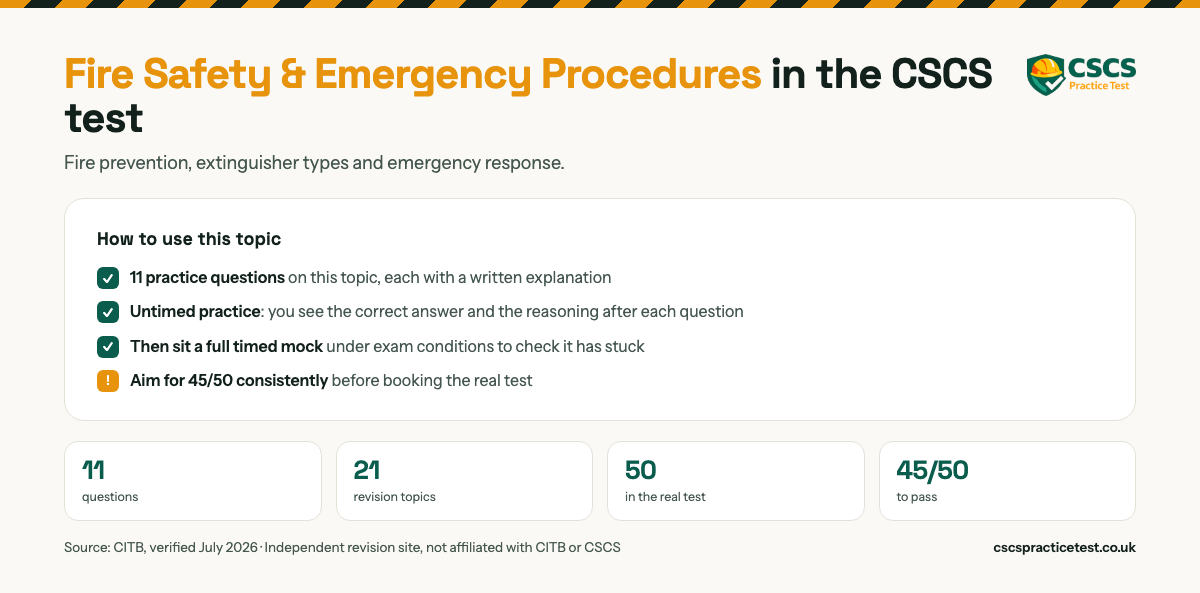
CSCS Fire Safety & Emergency Procedures Questions
Fire prevention, extinguisher types and emergency response.
These questions cover fire safety & emergency proceduresfor the CITB Health, Safety and Environment (HS&E) test, the exam UK construction workers pass to get a CSCS card.
Fire Safety & Emergency Procedures: practice questions (untimed, instant feedback)
- 50 questions · pass mark 90%
- Untimed practice: you see the correct answer immediately after each question.
- Some questions need more than one answer, and these are clearly marked.
All 50 Fire Safety & Emergency Procedures questions and answers
These are the same 50 questions as the practice test above, written out with the correct answer and the reasoning behind it. Read them through when you want to revise rather than test yourself.
1. Name two common fire risks on construction sites. (Choose two)
Answers: Poor housekeeping and a build-up of waste and Hot works carried out without control
- A) 110-volt extension reels
- B) 230-volt power tools
- C) Poor housekeeping and a build-up of waste (correct answer)
- D) Racks of timber
- E) Hot works carried out without control (correct answer)
Why: Waste build-up provides fuel and uncontrolled hot works provide ignition, two common fire risks.
2. What is a fire assembly point?
Answer: Where everyone gathers when the alarm sounds
- A) Where fire engines park on arrival
- B) The point at which the fire is thought to have begun
- C) Where extinguishers are stored
- D) Where everyone gathers when the alarm sounds (correct answer)
Why: The assembly point is the safe place everyone goes to when the fire alarm sounds.
3. You discover a fire. What should you do first?
Answer: Raise the alarm
- A) Finish your task if it is safe to do so
- B) Tidy your tools away
- C) Try to put it out
- D) Raise the alarm (correct answer)
Why: Raising the alarm first warns everyone else and is always the priority.
4. You must work in a corridor that is also a fire escape route. What must you check?
Answer: That your tools and materials do not obstruct the route
- A) That every door into the corridor is locked
- B) That only spark-proof tools are used
- C) That the fire-escape signs are taken down first
- D) That your tools and materials do not obstruct the route (correct answer)
Why: An escape route must stay clear, so make sure your tools and equipment don't block it.
5. What does a hot work permit allow you to do?
Answer: Carry out work that could cause a fire
- A) Carry out work that could cause a fire (correct answer)
- B) Carry out work that needs warm protective clothing
- C) Light a bonfire to burn waste on the site
- D) Work outdoors during periods of hot weather
Why: A hot work permit authorises work that could ignite a fire, with controls in place.
6. What will a hot work permit NOT tell you?
Answer: The location of the nearest fire station
- A) How to stop sparks or heat spreading
- B) Which extinguisher or fire watch is required
- C) The times at which you may start and must finish
- D) The location of the nearest fire station (correct answer)
Why: A permit covers controls, equipment and timing, not where the fire station is.
7. Which is a key step in the DRABC emergency approach?
Answer: Check for danger first
- A) Clear nearby debris
- B) Call for backup
- C) Give abdominal thrusts
- D) Check for danger first (correct answer)
Why: Danger comes first. Make sure it is safe before helping a casualty.
8. How should you treat a minor cut on site?
Answer: Clean it and cover with a sterile dressing
- A) Apply a tourniquet tightly above the injured area
- B) Clean it and cover with a sterile dressing (correct answer)
- C) Pour alcohol on it
- D) Leave it open to the air until it stops bleeding
Why: Clean the wound and cover it with a dressing to prevent infection.
9. What should you do if someone has a severe allergic reaction?
Answer: Help them use their adrenaline auto-injector
- A) Give them water
- B) Help them use their adrenaline auto-injector (correct answer)
- C) Get them to lie down and wait
- D) Offer them food
Why: An adrenaline auto-injector (e.g. EpiPen) can quickly counter a severe reaction.
10. When giving CPR, what is the compressions-to-breaths ratio?
Answer: 30:2
- A) 15:1
- B) 15:2
- C) 30:2 (correct answer)
- D) 30:1
Why: The standard adult CPR ratio is 30 compressions to 2 rescue breaths.
11. What information is vital when calling the emergency services?
Answer: The exact location of the incident
- A) The casualty's last meal
- B) The site manager's name
- C) The exact location of the incident (correct answer)
- D) The current weather conditions at the site
Why: The exact location lets the emergency services reach the casualty fast.
12. What does regulation 29 of CDM 2015 require steps to be taken against?
Answer: Fire or explosion, flooding, and substances liable to cause asphyxiation
- A) Fire or explosion, flooding, and substances liable to cause asphyxiation (correct answer)
- B) Fire and explosion only, since flooding is dealt with elsewhere in law
- C) Only substances that are classified as flammable under the CLP rules
- D) Only fires started deliberately by persons who trespass on the site
Why: Regulation 29 groups the three together and requires suitable and sufficient steps to prevent, so far as is reasonably practicable, the risk of injury from each.
13. What must emergency arrangements under regulation 30 include?
Answer: Procedures for any necessary evacuation of the site or part of it
- A) The telephone number of the nearest fire station to the work site
- B) A plan of the site showing where the fire extinguishers are kept
- C) A list of everyone who has been trained as a fire marshal on site
- D) Procedures for any necessary evacuation of the site or part of it (correct answer)
Why: Regulation 30(1) requires suitable and sufficient arrangements for any foreseeable emergency, and those arrangements must include evacuation procedures.
14. Which of these must be taken into account when making emergency arrangements?
Answer: The number of persons likely to be present on the site at one time
- A) The insurance policy held by the contractor who is carrying out the work
- B) The programme dates on which the works are due to be completed
- C) The qualifications held by the site manager for that site
- D) The number of persons likely to be present on the site at one time (correct answer)
Why: Regulation 30(2) lists the type of work, the characteristics and size of the site, the work equipment, the number of persons likely to be present, and the properties of substances on site.
15. What must be done once emergency arrangements have been made?
Answer: Steps must ensure each person the arrangements extend to is familiar with them
- A) They must be filed with the enforcing authority before work starts
- B) They must be reviewed by the client at each monthly progress meeting
- C) Steps must ensure each person the arrangements extend to is familiar with them (correct answer)
- D) They must be printed and displayed at every entrance to the work site
Why: Regulation 30(3)(a) requires suitable and sufficient steps to ensure that each person to whom the arrangements extend is familiar with them.
16. What does regulation 31 require of emergency routes and exits?
Answer: That a sufficient number of suitable routes let people reach safety quickly
- A) That they are locked outside working hours to prevent unauthorised entry
- B) That they are inspected once a month by an appointed competent person
- C) That they are at least two metres wide along their entire length
- D) That a sufficient number of suitable routes let people reach safety quickly (correct answer)
Why: Regulation 31(1) requires a sufficient number of suitable emergency routes and exits to enable any person to reach a place of safety quickly in the event of danger.
17. Where must an emergency route lead?
Answer: As directly as possible to an identified safe area
- A) To the site office, so that a roll call can be taken there
- B) To the nearest public highway regardless of where that is
- C) As directly as possible to an identified safe area (correct answer)
- D) To whichever exit is closest to the person using it
Why: Regulation 31(3) requires an emergency route or exit to lead as directly as possible to an identified safe area. The safe area has to be identified in advance.
18. What does regulation 31(4) require about emergency routes?
Answer: That they are kept clear and free from obstruction at all times
- A) That they are swept and cleaned at the end of every single working day
- B) That they are marked out on the ground using yellow line paint
- C) That they are covered over to protect users from falling objects
- D) That they are kept clear and free from obstruction at all times (correct answer)
Why: Regulation 31(4) requires the route or exit, and any traffic route giving access to it, to be kept clear and free from obstruction, with emergency lighting where necessary.
19. When must an emergency route be provided with emergency lighting?
Answer: Where necessary, so that the route may be used at any time
- A) Always, on every construction site without any exception at all
- B) Only where the route runs through a completed part of the building
- C) Where necessary, so that the route may be used at any time (correct answer)
- D) Only during the winter months when daylight hours are shorter
Why: Regulation 31(4) requires emergency lighting where necessary so that the route may be used at any time. The test is whether the route would otherwise be unusable.
20. What does regulation 32 require about fire-fighting equipment?
Answer: That it is provided and located in suitable places where necessary
- A) That it is provided and located in suitable places where necessary (correct answer)
- B) That one extinguisher is provided for every ten workers on the site
- C) That it is stored in a locked cabinet to prevent it from being misused
- D) That it is replaced with new equipment at the start of every year
Why: Regulation 32(1) requires suitable and sufficient fire-fighting equipment and fire detection and alarm systems to be provided and located in suitable places, where necessary.
21. Under BS EN 3-7, what colour is the body of a modern portable fire extinguisher?
Answer: Predominantly red, with a coloured band identifying the type
- A) Each type has a different body colour, such as cream, blue or black
- B) Whatever colour the manufacturer chooses for that product range
- C) Silver, with a printed label describing the contents of the unit
- D) Predominantly red, with a coloured band identifying the type (correct answer)
Why: Extinguisher bodies are predominantly red under the standard, with a colour-coded band or panel identifying the extinguishing medium. The older all-over body colours were withdrawn.
22. Which band identifies a carbon dioxide extinguisher?
Answer: A black band, distinguishing it from water, foam and powder
- A) A cream band, which is the marking used for foam extinguishers
- B) A blue band, which is the marking used for dry powder extinguishers
- C) A black band, distinguishing it from water, foam and powder (correct answer)
- D) A yellow band, which is the marking used for wet chemical
Why: The bands run water red, foam cream, dry powder blue, carbon dioxide black and wet chemical yellow, all on a predominantly red body.
23. Which band identifies a foam extinguisher?
Answer: A cream band, on an otherwise predominantly red body
- A) A cream band, on an otherwise predominantly red body (correct answer)
- B) A blue band, which is used for dry powder extinguishers
- C) A black band, which is used for carbon dioxide units
- D) A green band, which is not used on extinguishers at all
Why: Foam takes a cream band. Green is not one of the extinguisher band colours, which is a common distractor in mock questions.
24. What are the three elements of the fire triangle?
Answer: Fuel, oxygen and a source of ignition or heat
- A) Fuel, oxygen and a source of ignition or heat (correct answer)
- B) Fuel, smoke and a means of escape from the area
- C) Oxygen, water and a source of electrical energy
- D) Heat, pressure and a confined space to burn in
Why: Removing any one of the three stops the fire, which is why smothering, cooling and removing fuel all work as extinguishing methods.
25. What does Class A cover in the fire classification system?
Answer: Solid materials such as wood, paper, cardboard and textiles
- A) Flammable liquids such as petrol, diesel and white spirit
- B) Cooking oils and fats used in commercial kitchen fryers
- C) Flammable gases such as propane, butane and natural gas
- D) Solid materials such as wood, paper, cardboard and textiles (correct answer)
Why: Class A covers solid combustible materials. Class B is flammable liquids, Class C flammable gases, Class D metals and Class F cooking oils and fats.
26. What does Class B cover?
Answer: Flammable liquids such as petrol, diesel and solvents
- A) Solid materials such as timber, paper, card and textiles
- B) Flammable gases such as propane and butane
- C) Flammable liquids such as petrol, diesel and solvents (correct answer)
- D) Metals such as magnesium, sodium, lithium and aluminium
Why: Class B is flammable liquids. Confusing B with C is one of the most common errors, since gases are Class C.
27. Which class covers flammable gases?
Answer: Class C, which is specifically for flammable gases
- A) Class B, which also covers flammable liquids and solvents
- B) Class F, which is specifically for cooking oils and fats
- C) Class D, which covers combustible metals
- D) Class C, which is specifically for flammable gases (correct answer)
Why: Class C is flammable gases such as propane and butane, which are common on construction sites for heating and hot works.
28. Why is there no fire 'class' letter for electrical fires?
Answer: Because electricity is an ignition source, not a class of fuel
- A) Because electricity is not capable of starting a fire on its own
- B) Because electrical fires are always classed as Class D metal fires
- C) Because electricity is an ignition source, not a class of fuel (correct answer)
- D) Because electrical fires may only be tackled by the fire service
Why: Electrical equipment is shown by a symbol rather than a class letter, because the classes describe what is burning and electricity is what set it alight.
29. Which extinguisher is generally suitable where live electrical equipment is involved?
Answer: Carbon dioxide, which does not conduct and leaves no residue
- A) Water, because it cools the equipment fastest of all the types
- B) Foam, because it forms a blanket that excludes all the oxygen
- C) Carbon dioxide, which does not conduct and leaves no residue (correct answer)
- D) Wet chemical, which is designed for use on cooking oil fires
Why: Carbon dioxide is non-conductive and leaves no residue, which is why it is the usual choice near live electrical equipment. Water conducts and is the classic wrong answer.
30. Why must water never be used on a live electrical fire?
Answer: Because water conducts electricity back to the person using it
- A) Because water conducts electricity back to the person using it (correct answer)
- B) Because water damages the equipment beyond repair
- C) Because water evaporates before it can reach the seat of the fire
- D) Because water is only ever effective on Class F cooking oil fires
Why: Water is a conductor, so a jet aimed at live equipment can carry current back along the stream to the operator.
31. What does the 'Do not extinguish with water' sign indicate?
Answer: A prohibition sign, warning against using water on that risk
- A) A prohibition sign, warning against using water on that risk (correct answer)
- B) That the fire has already been dealt with by another method
- C) A mandatory sign, requiring a specific type of extinguisher to be used
- D) A safe condition sign, showing that water is available nearby
Why: It is one of the prohibition signs listed in the safety signs Regulations, so it takes the round white sign with red edging and a diagonal bar.
32. What should you do first on discovering a fire on site?
Answer: Raise the alarm so that others can be warned and can evacuate
- A) Attempt to put it out with the nearest available extinguisher
- B) Raise the alarm so that others can be warned and can evacuate (correct answer)
- C) Photograph the fire so there is a record for the investigation
- D) Find the site manager and report it to them in person directly
Why: Regulation 30 requires evacuation procedures and that everyone is familiar with them. Raising the alarm protects everyone, while tackling the fire protects only the immediate area.
33. When is it appropriate to tackle a fire yourself with an extinguisher?
Answer: Only if trained, the fire is small, and your escape route is clear
- A) Whenever an extinguisher of any type is within easy reach of you
- B) Only if trained, the fire is small, and your escape route is clear (correct answer)
- C) Only when the fire brigade has confirmed that they cannot attend
- D) Whenever the fire is inside a building rather than out in the open
Why: Extinguishers are for small fires in their early stages. Fighting a fire with your back to the exit, or without training on the type, turns a fire into a fatality.
34. What is a hot works permit used for?
Answer: To control work producing heat, sparks or flame that could start a fire
- A) To record which operatives have completed fire awareness training
- B) To control work producing heat, sparks or flame that could start a fire (correct answer)
- C) To authorise the storage of gas cylinders within the site compound
- D) To confirm that the site fire extinguishers have all been serviced this year
Why: Regulation 29 requires suitable and sufficient steps to prevent fire or explosion. A permit controls the ignition source, the fire watch and the checks afterwards.
35. Why is a fire watch kept after hot works finish?
Answer: Because smouldering material can ignite well after the work stops
- A) Because the permit cannot be signed off until an hour has passed
- B) Because smouldering material can ignite well after the work stops (correct answer)
- C) Because the equipment must be allowed to cool before storage
- D) Because the insurance company requires a witness to be present
Why: Heat conducted into a void or into stored material can smoulder unseen and break out later. Regulation 29 requires steps to prevent the risk, not just during the work.
36. How should LPG cylinders be stored on a construction site?
Answer: Upright and secured in a ventilated area away from ignition sources
- A) Lying flat inside the site hut so they cannot be knocked over
- B) Upright and secured in a ventilated area away from ignition sources (correct answer)
- C) In a sealed container so that any leaking gas cannot escape
- D) In the deepest part of the excavation where they are well out of the way
Why: LPG is heavier than air and collects in low spaces, so sealed stores and excavations are the worst places. Regulation 29 covers fire, explosion and asphyxiation together.
37. Why is LPG particularly dangerous in a trench or basement?
Answer: Because it is heavier than air and collects in low lying spaces
- A) Because it is lighter than air and rises out of the space quickly
- B) Because it is heavier than air and collects in low lying spaces (correct answer)
- C) Because it becomes more flammable as the temperature falls
- D) Because it reacts with groundwater to produce a toxic vapour cloud
Why: Being denser than air, LPG pools at low level where it can reach an explosive concentration and where it also displaces oxygen, which is the asphyxiation limb of regulation 29.
38. What must be taken into account under regulation 32(2) when providing fire equipment?
Answer: The matters listed in regulation 30(2) about the site and the work
- A) The matters listed in regulation 30(2) about the site and the work (correct answer)
- B) The cost of the equipment measured against the project budget
- C) The preference of the operatives who will be working on the site
- D) The distance from the site to the nearest fire and rescue service station
Why: Regulation 32(2) applies the same list as regulation 30(2): type of work, size of site, work equipment, number of persons, and properties of substances present.
39. How must each emergency route or exit be marked?
Answer: It must be indicated by suitable signs so it can be identified
- A) It must be indicated by suitable signs so it can be identified (correct answer)
- B) It must be painted with a continuous green line along the floor
- C) It must be lit by a flashing beacon during working hours only
- D) It must be numbered so that a roll call can be taken by exit
Why: Regulation 31(5) requires each emergency route or exit to be indicated by suitable signs, which is why the green running figure signs appear along escape routes.
40. A fire exit route is being used to store materials. What is wrong?
Answer: The route must be kept clear and free from obstruction
- A) Nothing, provided a gap of one metre is left down the middle
- B) Nothing, provided the materials are removed at the end of the day
- C) The route must be kept clear and free from obstruction (correct answer)
- D) The materials must be covered with a fire retardant sheet
Why: Regulation 31(4) requires the route and any traffic route giving access to it to be kept clear and free from obstruction, so partial blockage is still a breach.
41. What does regulation 30(2)(e) require account to be taken of?
Answer: The physical and chemical properties of substances on the site
- A) The physical and chemical properties of substances on the site (correct answer)
- B) The number of fire extinguishers already provided on the site
- C) The training records of everyone working on the site that day
- D) The weather forecast for the whole duration of the construction work
Why: Regulation 30(2)(e) covers the physical and chemical properties of any substances or materials on, or likely to be on, the site, which shapes the emergency plan.
42. Which extinguisher type is identified by a blue band?
Answer: Dry powder, which is effective across several fire classes
- A) Water, which is the most common type found on building sites
- B) Foam, which is effective on both solids and flammable liquids
- C) Dry powder, which is effective across several fire classes (correct answer)
- D) Carbon dioxide, which is used near live electrical equipment
Why: Dry powder takes the blue band. It is versatile but creates a residue and reduces visibility, which is why it is often restricted indoors.
43. Which extinguisher type is identified by a yellow band?
Answer: Wet chemical, designed for cooking oils and fats in Class F
- A) Wet chemical, designed for cooking oils and fats in Class F (correct answer)
- B) Water, which is the standard type for Class A solid fires
- C) Foam, which is used on solids and on flammable liquid fires
- D) Dry powder, which covers several different classes of fire
Why: Wet chemical takes a yellow band and is aimed at Class F cooking oil and fat fires, where water or foam would cause a violent reaction.
44. What is the purpose of a fire assembly point?
Answer: To act as the identified safe area that escape routes lead to
- A) To provide shelter for workers during periods of bad weather
- B) To act as the identified safe area that escape routes lead to (correct answer)
- C) To store the site fire extinguishers in one convenient place
- D) To give the fire brigade somewhere to park
Why: Regulation 31(3) requires the route to lead as directly as possible to an identified safe area, and the assembly point is where a roll call establishes who is out.
45. Why does regulation 29 group asphyxiation with fire and explosion?
Answer: Because gases and vapours can suffocate as well as ignite
- A) Because they are all caused by the same substances on a site
- B) Because gases and vapours can suffocate as well as ignite (correct answer)
- C) Because asphyxiation is a legal subcategory of fire injury
- D) Because the fire brigade attends all three types of incident
Why: A substance such as LPG or carbon dioxide can displace oxygen and asphyxiate without ever igniting, so both outcomes need preventing.
46. Fire detection and alarm systems must be what, under regulation 32?
Answer: Provided and located in suitable places where necessary
- A) Provided and located in suitable places where necessary (correct answer)
- B) Installed in every room of a building under construction
- C) Connected directly to the local fire and rescue service
- D) Tested by a competent person at the start of every shift
Why: Regulation 32(1) covers both fire-fighting equipment and fire detection and alarm systems, requiring them to be suitable, sufficient and suitably located where necessary.
47. Waste and packaging are allowed to build up on a site. Why is that a fire issue?
Answer: Because it adds fuel, one of the three sides of the fire triangle
- A) Because it makes the site untidy and creates a poor impression
- B) Because it adds fuel, one of the three sides of the fire triangle (correct answer)
- C) Because all site waste must be removed within seven days by law
- D) Because packaging materials are always classed as hazardous
Why: Removing fuel is one of the three ways of preventing a fire, and regulation 29 requires suitable and sufficient steps to prevent the risk of injury from fire.
48. What should you do if the fire alarm sounds while you are working?
Answer: Leave by the nearest emergency route and go to the assembly point
- A) Finish the immediate task safely, then leave by the nearest exit
- B) Wait for a supervisor to confirm that the alarm is a genuine one
- C) Leave by the nearest emergency route and go to the assembly point (correct answer)
- D) Collect all your tools and personal belongings before you leave
Why: Regulation 30 requires evacuation procedures that everyone is familiar with. Delay and collecting belongings are what turn evacuations into casualties.
49. Who do the emergency arrangements under regulation 30 have to reach?
Answer: Each person to whom the arrangements extend, who must be familiar
- A) Only the directly employed workforce of the principal contractor
- B) Each person to whom the arrangements extend, who must be familiar (correct answer)
- C) Only those workers who have been on the site longer than a week
- D) Only the appointed fire marshals and the first aiders working on the site
Why: Regulation 30(3)(a) requires steps to ensure each person to whom the arrangements extend is familiar with them, which includes visitors and subcontractors.
50. Which statement about extinguisher selection is correct?
Answer: The type must match the class of fire that is actually burning
- A) Any extinguisher will work on any fire if enough is applied
- B) The type must match the class of fire that is actually burning (correct answer)
- C) Water extinguishers are suitable for every class except Class D
- D) Carbon dioxide is suitable for Class F cooking oil fires
Why: Using the wrong medium can spread the fire or endanger the user, for example water on burning liquid or on live electrical equipment.
What this topic covers in the CSCS test
A fire needs three things to start: a source of ignition, fuel and oxygen. Take away any one of them and there is no fire, which is why almost every control on site is aimed at separating heat from what will burn. The Regulatory Reform (Fire Safety) Order 2005 sets the law on general fire safety for construction sites, and the CDM Regulations 2015 add a duty to prevent risk from fire.
- The fire triangle and how removing one side prevents or stops a fire
- Site ignition sources: hot works, plant, smoking, electrical faults, bonfires and arson
- Hot work permits, clearing combustibles and keeping a fire watch after the work stops
- Classes of fire and matching the right extinguisher to what is burning
- Escape routes, assembly points, raising the alarm and the site fire plan
- Raising the alarm, calling the emergency services and basic first aid until they arrive
Key facts worth memorising
- The fire triangle
- For a fire to start you need a source of ignition, fuel and oxygen, and removing any one of the three prevents or extinguishes it.
- The classes of fire
- Class A is solids such as wood, paper and textiles, Class B is flammable liquids, Class C is gases, Class D is metals and Class F is cooking oils.
- Match the extinguisher to the fuel
- HSE says use water on wood, paper and cloth, dry powder or foam on flammable liquids, and carbon dioxide on electrical fires.
- Extinguisher colour codes
- Extinguishers to the current standard are predominantly red with a colour-coded band or zone: red for water, cream for foam, blue for dry powder and black for carbon dioxide. Read the label, not the body colour.
- The responsible person
- Under the Fire Safety Order a responsible person, usually the main or principal contractor, must carry out and keep up to date the site fire risk assessment.
- Five steps to a fire risk assessment
- Identify the hazards, identify the people at risk, evaluate and act, record and plan and train, then review it as the site changes.
What people get wrong
Tackle the fire first, then raise the alarm.
Raising the alarm comes first, so everyone can get out and the fire service can be called. Only tackle a small fire if you are trained, it is safe to do so and your escape route stays clear behind you.
A water extinguisher is a safe all-rounder.
Water conducts electricity and spreads burning liquid. HSE directs you to carbon dioxide for electrical fires and foam or dry powder for flammable liquids.
A hot work permit is paperwork you sign afterwards.
A permit authorises the job before it starts, and HSE says a permit-to-work system can help manage the risk on larger projects. HSE lists clearing the area of combustible materials, having suitable extinguishers to hand and maintaining a careful watch throughout the work.
You can block an escape route while you work in it.
Escape routes must be kept available and unobstructed. Your tools, materials, leads and waste must not narrow or block a corridor that people would use to get out.
Answering these questions in the test
Fire questions fall into three groups: preventing fire, escaping from it, and dealing with casualties. For prevention, the correct answer usually removes fuel or an ignition source, which is the fire triangle applied in practice, so look for tidying waste, storing gas cylinders properly or controlling hot works. For escape, the right answer nearly always involves raising the alarm and getting out by the nearest clear route, never going back for tools, a vehicle or personal belongings. For extinguishers, match what is burning rather than what is nearest to hand. And for first aid, the safest option wins: check for danger before you approach, and give the emergency services your exact location.
Background reading
Drilling the questions tells you what you are getting wrong. It does not always tell you why. For this topic that is covered in Fire Extinguisher Types. The colour band on each red body, what must never be used on what, and why there is no class E.
Sources
Written from the following. Where a figure could not be verified against one of these, it has been left out rather than approximated. Our sources and methodology explains how we date and re-check them. Spotted something wrong? Report an error and we will fix it.
Topics that come up alongside fire safety & emergency procedures
Ready for the real thing?
When you are scoring 90% or better here, take a CSCS mock test for Operatives under exam conditions, then how to book the CSCS test.