
CSCS Electrical Safety Questions
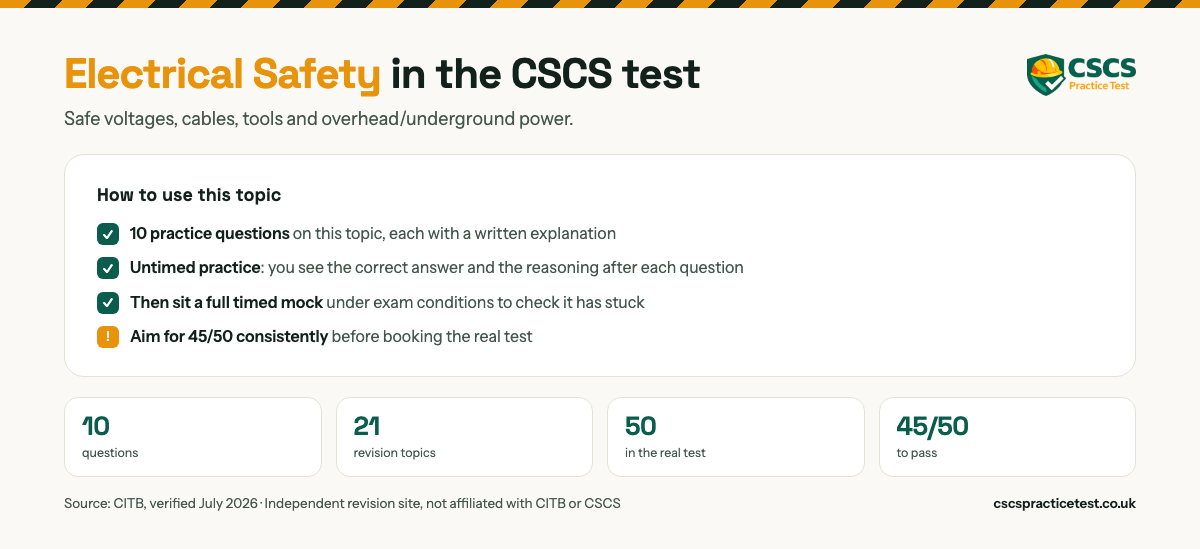
Safe voltages, cables, tools and overhead/underground power.
These questions cover electrical safetyfor the CITB Health, Safety and Environment (HS&E) test, the exam UK construction workers pass to get a CSCS card.
Electrical Safety: practice questions (untimed, instant feedback)
- 50 questions · pass mark 90%
- Untimed practice: you see the correct answer immediately after each question.
- Some questions need more than one answer, and these are clearly marked.
All 50 Electrical Safety questions and answers
These are the same 50 questions as the practice test above, written out with the correct answer and the reasoning behind it. Read them through when you want to revise rather than test yourself.
1. Why should you never carry batteries loose in your tool bag?
Answer: If the terminals short out they can start a fire
- A) The extra weight in the bag could hurt your back over a long day
- B) They release a poisonous gas when carried in confined spaces
- C) You may forget to put them on charge before the next shift
- D) If the terminals short out they can start a fire (correct answer)
Why: Loose battery terminals can short against metal objects and start a fire.
2. Why does HSE advise using cordless (battery) tools on site where you can?
Answer: They remove the electric shock risk that comes with a mains supply at the tool
- A) They can be used in wet conditions without any precautions
- B) They never need inspection, testing or maintenance
- C) They do not cause hand-arm vibration
- D) They remove the electric shock risk that comes with a mains supply at the tool (correct answer)
Why: HSE says to use cordless tools, or tools running from a 110V centre tapped to earth supply so the maximum voltage to earth does not exceed 55V. A cordless tool has no mains supply at the tool and no trailing lead to damage or trip over, which removes that shock risk. It does not remove the others: battery tools still need inspection and maintenance, and they still cause hand-arm vibration.
3. What is the recommended safe voltage for electrical equipment on a building site?
Answer: 110 volts
- A) 24 volts
- B) 12 volts
- C) 230 volts
- D) 110 volts (correct answer)
Why: 110 volts, supplied through a transformer, is the recommended safe voltage for site power tools.
4. How do you check that an RCD (residual current device) fitted to a power tool is working?
Answer: Press the test button on the RCD
- A) Press the test button on the RCD (correct answer)
- B) Run the tool flat out to see if it trips
- C) Turn the tool on and off
- D) Test it with a hand-held RCD meter
Why: Pressing the test button confirms the RCD trips as it should.
5. What two things must you do to stop an extension reel overheating while it is in use? (Choose two)
Answers: Avoid overloading it and Fully unwind the cable
- A) Avoid overloading it (correct answer)
- B) Run it at its maximum capacity
- C) Keep it near a fan
- D) Fully unwind the cable (correct answer)
- E) Wind the cable up tightly
Why: A coiled or overloaded reel overheats. Fully unwind it and don't overload it.
6. What is the most important step before using a portable electrical tool?
Answer: Inspect it for damage
- A) Read the manual right through
- B) Inspect it for damage (correct answer)
- C) Test how fast it runs
- D) Wipe it clean with a rag
Why: A pre-use visual check for damage is the key safety step.
7. What should you do with a defective portable electrical tool?
Answer: Tell your supervisor and label it as defective
- A) Tell your supervisor and label it as defective (correct answer)
- B) Try to repair it yourself before you use it again
- C) Use it carefully
- D) Throw it away in the nearest site skip on the spot
Why: Report and label a faulty tool so no one else uses it until it is repaired.
8. Why use tools with double insulation?
Answer: They give extra protection against electric shock
- A) They are cheaper
- B) They do not conduct electricity
- C) They give extra protection against electric shock (correct answer)
- D) They are lighter
Why: Double insulation adds a second layer of protection against shock.
9. Which plug colour indicates a 110-volt tool?
Answer: Yellow
- A) Red
- B) Blue
- C) Yellow (correct answer)
- D) Green
Why: 110-volt site tools use a yellow plug/connector.
10. What does a residual current device (RCD) do?
Answer: Protects the user from electric shock
- A) Boosts the power efficiency of the tool
- B) Protects the user from electric shock (correct answer)
- C) Makes the tool faster
- D) Cuts the noise that the tool makes while it is running
Why: An RCD rapidly cuts the power to prevent a serious electric shock.
11. Under regulation 4(1), how must all electrical systems be constructed?
Answer: So as to prevent danger, so far as is reasonably practicable, at all times
- A) So as to prevent danger, so far as is reasonably practicable, at all times (correct answer)
- B) So that they can be dismantled quickly by any operative on the work site
- C) So that they carry a current rating stamped clearly on the outer casing
- D) So that they are inspected by the enforcing authority before being used
Why: Regulation 4(1) sets a continuing duty: all systems shall at all times be of such construction as to prevent, so far as is reasonably practicable, danger.
12. What does regulation 4(2) require about maintenance of electrical systems?
Answer: That systems are maintained as necessary to prevent danger, so far as practicable
- A) That every system is stripped down and rebuilt once in each calendar year
- B) That only the manufacturer of the equipment may carry out any maintenance
- C) That maintenance records are submitted to the client at the end of the job
- D) That systems are maintained as necessary to prevent danger, so far as practicable (correct answer)
Why: Regulation 4(2) requires systems to be maintained, as may be necessary to prevent danger, so as to prevent danger so far as is reasonably practicable. The trigger is danger, not a fixed interval.
13. What does regulation 4(4) require of protective equipment provided for electrical work?
Answer: That it is suitable, maintained in a suitable condition, and properly used
- A) That it is replaced with a new item at the start of every working week
- B) That it is stored in a locked cabinet whenever it is not being used
- C) That it is marked with the name of the person to whom it was issued
- D) That it is suitable, maintained in a suitable condition, and properly used (correct answer)
Why: Regulation 4(4) sets three tests together: suitable for the use provided, maintained in a condition suitable for that use, and properly used. Failing any one of the three breaches it.
14. Regulation 6 covers equipment exposed to adverse conditions. Which is listed?
Answer: Mechanical damage, weather, wet or dusty conditions, and flammables
- A) Only exposure to rain and to standing water on the working surface
- B) Only exposure to flammable gases in a confined space or a trench
- C) Only exposure to mechanical damage caused by site plant and vehicles
- D) Mechanical damage, weather, wet or dusty conditions, and flammables (correct answer)
Why: Regulation 6 lists mechanical damage; weather, natural hazards, temperature or pressure; wet, dirty, dusty or corrosive conditions; and any flammable or explosive substance including dusts, vapours or gases.
15. What must be done about conductors in a system that may give rise to danger?
Answer: They must be suitably covered with insulation, or otherwise made safe
- A) They must be suitably covered with insulation, or otherwise made safe (correct answer)
- B) They must be painted in a colour that identifies the voltage they carry
- C) They must be tested by a competent person at the start of every shift
- D) They must be replaced with armoured cable wherever they run outdoors
Why: Regulation 7 gives two alternatives: suitably covered with insulating material and protected as necessary, or other precautions taken including being suitably placed.
16. Regulation 7 allows an alternative to insulating a conductor. What is it?
Answer: Taking other precautions, including placing the conductor suitably
- A) Reducing the voltage carried by that conductor to below fifty volts
- B) Limiting access to the working area to electrically competent persons only
- C) Marking the conductor clearly so that workers know that it is dangerous
- D) Taking other precautions, including placing the conductor suitably (correct answer)
Why: Regulation 7(b) permits such precautions as will prevent danger so far as reasonably practicable, including where appropriate the conductors being suitably placed, meaning out of reach.
17. What is the purpose of earthing under regulation 8?
Answer: To prevent danger where a conductor may foreseeably become charged
- A) To reduce the electricity bill by returning unused current to the supply
- B) To improve the performance of the equipment connected to the circuit
- C) To allow the supply to be switched off remotely in an emergency only
- D) To prevent danger where a conductor may foreseeably become charged (correct answer)
Why: Regulation 8 requires precautions, by earthing or other suitable means, to prevent danger where a conductor other than a circuit conductor may foreseeably become charged through use or a fault.
18. When is a conductor regarded as earthed for the purposes of regulation 8?
Answer: When it is connected to the general mass of earth by a suitable conductor
- A) When it is connected to the general mass of earth by a suitable conductor (correct answer)
- B) When it has been disconnected from every single source of electrical energy
- C) When it has been tested and then found to carry no current whatsoever
- D) When it is fitted with a residual current device at the supply point
Why: Regulation 8 defines earthed as connected to the general mass of earth by a conductor of sufficient strength and current-carrying capability.
19. What does 'isolation' mean under regulation 12(2)?
Answer: Disconnection and separation from every source of energy, securely
- A) Switching the equipment off using the nearest available local switch
- B) Fitting a warning notice to the equipment before any work is started
- C) Moving the equipment away from all other electrical equipment on site
- D) Disconnection and separation from every source of energy, securely (correct answer)
Why: Regulation 12(2) defines isolation as the disconnection and separation of the equipment from every source of electrical energy in such a way that the disconnection and separation is secure.
20. Why does regulation 12 refer to methods of identifying circuits?
Answer: Because isolating the wrong circuit leaves the work equipment still live
- A) Because circuits must be numbered for the purposes of billing the client
- B) Because the enforcing authority requires a circuit schedule to be kept
- C) Because circuits must be identified before the building can be occupied
- D) Because isolating the wrong circuit leaves the work equipment still live (correct answer)
Why: Regulation 12(1) requires suitable means, including where appropriate methods of identifying circuits, precisely so that the right supply is the one that gets cut off.
21. Equipment has been made dead so that work can be carried out. What does regulation 13 require?
Answer: That adequate precautions prevent it becoming charged during the work
- A) That the work is completed within a single shift once it has started
- B) That a second competent person witnesses every stage of the work
- C) That adequate precautions prevent it becoming charged during the work (correct answer)
- D) That the equipment is replaced rather than repaired wherever possible
Why: Regulation 13 targets the reconnection risk: adequate precautions must prevent equipment made dead from becoming electrically charged during the work if danger may arise.
22. Regulation 14 sets conditions for working on or near a live conductor. How many must be met?
Answer: All three conditions must be satisfied before live work may proceed
- A) Any one of the three conditions is enough to permit the live working
- B) Two of the three, provided a permit to work has also been issued
- C) All three conditions must be satisfied before live work may proceed (correct answer)
- D) None, provided the worker holds a recognised electrical qualification
Why: Regulation 14 joins its conditions with and: it must be unreasonable for the conductor to be dead, reasonable for the person to work on it live, and suitable precautions must be taken.
23. What is the first condition in regulation 14 for working on a live conductor?
Answer: That it is unreasonable in all the circumstances for it to be dead
- A) That the worker holds a current electrical competence card for the work
- B) That it is unreasonable in all the circumstances for it to be dead (correct answer)
- C) That the supply cannot physically be isolated from the equipment
- D) That the client has given written permission for the work to proceed
Why: Regulation 14(a) is the starting point: live working is only contemplated where it is unreasonable in all the circumstances for the conductor to be dead. Convenience is not the test.
24. What is the third condition in regulation 14?
Answer: That suitable precautions are taken to prevent injury during the work
- A) That suitable precautions are taken to prevent injury during the work (correct answer)
- B) That the work is carried out well outside of normal site working hours
- C) That the work is recorded in the site register before it is started
- D) That the voltage involved is below the threshold set out in the schedule
Why: Regulation 14(c) requires suitable precautions, including where necessary the provision of suitable protective equipment, to prevent injury.
25. A conductor is suitably covered with insulating material so danger cannot arise. Does regulation 14 apply?
Answer: No. The regulation excludes conductors suitably covered to prevent danger
- A) Yes, regulation 14 applies to every conductor regardless of its covering
- B) Yes, but only where the work will last for longer than one whole shift
- C) No. The regulation excludes conductors suitably covered to prevent danger (correct answer)
- D) No, unless the work is being carried out in a wet or dusty environment
Why: Regulation 14 expressly carves out a live conductor that is suitably covered with insulating material so as to prevent danger, which is why working near insulated cable is not live working.
26. What does regulation 16 require of persons doing electrical work?
Answer: That they have the technical knowledge or experience, or are supervised
- A) That they hold a nationally recognised formal qualification in electrical work
- B) That they are supervised at all times by a qualified electrician on site
- C) That they have the technical knowledge or experience, or are supervised (correct answer)
- D) That they are directly employed rather than working through an agency firm
Why: Regulation 16 bars work needing technical knowledge or experience unless the person has it, or is under such degree of supervision as is appropriate to the nature of the work.
27. An apprentice is doing work needing technical knowledge they do not yet have. Is that lawful?
Answer: Yes, if under a degree of supervision appropriate to the work
- A) No, only a fully qualified person may ever carry out such work
- B) Yes, if under a degree of supervision appropriate to the work (correct answer)
- C) Yes, provided the apprentice signs a declaration accepting the risk
- D) No, unless the work is carried out with the supply fully isolated
Why: Regulation 16 offers supervision as the alternative to personal knowledge or experience, with the degree of supervision matched to the nature of the work.
28. Why is reduced low voltage commonly used for site tools?
Answer: Because it lowers the severity of shock if a fault or damage occurs
- A) Because it makes the tools noticeably lighter and easier to handle
- B) Because it lowers the severity of shock if a fault or damage occurs (correct answer)
- C) Because the regulations set out a maximum voltage for portable tools
- D) Because it allows longer extension leads to be used without any drum
Why: The Regulations are goal-setting and do not name a voltage, but reducing voltage is a recognised way of meeting regulation 4(1) by preventing danger so far as reasonably practicable.
29. Where does the colour coding of industrial plugs and connectors come from?
Answer: A British Standard for industrial plugs and connectors, set outside the law
- A) Guidance published by the Health and Safety Executive on powering a site
- B) The Electricity at Work Regulations 1989, in a schedule to those Regulations
- C) A British Standard for industrial plugs and connectors, set outside the law (correct answer)
- D) The Building Regulations, in the part that deals with electrical safety work
Why: The colour coding sits in a product standard, not in the Regulations and not in HSE guidance. The Electricity at Work Regulations 1989 were checked in full and contain no reference to plugs, sockets, connectors or colour at all: they set goals and leave the technical detail to standards.
30. A cable is run across a site roadway used by vehicles. Which regulation is engaged?
Answer: Regulation 6, because the equipment is exposed to mechanical damage
- A) Regulation 16, because only competent persons may lay site cables
- B) Regulation 13, because the cable will need to be made dead beforehand
- C) Regulation 12, because the supply must be capable of being cut off
- D) Regulation 6, because the equipment is exposed to mechanical damage (correct answer)
Why: Regulation 6 requires equipment reasonably foreseeably exposed to mechanical damage to be constructed or protected so as to prevent danger. A cable under wheels is the textbook case.
31. Portable equipment is used outdoors in wet weather. Which regulation applies directly?
Answer: Regulation 6, covering the effects of weather and wet conditions
- A) Regulation 6, covering the effects of weather and wet conditions (correct answer)
- B) Regulation 14, because wet conditions make all work live working
- C) Regulation 8, because water always causes a conductor to be charged
- D) Regulation 12, because the supply must be isolated in wet weather
Why: Regulation 6(b) and 6(c) cover the effects of the weather and of wet, dirty, dusty or corrosive conditions, requiring construction or protection to prevent danger.
32. Work is to be done in an atmosphere that may contain flammable vapour. What does regulation 6 require?
Answer: That the equipment is constructed or protected to prevent danger there
- A) That the equipment is constructed or protected to prevent danger there (correct answer)
- B) That the equipment is switched off whenever anyone else enters the area
- C) That only battery powered equipment may ever be used in such an area
- D) That the area is ventilated for a full hour before the work can begin
Why: Regulation 6(d) covers any flammable or explosive substance, including dusts, vapours or gases, and requires construction or protection appropriate to that exposure.
33. What does regulation 4(3) cover?
Answer: The way work activities, including work near a system, are carried out
- A) The design of every electrical system installed on a construction site
- B) The way work activities, including work near a system, are carried out (correct answer)
- C) The qualifications required by anyone who works on electrical systems
- D) The records that must be kept of electrical inspection and testing
Why: Regulation 4(3) reaches beyond the equipment to the activity: every work activity, including operation, use, maintenance, and work near a system, must not give rise to danger.
34. A ladder is carried near an overhead line. Which duty does that engage?
Answer: Regulation 4(3), because work near a system must not give rise to danger
- A) None, because the line belongs to the distribution company not the site
- B) Regulation 4(3), because work near a system must not give rise to danger (correct answer)
- C) Regulation 7, because overhead lines must always be insulated by statute
- D) Regulation 8, because the ladder must be earthed before it is carried
Why: Regulation 4(3) expressly includes work near a system. Overhead lines are commonly bare conductors relying on placing under regulation 7(b) rather than insulation.
35. Equipment is itself a source of electrical energy, such as a battery. What does regulation 12(3) say?
Answer: The isolation requirement does not apply, but precautions are still needed
- A) The isolation requirement does not apply, but precautions are still needed (correct answer)
- B) The isolation requirement applies in exactly the same way as for mains
- C) Such equipment sits well outside the scope of these Regulations altogether
- D) Such equipment must be removed from site before any work is carried out
Why: Regulation 12(3) disapplies paragraph (1) for equipment that is itself a source of energy, but requires precautions as necessary to prevent danger so far as reasonably practicable.
36. What is the risk that regulation 13 is designed to prevent?
Answer: That equipment made dead becomes charged again while work continues
- A) That the equipment is damaged by the work being carried out on it
- B) That the work takes longer than the time allowed in the programme
- C) That equipment made dead becomes charged again while work continues (correct answer)
- D) That the wrong equipment is worked on because circuits are unmarked
Why: Regulation 13 is aimed squarely at re-energisation during the work, which is why locking off and proving dead matter as much as switching off.
37. Why is proving a circuit dead before touching it important?
Answer: Because switching off does not by itself prove the conductor is dead
- A) Because the Regulations require a written record of every proving test
- B) Because switching off does not by itself prove the conductor is dead (correct answer)
- C) Because the supply company must be notified before any work can start
- D) Because proving dead removes the need to isolate the supply at all
Why: Regulations 12 and 13 turn on secure disconnection and on preventing re-energisation. A switch may be mislabelled or faulty, so the state has to be verified rather than assumed.
38. Which of these best describes the standard set by 'so far as is reasonably practicable'?
Answer: Precautions are weighed against the risk they are intended to address
- A) Every conceivable precaution must be taken, whatever the cost involved might be
- B) Precautions are weighed against the risk they are intended to address (correct answer)
- C) Precautions are required only where the employer can easily afford them
- D) Precautions are required only where an accident has already occurred on site
Why: The qualifier appears throughout the Regulations and allows the degree of risk to be weighed against the effort needed to avert it, which is a lower standard than an absolute duty.
39. A damaged extension lead is found on site. What is the correct action?
Answer: Take it out of use, because systems must be maintained to prevent danger
- A) Repair the outer sheath using insulating tape and then continue using it
- B) Coil it neatly and leave it in place for the next shift to deal with
- C) Take it out of use, because systems must be maintained to prevent danger (correct answer)
- D) Use it only for low powered tools until a replacement can be obtained
Why: Regulation 4(2) requires maintenance as necessary to prevent danger. A damaged lead is a system that no longer prevents danger, and taping it does not restore it.
40. Who does regulation 16 apply to?
Answer: Any person engaged in work needing technical knowledge or experience
- A) Only to electricians directly employed by the principal contractor
- B) Only to those people working on systems above two hundred and thirty volts
- C) Any person engaged in work needing technical knowledge or experience (correct answer)
- D) Only to those persons working on live conductors under regulation 14
Why: Regulation 16 is framed around the work, not the job title. If preventing danger needs technical knowledge or experience, the person must have it or be suitably supervised.
41. What does regulation 12(1) require to be available where necessary to prevent danger?
Answer: Means of cutting off the supply and of isolating electrical equipment
- A) Means of cutting off the supply and of isolating electrical equipment (correct answer)
- B) A written permit to work issued before any item of equipment is switched off
- C) A residual current device fitted to every single socket outlet on the site
- D) An emergency lighting system covering the whole of the working area
Why: Regulation 12(1) requires suitable means for cutting off the supply of electrical energy to any equipment and for the isolation of any equipment.
42. A worker without electrical training resets a tripped distribution board. Is that acceptable?
Answer: No, if preventing danger needs knowledge or experience they lack
- A) Yes, resetting a breaker is not work needing technical knowledge
- B) Yes, provided they report the trip to the supervisor afterwards
- C) No, if preventing danger needs knowledge or experience they lack (correct answer)
- D) No, unless the board is fitted with a residual current device
Why: A trip indicates a fault. Deciding whether it is safe to re-energise needs technical knowledge, which brings regulation 16 into play, and regulation 13 guards against re-energising during work.
43. Which regulation would a missing earth connection most directly breach?
Answer: Regulation 8, requiring earthing or other suitable precautions
- A) Regulation 14, covering work on or near live conductors on the site
- B) Regulation 8, requiring earthing or other suitable precautions (correct answer)
- C) Regulation 16, requiring competence in the persons doing the work
- D) Regulation 12, requiring means of cutting off the supply of energy
Why: Regulation 8 requires precautions by earthing or other suitable means where a conductor may foreseeably become charged through use of the system or a fault in it.
44. When did the Electricity at Work Regulations 1989 come into force?
Answer: On the first of April 1990, as stated in the commencement information
- A) On the first of April 1990, as stated in the commencement information (correct answer)
- B) On the first of January 1989, immediately after they were first made
- C) On the sixth of April 2022, when they were most recently amended again
- D) On the first of January 1993, alongside the six pack regulations
Why: The commencement information against each regulation records that it came into force on 1 April 1990.
45. What does 'danger' being prevented 'at all times' in regulation 4(1) mean in practice?
Answer: The duty is continuous, not limited to when the system is being used
- A) The duty applies only while the system is energised and in active use
- B) The duty applies only during the commissioning of a brand new installation
- C) The duty is continuous, not limited to when the system is being used (correct answer)
- D) The duty applies only during normal working hours on the construction site
Why: The words at all times in regulation 4(1) make the construction duty continuous, covering periods when the system is idle, part built or awaiting commissioning.
46. Buried cables are suspected in an area where excavation is planned. Which duty is most relevant?
Answer: Regulation 4(3), because work near a buried cable can cause danger
- A) Regulation 12, because the supply must always be capable of being cut off
- B) Regulation 4(3), because work near a buried cable can cause danger (correct answer)
- C) Regulation 7, because buried cables must always be suitably placed
- D) Regulation 8, because buried cables must be earthed before digging
Why: Regulation 4(3) covers work near a system. Buried cables rely on placing under regulation 7(b), so the protection is depth and position, which excavation removes.
47. What does regulation 4(4) mean by protective equipment being 'properly used'?
Answer: That it is used in the manner it was designed and provided for
- A) That it is stored correctly between uses in a dedicated container
- B) That it is used in the manner it was designed and provided for (correct answer)
- C) That it is used only by persons who are directly employed on site
- D) That it is used only after being tested at the start of each shift
Why: Regulation 4(4) requires suitability, maintenance and proper use together. Insulated tools used as levers, or gloves used beyond their rating, fail the third limb.
48. Which statement about the Electricity at Work Regulations is correct?
Answer: They are goal-setting, requiring danger to be prevented by any suitable means
- A) They set specific voltages and equipment types that must be used
- B) They are goal-setting, requiring danger to be prevented by any suitable means (correct answer)
- C) They apply only to permanent installations and not to temporary site supplies
- D) They apply only to work carried out by qualified electrical contractors
Why: The Regulations repeatedly use the formula prevent danger so far as is reasonably practicable, leaving the technical means to standards and good practice.
49. Work near a live conductor is convenient rather than necessary. Does regulation 14 permit it?
Answer: No. It must be unreasonable in all the circumstances for it to be dead
- A) Yes, provided suitable protective equipment is worn during the work
- B) Yes, provided that the worker is competent under regulation 16 as well
- C) No. It must be unreasonable in all the circumstances for it to be dead (correct answer)
- D) No, unless a second person is present to act as a safety observer
Why: Convenience does not satisfy regulation 14(a). All three limbs must be met, and the first asks whether it is unreasonable for the conductor to be dead at all.
50. What is the relationship between regulations 12 and 13?
Answer: Regulation 12 provides the means to isolate, regulation 13 keeps it dead
- A) Regulation 12 provides the means to isolate, regulation 13 keeps it dead (correct answer)
- B) Regulation 12 applies to fixed systems and regulation 13 to portable ones
- C) Regulation 12 applies to competent persons and regulation 13 to others
- D) Regulation 12 covers live work and regulation 13 covers dead working
Why: Regulation 12 requires suitable means of cutting off and isolating. Regulation 13 then requires adequate precautions to stop the equipment becoming charged again while work continues.
What this topic covers in the CSCS test
Electricity gives no warning. As HSE puts it, unlike most other hazards you cannot see, feel, hear or smell it. About three workers are electrocuted each year during refurbishment work on buildings, and more die in incidents involving overhead lines and buried cables. The test sticks to what an operative controls: site voltage, RCDs, and checking a tool before you plug it in.
- Why site tools run at 110V from a transformer centre tapped to earth
- The plug and connector colour convention on UK sites
- What an RCD does, its tripping current, and how to test it
- Pre-use visual checks, and how often 110V and 230V equipment is inspected and tested
- Reporting and labelling defective tools, and why makeshift repairs are banned
- Double insulation, battery tools and safe use of extension reels
- Working near overhead power lines and buried cables
Key facts worth memorising
- 110V centre tapped to earth
- HSE says use cordless tools, or tools running from a 110V centre tapped to earth supply so the maximum voltage to earth does not exceed 55V.
- Yellow means 110V
- Site plugs and connectors are yellow for 110V and blue for 230V. The colour code is set by the industrial connector standard (BS EN 60309-2), not by HSE, but it is universal on UK sites.
- An RCD should trip at no more than 30 mA
- HSE gives 30 milliamps as the maximum tripping current for protecting people, and says to press the test button before use to confirm the mechanism works.
- Check intervals differ by voltage
- On construction sites HSE suggests a user check weekly for 110V and every shift for 230V, with a combined inspection and test before first use then three monthly for 110V and monthly for 230V.
- An RCD is a second line of defence
- It detects some, but not all, faults, so a shock can still be fatal. Never bypass one, and treat every trip as a fault to find before the tool goes back into use.
- You need not touch a power line to be hurt by it
- HSE warns that a close approach to live conductors can cause a flashover, that contact can be lethal at voltages as low as 230V, and that current can flow through damp wood or plastic.
What people get wrong
The tool is on an RCD, so a damaged lead does not matter.
An RCD only catches some faults and HSE treats it as a secondary measure. The visual check comes first: an undamaged plug, no exposed internal wires, and no cable patched with tape or an unsuitable connector.
If the RCD trips, reset it and carry on.
A trip means there is a fault. HSE says check the system before using it again, and if it keeps tripping with no fault found, consult the manufacturer of the RCD.
Taping a nicked cable will do until the job is finished.
HSE says damaged cable must be replaced by a competent person and that makeshift repairs must not be made. Take the tool out of service, label it and report it so nobody else picks it up.
110V cannot hurt you.
Centre tapping to earth holds the voltage to earth at about 55V, which makes a fatal shock far less likely. It reduces the risk, it does not remove it, and damaged 110V equipment still comes out of use.
Answering these questions in the test
Four numbers cover most of these questions: 110V for site tools, 55V maximum to earth, 30 mA for an RCD trip, and yellow for the 110V plug. Otherwise the pattern is the usual one. Where one option is a check, a report or an isolation and another is a workaround, take the check. And remember the inspection intervals differ by voltage: on site, user checks are weekly for 110V but every shift for 230V.
Background reading
Drilling the questions tells you what you are getting wrong. It does not always tell you why. For this topic that is covered in Fire Extinguisher Types. Which extinguisher is safe on live equipment, and why electricity is an ignition source rather than a class of fire.
Check which card scheme covers your trade
If you work as an electrician, check this before you book anything. Electrotechnical workers are carded by ECS, not CSCS, and ECS states it cannot accept the CITB test for any of its cards, so a pass here will not get you a card. The route and the exam ECS does want are on ECS card.
Sources
Written from the following. Where a figure could not be verified against one of these, it has been left out rather than approximated. Our sources and methodology explains how we date and re-check them. Spotted something wrong? Report an error and we will fix it.
Topics that come up alongside electrical safety
Ready for the real thing?
When you are scoring 90% or better here, take a CSCS mock test for Operatives under exam conditions, then how to book the CSCS test.