
CSCS Highway Works (Specialist) Questions
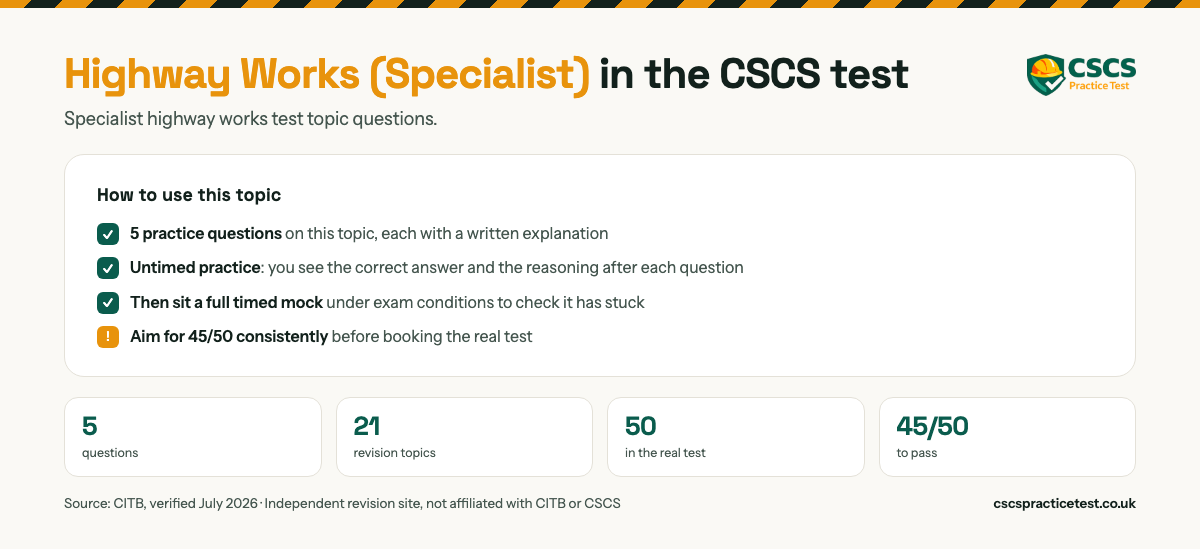
Specialist highway works test topic questions.
These questions cover highway works (specialist)for the CITB Health, Safety and Environment (HS&E) test, the exam UK construction workers pass to get a CSCS card.
Highway Works (Specialist): practice questions (untimed, instant feedback)
- 50 questions · pass mark 90%
- Untimed practice: you see the correct answer immediately after each question.
- Some questions need more than one answer, and these are clearly marked.
All 50 Highway Works (Specialist) questions and answers
These are the same 50 questions as the practice test above, written out with the correct answer and the reasoning behind it. Read them through when you want to revise rather than test yourself.
1. Which roads does the Safety at Street Works and Road Works Code of Practice apply to?
Answer: All highways except motorways and dual carriageways of 50 mph or more
- A) All highways except motorways and dual carriageways of 50 mph or more (correct answer)
- B) Only motorways and the trunk roads that are run by the national highway body
- C) Only local streets with a permanent speed limit of 30 mph or below
- D) Every road in the country, including all works taking place on motorways
Why: The Code states that it applies to all highways and roads except motorways and any dual carriageway with a speed limit of 50 mph or more. Guidance for those faster roads is in Chapter 8 of the Traffic Signs Manual instead, so using the Code there would leave the layout short of the required standard.
2. On a street works site, who or what does the safety zone protect?
Answer: Both the workforce from passing traffic and passing traffic from the works
- A) Only the stored materials from theft during the hours of darkness
- B) Both the workforce from passing traffic and passing traffic from the works (correct answer)
- C) Only the open excavation from damage caused by heavy goods vehicles passing
- D) Only pedestrians walking along the footway beside the working space
Why: The Code puts it directly: the safety zone is provided to protect you from traffic and to protect the traffic from you. It is a two way barrier of empty space, which is why nothing may be stored in it.
3. When may you enter the safety zone at a street works site?
Answer: Only to place, maintain or remove cones, barriers, lights and signs
- A) At any time, provided you are wearing high-visibility clothing
- B) Whenever you need somewhere handy to set down your tools and materials
- C) Only to place, maintain or remove cones, barriers, lights and signs (correct answer)
- D) Whenever the shortest route across the site happens to run through it
Why: The Code warns that you must not enter the safety zone in the normal course of work, and that materials, equipment and vehicles must not be placed in it. The only reason to step in is to maintain the cones, barriers and signs that form the guarding.
4. What does the sideways clearance (S) measure at a street works site?
Answer: The width between the working space and the moving traffic
- A) The width of running lane left available to passing traffic
- B) The gap between the outer cone line and the nearside kerb face
- C) The distance between the parked works vehicle and the works
- D) The width between the working space and the moving traffic (correct answer)
Why: The glossary defines sideways clearance (S) as the part of the safety zone between the working space and moving traffic. Its size depends on the speed limit, and the Code says a greater width should be considered where traffic runs fast.
5. A works vehicle is parked in front of the works area to give protection. What clearance must be left between it and the works?
Answer: 2 metres at 30 mph or less, and 5 metres at 40 mph or more
- A) 2 metres at 30 mph or less, and 5 metres at 40 mph or more (correct answer)
- B) A clear 1 metre at 30 mph or less, and 2 metres at 40 mph or more
- C) 5 metres at every speed limit that the Code of Practice covers
- D) 10 metres at 30 mph or less, and 20 metres at 40 mph or more
Why: Clearance C in the Works vehicle section is 2 metres for a speed limit of 30 mph or less and 5 metres for 40 mph or more. That gap is what absorbs the movement if the parked vehicle is shunted forward by another vehicle.
6. Which sign should approaching drivers see first on the way to a street works site?
Answer: The road works ahead sign, sited well before the lead-in taper
- A) The end of road works sign showing where restrictions stop
- B) The road works ahead sign, sited well before the lead-in taper (correct answer)
- C) The keep right arrow sign placed at the start of the lead-in taper
- D) The road narrows ahead sign warning of the obstructed side
Why: Advance signing lists road works ahead as the first sign to be seen by approaching traffic. Its size and its distance (D) from the start of the lead-in taper come from the table inside the back cover and vary with road type and speed limit.
7. What must never be used to weight down or secure road works signs and barriers?
Answer: Barrels, kerbstones, spoil, road pins or similar heavy objects
- A) Sacks of granular material placed at low level on the sign feet
- B) Manufacturer-approved ballast clipped to the base of the frame
- C) Barrels, kerbstones, spoil, road pins or similar heavy objects (correct answer)
- D) Purpose-made built-in weights supplied with the sign equipment
Why: The Code warns against barrels, kerbstones, spoil, road pins or similar objects because they could create a danger for highway users if struck by a vehicle. Built-in weights, or sacks of granular material at low level, are what it recommends.
8. What is the maximum spacing between cones along the longitudinal lengths of a coned area?
Answer: 9 metres, with at least two cones in any length between tapers
- A) 3 metres, with at least four cones in any length between tapers
- B) 20 metres, with at least one cone in any length between tapers
- C) 1.2 metres, with at least six cones in any length between tapers
- D) 9 metres, with at least two cones in any length between tapers (correct answer)
Why: Note 2 to the setting out table gives a maximum spacing of 9 metres in longitudinal lengths, and says no fewer than two cones shall be used in any length between tapers. Wider gaps let drivers drift into the works.
9. What is the minimum height of traffic cones on a road with a 50 mph speed limit?
Answer: 750 mm, against 450 mm where the limit is 40 mph or less
- A) 750 mm, against 450 mm where the limit is 40 mph or less (correct answer)
- B) 450 mm, against 750 mm where the limit is 40 mph or less
- C) 300 mm, against 450 mm where the limit is 40 mph or less
- D) 1000 mm, against 750 mm where the limit is 40 mph or less
Why: Note 1 to the setting out table sets a minimum cone height of 450 mm where the speed limit is 40 mph or less and 750 mm where it is 50 mph or more. Faster traffic needs a taller cone to be seen in time.
10. What does the Code say about traffic cones with damaged retroreflective sleeves?
Answer: They must not be used, and sleeves must be kept clean in service
- A) They may be used if a warning light is placed beside each cone
- B) They must not be used, and sleeves must be kept clean in service (correct answer)
- C) They may be used at the rear of the coned area but nowhere else
- D) They may be used during daylight hours but never after darkness
Why: Both the Coned area section and Part 3 state that the retroreflective sleeves of cones must be kept clean and that damaged sleeves or cones must not be used. A dull or split sleeve stops working exactly when headlights are the only light.
11. On which roads must warning lights be lit at street works during darkness or poor visibility?
Answer: Roads with a speed limit of 40 mph or more, at all such sites
- A) Only roads that have no permanent street lighting installed
- B) Only dual carriageway roads, whatever their speed limit is
- C) Roads with a speed limit of 40 mph or more, at all such sites (correct answer)
- D) Roads with a speed limit of 20 mph or less, at all such sites
Why: The Coned area section requires warning lights at all street and road works on roads with a speed limit of 40 mph or more, illuminated in poor visibility or during the hours of darkness. A risk assessment can call for them on slower roads too.
12. What must the information board at a street works site show?
Answer: The organisation, any principal contractor and an emergency number
- A) The names and card numbers of every operative working on the site
- B) The permit reference and the depth of the excavation being opened
- C) The dates of the highway authority's next planned site inspection
- D) The organisation, any principal contractor and an emergency number (correct answer)
Why: The Information board section requires the name of the organisation undertaking the works, any principal contractor and an emergency contact telephone number. A board must be displayed at every site except mobile, short duration and minor works without excavation.
13. Which conditions allow traffic to be controlled by give and take?
Answer: 30 mph or less, works 50 metres or less, and 50 metres visibility
- A) 30 mph or less, works 50 metres or less, and 50 metres visibility (correct answer)
- B) 40 mph or less, works 80 metres or less, and 80 metres visibility
- C) 60 mph or less, works 100 metres or less, and 60 metres visibility
- D) 30 mph or less, works 200 metres or less, and 20 metres visibility
Why: Give and take is only allowed where the speed limit is 30 mph or less, the works run 50 metres or less from first cone to last cone, and drivers from either direction can see 50 metres beyond the end of the works. Flow limits of 20 vehicles in 3 minutes and 20 HGVs an hour also apply.
14. Which conditions apply when remotely controlled Stop/Go boards are used?
Answer: The boards are 200 metres apart at most and used in daylight
- A) The boards are 1000 metres apart at most and used in daylight
- B) The boards are 200 metres apart at most and used in daylight (correct answer)
- C) The boards are 500 metres apart at most and used at any hour of the day
- D) The boards are 50 metres apart at most and used only at night
Why: The Code sets five conditions for remotely controlled boards, including a maximum of 200 metres between them, use restricted to daylight hours, an unobstructed view of both approaches, the operative within 100 metres of both boards, and flow under 850 vehicles an hour.
15. What is the maximum distance between the WAIT HERE signs at two-way portable traffic signals?
Answer: 300 metres, and the highway authority must give written permission
- A) 100 metres, and the highway authority must be told within 24 hours
- B) 1000 metres, and the highway authority need only be told in writing
- C) 300 metres, and the highway authority must give written permission (correct answer)
- D) 500 metres, and the highway authority must give written permission
Why: Portable traffic signals may be used where works are no more than 300 metres long, and the Code lists written permission from the highway authority among the conditions, along with vehicle actuation and type approval.
16. What must be kept available on site whenever portable traffic signals are in use?
Answer: Stop/Go boards, in case the portable signals were to break down
- A) A spare signal head already wired into the signal control cabinet
- B) A police officer able to direct the traffic through the shuttle lane
- C) A tow vehicle able to remove the signals from site at very short notice
- D) Stop/Go boards, in case the portable signals were to break down (correct answer)
Why: The Code requires Stop/Go boards to be available on site in case the portable traffic signals break down, and an emergency contact number for the signal provider to be displayed. A dead signal head leaves a shuttle lane with no control at all.
17. For how long may a Stop works sign be used to hold traffic?
Answer: No more than 2 minutes in any period of 15 minutes
- A) No more than 2 minutes in any period of 15 minutes (correct answer)
- B) No more than 12 minutes in any period of 15 minutes
- C) No more than 20 minutes in any period of 60 minutes
- D) No more than 6 minutes in any period of 10 minutes
Why: The Code limits each period of use of the Stop works sign to no more than 2 minutes in any 15 minutes. It must not be used as a substitute for a proper form of traffic control and only at sites assessed as low risk.
18. A footway is temporarily obstructed at an attended site with no alternative route available. What must be provided for pedestrians?
Answer: Enough operatives to advise, assist and direct people past the works
- A) A written notice delivered to every property along the closed footway
- B) Enough operatives to advise, assist and direct people past the works (correct answer)
- C) A printed diversion map fixed to the barrier at each end of the site
- D) A temporary pedestrian crossing worked from the works vehicle cab
Why: Short delays on footways are permissible only if all the listed conditions apply, including sufficient operatives at all times to advise, assist and direct footway users safely past the works, closure for no more than 15 minutes in every full hour, and no wait longer than 5 minutes for help.
19. What unobstructed footway width should be kept for pedestrians passing works?
Answer: 1.5 metres preferred, with 1 metre as the absolute minimum
- A) 2 metres preferred, with 1.5 metres as the absolute minimum
- B) 1.2 metres preferred, with 0.9 metres as the absolute minimum
- C) 1.5 metres preferred, with 1 metre as the absolute minimum (correct answer)
- D) 1 metre preferred, with 0.6 metres as the absolute minimum
Why: The Code says the footway should ideally be a minimum of 1.5 metres wide for temporary situations, reduced to an absolute minimum of 1 metre unobstructed width. Barrier feet must not eat into that space, and below 1 metre you must consult your supervisor.
20. Pedestrians are diverted into a walkway in the carriageway. What must be provided at the kerb?
Answer: Ramps or raised footway boards for wheelchairs and pushchairs
- A) A step formed from stacked road plates at each end of the route
- B) A single handrail fixed along the traffic side of the walkway
- C) An operative stationed to lift wheelchairs over the kerb face
- D) Ramps or raised footway boards for wheelchairs and pushchairs (correct answer)
Why: The Code requires suitable ramps or raised footway boards so that people using wheelchairs or pushchairs can negotiate kerbs safely, and the layout must let wheelchair and scooter users enter and leave the walkway safely.
21. Who is the tapping rail on a pedestrian barrier there for?
Answer: Visually impaired people using a long cane to find the edge
- A) Visually impaired people using a long cane to find the edge (correct answer)
- B) Operatives who need a low kerb to stand on inside the site
- C) Drivers who need a reflective strip to judge the site width
- D) Children who need something to hold while walking past works
Why: The glossary defines the tapping rail as a rail at the base of pedestrian barriers used by visually impaired long-cane users. A barrier with only a high handrail gives a cane nothing to find, so the route can be missed entirely.
22. A site is left unattended with an open excavation within 2 metres of a footway. What should be considered?
Answer: Temporary covers over the excavation, or an enhanced barrier
- A) A warning light placed on the spoil heap beside the opening
- B) Temporary covers over the excavation, or an enhanced barrier (correct answer)
- C) A single line of traffic cones set out around the excavation
- D) Backfilling the excavation loosely until work starts again
Why: The Unattended works section says you should consider either temporary covers over the excavation or an enhanced barrier around it, unless a site specific risk assessment shows that the extra protection is not justified.
23. How often should an unattended street works site in England be checked?
Answer: Every day including weekends, unless risk assessment says otherwise
- A) Only when the works team next returns to carry on with the job
- B) Every four hours right through the period the site is unmanned
- C) Every day including weekends, unless risk assessment says otherwise (correct answer)
- D) Every seven days, unless the site risk assessment calls for more often
Why: The Code says you should carry out a site check every day, including at weekends, unless your risk assessment deems this unnecessary, and that if nobody will visit the next day you must agree the next visit with your supervisor.
24. In what order should signs be taken down when street works are finished?
Answer: Reverse of setting out, with road works ahead removed last
- A) Reverse of setting out, with road works ahead removed first
- B) Same order as setting out, starting with the advance signs
- C) Any order, provided the whole site is cleared within an hour
- D) Reverse of setting out, with road works ahead removed last (correct answer)
Why: The setting out sequence says to reverse the procedure when removing signs, taking the end of road works sign second to last and the road works ahead sign last of all. The advance warning stays up until the hazard has gone.
25. Why must signs never be left lying flat on the ground during site clearance?
Answer: They form a trip hazard and the public may stand them up again
- A) They form a trip hazard and the public may stand them up again (correct answer)
- B) They lose their reflectivity permanently once laid face down
- C) They are more likely to be blown into the live carriageway
- D) They cannot be counted by the highway authority inspector
Why: Site clearance says signs should not be laid flat, as they may form a trip hazard and members of the public may pick them up again thinking they have been knocked over. Surplus signs must be removed or covered.
26. How should you set out the cones that form the lead-in taper?
Answer: Facing oncoming traffic, starting at the kerb and working out
- A) From a slow-moving vehicle driven along the line of the taper
- B) Facing oncoming traffic, starting at the kerb and working out (correct answer)
- C) With your back to traffic, starting at the works and working in
- D) From the centre of the road outwards towards both kerb lines
Why: Step 4 of the setting out sequence says to always face the oncoming traffic when you set out the cones for the lead-in taper, starting from the kerb or road edge and working out towards the works.
27. What does the Code say about getting out of the works vehicle when you arrive on site?
Answer: Put high-visibility clothing on first and leave by the passenger side
- A) Wait for the amber beacons to be switched off before opening a door
- B) Put high-visibility clothing on once you have reached the works area
- C) Put high-visibility clothing on first and leave by the passenger side (correct answer)
- D) Leave by the driver's door quickly so the vehicle is not blocking
Why: Setting out the works says to put your high visibility clothing on before leaving the vehicle, and that it will be safer to get out on the passenger side rather than stepping into the traffic stream.
28. What must you not be distracted by while setting out signs on the highway?
Answer: Mobile phones, including hands-free phones, radios and devices
- A) Conversation with the operative who is placing the cone taper
- B) The reversing alarm sounding on the parked site works vehicle
- C) The information board being read by members of the public
- D) Mobile phones, including hands-free phones, radios and devices (correct answer)
Why: The Code states that you must not be distracted by mobile phones, including hands-free phones, radios or other devices during the setting out operation, because you are working with your back to live traffic for part of it.
29. Works are carried out in the space between parked vehicles. What does the Code allow?
Answer: No advance signing or tapers if the works stay behind the parked line
- A) No advance signing or tapers if the works stay behind the parked line (correct answer)
- B) No signing at all of any kind, including the site information board itself
- C) No safety zone, provided the parked cars remain there all day long
- D) No risk assessment, because the parked vehicles already form the protection
Why: The Parked vehicles section allows works between parked vehicles to go without advance signing or lead-in and exit tapers, provided the whole works including the safety zone does not extend beyond the line of vehicles. All other signing and guarding is still required, and if the cars move the site must revert to the basic layout.
30. A short-duration stop on the highway overruns past 60 minutes in England. What must happen?
Answer: Signing, lighting and guarding for a fixed site must be provided
- A) The highway authority must be told within the next working day
- B) Signing, lighting and guarding for a fixed site must be provided (correct answer)
- C) The works may carry on unchanged until the end of that shift
- D) An extra road works ahead sign is added on each approach only
Why: Short-duration works are stops of less than 60 minutes, 30 minutes in Scotland, including set-up and dismantling. The Code says works involving stops expected to last longer must have the signing and guarding as for a fixed site, and an overrun means reviewing the risk assessment.
31. What does the Code specify for rear chevron markings on vehicles stopping on the highway for works?
Answer: Alternate strips at least 150 mm wide, angled upwards at 45 to 60 degrees
- A) Alternate strips at least 25 mm wide, angled downwards at 30 degrees
- B) Reflective tape running around the registration plate and rear light units
- C) Alternate strips at least 150 mm wide, angled upwards at 45 to 60 degrees (correct answer)
- D) A single block of plain orange paint covering the whole tailgate area
Why: Part 3 describes high visibility rear chevron markings as alternate strips of fluorescent orange or red retroreflective material and fluorescent yellow non-retroreflective material, not less than 150 mm wide each, inclined at 45 to 60 degrees to the horizontal and pointing upwards.
32. When must high-visibility clothing be worn at street works under the Code?
Answer: Whenever you are operating outside the working space on the highway
- A) Only while a positive method of traffic control is actually being operated
- B) Only after dark or when visibility on the road has become poor
- C) Only by the supervisor who is monitoring the traffic management
- D) Whenever you are operating outside the working space on the highway (correct answer)
Why: Part 3 requires high visibility clothing whenever operating outside the working space, for example setting out, maintaining or removing signing, lighting, guarding and temporary traffic control. Your employer may also require it inside the working space.
33. Under section 65 of the New Roads and Street Works Act 1991, whose needs must an undertaker have particular regard to when guarding works and placing signs?
Answer: The needs of people with a disability using the street
- A) The needs of people with a disability using the street (correct answer)
- B) The needs of freight operators running heavy vehicles
- C) The needs of the undertaker's own insurance provider
- D) The needs of the emergency services attending the area
Why: Section 65(1) requires the broken-up or obstructed street to be adequately guarded and lit and traffic signs to be placed, maintained and where necessary operated, having regard in particular to the needs of people with a disability.
34. What is the legal effect of complying with a code of practice approved under section 65 of the New Roads and Street Works Act 1991?
Answer: You are taken to comply with the statutory duty in section 65(1)
- A) You get a discount on the fine if the works are later prosecuted in court
- B) You are taken to comply with the statutory duty in section 65(1) (correct answer)
- C) You gain a defence only if the street authority has agreed to it first
- D) You are exempt from the whole of Part 3 of the 1991 Act itself
Why: Section 65(3)(a) says that so far as an undertaker complies with such a code of practice he shall be taken to comply with subsection (1). Paragraph (b) is the mirror image: a failure to comply with the code is evidence of failure to comply with the duty.
35. A member of the public pulls down a barrier and puts out a lamp at street works. Which offence is committed?
Answer: Interfering with guarding placed under section 65 of the 1991 Act
- A) Damaging highway apparatus belonging to the highway authority
- B) Breaching the code of practice on signing, lighting and guarding
- C) Interfering with guarding placed under section 65 of the 1991 Act (correct answer)
- D) Obstructing a statutory undertaker in the course of street works
Why: Section 65(6) makes it an offence, without lawful authority or excuse, to take down, alter or remove any fence, barrier, traffic sign or light placed under the section, or to extinguish a light so placed.
36. What does section 66 of the New Roads and Street Works Act 1991 require of an undertaker who has broken up the street?
Answer: To carry on and complete the works with all reasonably practicable dispatch
- A) To finish the works inside the number of working days stated on the permit
- B) To work continuous shifts including nights until the street is reinstated
- C) To pay the street authority a daily charge until the excavation is closed
- D) To carry on and complete the works with all reasonably practicable dispatch (correct answer)
Why: Section 66(1) requires works involving breaking up or opening the street, or tunnelling or boring under it, to be carried on and completed with all such dispatch as is reasonably practicable. Leaving a hole open longer than needed is an offence in its own right.
37. An undertaker leaves an obstruction in the street for longer than is reasonably necessary. What may the street authority do?
Answer: Serve a notice requiring reasonable steps to mitigate the obstruction
- A) Serve a notice requiring reasonable steps to mitigate the obstruction (correct answer)
- B) Withdraw the undertaker's street works qualification cards on the spot
- C) Prosecute the individual operatives who set out the traffic management
- D) Close the street to all traffic without any temporary regulation order
Why: Section 66(3) lets the street authority serve a notice requiring the undertaker to take specified reasonable steps to mitigate or discontinue the obstruction. If he does not comply within 24 hours, section 66(4) lets the authority act and recover its costs.
38. Under section 67 of the New Roads and Street Works Act 1991, who must be on site while street works involving breaking up the street are in progress?
Answer: At least one person holding a prescribed trained operative qualification
- A) An inspector employed by the undertaker to check the reinstatement
- B) At least one person holding a prescribed trained operative qualification (correct answer)
- C) At least two people holding a prescribed supervisor qualification each
- D) A representative sent to the site by the relevant highway authority
Why: Section 67(2) requires the undertaker to secure that there is on site at all times, when such works are in progress, at least one person having a prescribed qualification as a trained operative. Section 67(1) separately requires supervision by a qualified supervisor.
39. Under the Street Works (Qualifications of Operatives and Supervisors) (England) Regulations 2016, which extra unit must every qualified street works operative hold?
Answer: Signing, lighting and guarding, on top of the work type itself
- A) Abrasive wheels, on top of the particular type of work being carried out
- B) Confined space entry, on top of the work type being carried out
- C) Signing, lighting and guarding, on top of the work type itself (correct answer)
- D) First aid at work, on top of the type of work being carried out
Why: Regulation 3(1) says a person has a prescribed qualification for a type of work only if qualified in that work and in the additional types of work, which are signing, lighting and guarding, and location and avoidance of underground apparatus. Regulation 3(2) adds monitoring for supervisors.
40. When must an undertaker begin reinstating the street after street works?
Answer: As soon after completing any part of the works as is reasonably practicable
- A) Within 10 working days of first breaking up the surface of the street itself
- B) Once the street authority has inspected and signed off the excavation
- C) At the end of the calendar month in which the works were completed
- D) As soon after completing any part of the works as is reasonably practicable (correct answer)
Why: Section 70(2) requires reinstatement to begin as soon after the completion of any part of the street works as is reasonably practicable, and to be carried on and completed with all such dispatch as is reasonably practicable.
41. An interim reinstatement has been completed. By when must the permanent reinstatement be finished?
Answer: Within 6 months of the date the interim reinstatement was completed
- A) Within 6 months of the date the interim reinstatement was completed (correct answer)
- B) Within 2 years of the date the interim reinstatement was completed
- C) Within 28 days of the date the interim reinstatement was completed
- D) There is no time limit, provided the interim surface stays sound
Why: Section 70(4) requires the permanent reinstatement to be completed as soon as reasonably practicable and in any event within 6 months from the date the interim reinstatement was completed. Notice of completion must follow within 10 working days.
42. Section 70 of the New Roads and Street Works Act 1991 says permanent reinstatement must include what in particular?
Answer: Reinstatement of features designed to assist people with a disability
- A) Reinstatement of the verge and any planting along both sides of the road
- B) Reinstatement of features designed to assist people with a disability (correct answer)
- C) Reinstatement of any road markings that were worn before the works
- D) Reinstatement of the street lighting columns along the whole street
Why: Section 70(5) states that permanent reinstatement of the street shall include, in particular, the reinstatement of features designed to assist people with a disability, for example tactile paving and dropped kerbs at crossings.
43. Someone is carrying out works in a street that are not street works under the 1991 Act. What does section 174 of the Highways Act 1980 require?
Answer: Barriers and traffic signs to prevent danger, plus guarding and lighting
- A) A temporary traffic regulation order for every job whatever its size
- B) Written notice to every occupier of premises along the length of street
- C) Barriers and traffic signs to prevent danger, plus guarding and lighting (correct answer)
- D) A permit issued by the police before the first barrier can be placed
Why: Section 174(1) requires the person executing the works to erect barriers and traffic signs to prevent danger, regulate traffic and warn of hazards, to remove them when no longer needed, to keep the works properly guarded and lit during darkness, and to shore up adjoining buildings where the work requires it.
44. Chapter 8 of the Traffic Signs Manual gives a rule of thumb for judging a safe gap when crossing a carriageway on foot. What is it?
Answer: At least three seconds per lane, or a safe gap of 150 metres per lane
- A) At least one second per lane, or a safe gap of 20 metres for each lane
- B) At least ten seconds per lane, or a safe gap of 500 metres per lane
- C) At least three minutes per lane, or a complete stop in the traffic flow
- D) At least three seconds per lane, or a safe gap of 150 metres per lane (correct answer)
Why: Paragraph O3.5.3 says safe gaps are only likely in flows under 40 vehicles a minute on three-lane carriageways, and that at least three seconds per lane, or a safe gap of 150 metres per lane, should be allowed when estimating crossing times.
45. What does Chapter 8 of the Traffic Signs Manual say about trailers in temporary traffic management work?
Answer: They must not be used for operations that involve any reversing
- A) They must not be used for operations that involve any reversing (correct answer)
- B) They must not be used unless a trained signaller is watching them
- C) They must not be used on roads with a posted speed limit above 40 mph
- D) They must not be used unless fitted with amber beacons at the rear
Why: Paragraph O5.9.10 states that trailers shall not be used for temporary traffic management operations which involve reversing. Reversing a trailer beside live traffic lanes puts the driver's blind side towards moving vehicles.
46. Which way should vehicles setting out or removing traffic management next to live lanes be facing?
Answer: In the direction of the traffic, at all times while they are there
- A) In whichever direction gets the equipment closest to the taper
- B) In the direction of the traffic, at all times while they are there (correct answer)
- C) Across the lane, so that the load bed is turned away from traffic
- D) Into the oncoming traffic, so the driver can watch it approaching
Why: Paragraph O5.9.9 says vehicles located outside the works area and engaged in installing or removing traffic management equipment adjacent to live lanes should face in the direction of the traffic at all times, so they can pull away with the flow.
47. How should the outer boundary of the safety zone be marked, according to Chapter 8 of the Traffic Signs Manual?
Answer: Always by traffic cones, with warning lights in darkness or bad weather
- A) Always by a painted white line applied to the surface of the road
- B) Always by pedestrian barriers with a tapping rail along the base
- C) Always by traffic cones, with warning lights in darkness or bad weather (correct answer)
- D) Always by a solid temporary vehicle safety barrier, whatever the road
Why: Paragraph O3.2.9 says the outer boundary should always be marked by traffic cones, with warning lights added in poor weather or darkness, or by an approved temporary vehicle safety barrier. Where the permanent limit is above 40 mph the inner boundary must be marked too.
48. HSE guidance sets a limit on how many lanes workers should cross on foot during temporary traffic management. What is it?
Answer: No more than four continuous lanes, counting any slip roads as lanes
- A) No more than two continuous lanes, counting any slip roads as lanes
- B) No more than six continuous lanes, counting any slip roads as lanes too
- C) There is no limit, provided a spotter watches the traffic approaching
- D) No more than four continuous lanes, counting any slip roads as lanes (correct answer)
Why: HSE Construction Information Sheet 53 says systems of work should not involve crossing the carriageway unless there are adequate sight lines, flows generating suitable gaps, no more than four continuous lanes to cross including slip roads, and safe points to start and finish.
49. How does HSE guidance say a worker should carry signs across a live carriageway?
Answer: So the view of traffic is clear and the sign face is not shown to it
- A) So the view of traffic is clear and the sign face is not shown to it (correct answer)
- B) Face up above the head, so that approaching drivers are able to read it
- C) Dragged along the surface, so both hands stay free for balance
- D) Held out to one side at arm's length and turned towards traffic
Why: Construction Information Sheet 53 says operatives should carry equipment in a way that does not obstruct their view of oncoming traffic, should avoid displaying the front of signs to oncoming traffic, and should not obscure their high-visibility clothing.
50. HSE guidance says how far a worker should judge approaching vehicles before crossing a road. What method does it suggest?
Answer: Counting marker posts or lamp posts, allowing more time in poor weather
- A) Relying on the driver of the works vehicle to sound the horn as a signal
- B) Counting marker posts or lamp posts, allowing more time in poor weather (correct answer)
- C) Timing the vehicle against the second hand of a wristwatch or phone
- D) Using the length of the coned taper that is already laid out on the approach
Why: Construction Information Sheet 53 says operatives must be able to estimate the distance of approaching vehicles, that distances can be estimated by counting marker posts or lamp posts, and that more time should be allowed in poor weather, at night and when carrying loads.
What this topic covers in the CSCS test
Highway works is a CITB specialist test that adds road and street works questions to the five core Operatives topics. The governing document is Safety at Street Works and Road Works: A Code of Practice, the Red Book, issued under section 65 of the New Roads and Street Works Act 1991. It covers all roads except motorways and dual carriageways at 50 mph or more. For those, and for further guidance generally, the Code points you to Chapter 8 of the Traffic Signs Manual, which it describes as authoritative advice that does not itself have the status of a Code of Practice under the Act.
- Signing, lighting and guarding: advance signs, tapers, cones, barriers and warning lights
- Site layout: works area, working space and safety zone, and what belongs in each
- High-visibility clothing classes and other PPE for working near live traffic
- Traffic control: give and take, priority signs, Stop/Go boards and portable signals
- Looking after pedestrians, cyclists, horse riders and disabled users
- Qualifications for street works operatives and supervisors
Key facts worth memorising
- The safety zone is not a work area
- Do not enter the safety zone in the normal course of work, and never place materials, equipment or vehicles in it. It protects you from traffic and traffic from you.
- Class 2 or 3, Class 3 on high-speed roads
- Chapter 8 requires high-visibility clothing at all times on site, to Class 2 or 3, and Class 3 with full-length sleeves on motorways and other high-speed roads.
- One metre for pedestrians
- In no circumstances may footway width be reduced below 1.0 metre. If you cannot maintain that, stop and consult your supervisor.
- Warning lights from 40 mph up
- Works on roads of 40 mph or more need warning lights lit in poor visibility or darkness, no more than 1.5 metres above the road at 40 mph or less and 1.2 metres at 50 mph or more.
- Traffic control has limits
- Give and take suits roads up to 30 mph with 50 metres of cones at most, priority signs up to 80 metres, manually rotated Stop/Go boards up to 500 metres, and portable signals up to 300 metres with highway authority permission. Remotely controlled Stop/Go boards are limited to 200 metres apart and to daylight hours.
- A qualified operative at all times
- NRSWA requires at least one operative on site whose qualifications match the work whenever street works are in progress, plus a qualified supervisor, who need not be present throughout.
What people get wrong
The safety zone is a handy place to stack cones, spoil or the van.
It is not. Materials, equipment and vehicles must not be placed there. Tools, spoil and plant belong in the working space.
Any high-visibility vest will do on the road.
Chapter 8 sets the class: 2 or 3, and Class 3 with full-length sleeves on high-speed roads. It must be clean, fastened and serviceable, and damaged garments replaced.
Get the signs out first and sort the layout afterwards.
The distances, including safety zone dimensions, are worked out first from the table in the Code for that road and speed limit. Advance signing must be in place before any works equipment goes in the carriageway.
A Stop/Go board is fine at night as long as the site is lit.
Chapter 8 requires each sign face to be lit by its own source of light, says reflectorised material alone is not sufficient, and states that it is unlawful to use Stop/Go boards at night unless they are directly lit.
Answering these questions in the test
Two habits carry you through most of these questions. First, the road decides the layout, not convenience: road type and speed limit set the sign sizes, distances, taper and safety zone, and you look them up before you unload. Second, keep the working space and the safety zone separate in your head, because confusing the two causes more wrong answers than anything else here. Failure to follow the Code is evidence of failing the legal duty to sign, light and guard works, so a short job is never an excuse.
Sources
Written from the following. Where a figure could not be verified against one of these, it has been left out rather than approximated. Our sources and methodology explains how we date and re-check them. Spotted something wrong? Report an error and we will fix it.
- gov.uk/government/publications/safety-at-street-works-and-road-works
- assets.publishing.service.gov.uk/media/5a7d8038e5274a676d532707/safety-at-streetworks.pdf
- assets.publishing.service.gov.uk/media/5a7cc632e5274a38e5756aa3/traffic-signs-manual-chapter-08-part-02.pdf
- gov.uk/government/publications/street-works-qualifications-in-england/street-works-qualifications-in-england-guidance-for-operatives-and-supervisors
- citb.co.uk/courses-tests/health-safety-and-environment-hse-test/specialist-test
Topics that come up alongside highway works (specialist)
Ready for the real thing?
When you are scoring 90% or better here, take a CSCS mock test for Operatives under exam conditions, then how to book the CSCS test.