
CSCS Excavations & Confined Spaces Questions
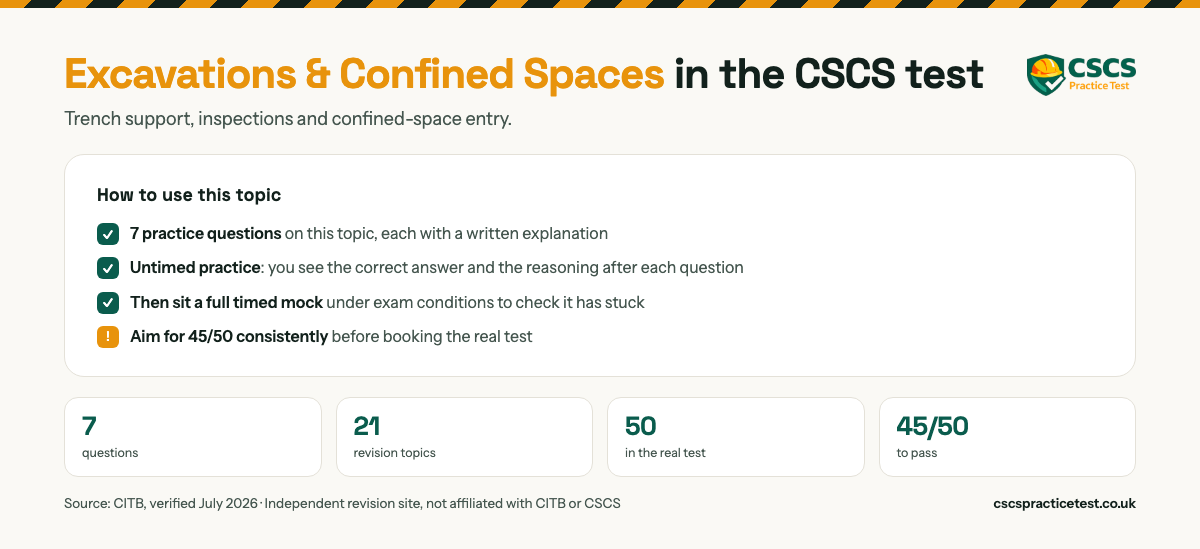
Trench support, inspections and confined-space entry.
These questions cover excavations & confined spacesfor the CITB Health, Safety and Environment (HS&E) test, the exam UK construction workers pass to get a CSCS card.
Excavations & Confined Spaces: practice questions (untimed, instant feedback)
- 50 questions · pass mark 90%
- Untimed practice: you see the correct answer immediately after each question.
- Some questions need more than one answer, and these are clearly marked.
All 50 Excavations & Confined Spaces questions and answers
These are the same 50 questions as the practice test above, written out with the correct answer and the reasoning behind it. Read them through when you want to revise rather than test yourself.
1. You see the side supports move while you are working in an excavation. What should you do?
Answer: Get yourself and everyone else out quickly
- A) Nothing, the sides always move a little
- B) Watch to see whether they shift again
- C) Move to another part of the trench
- D) Get yourself and everyone else out quickly (correct answer)
Why: Moving supports warn of collapse. Get everyone out of the excavation at once.
2. The gas alarm sounds while you are in a confined space. What should you do?
Answer: Leave the confined space straight away
- A) Leave the confined space straight away (correct answer)
- B) Keep working but take fresh-air breaks
- C) Keep working but avoid electrical tools
- D) Turn the alarm off and carry on with the work
Why: A gas alarm means leave the confined space immediately.
3. What is the recommended way to protect the edge of an excavation?
Answer: Install a barrier
- A) Put up a warning sign
- B) Install a barrier (correct answer)
- C) Tell people verbally
- D) Place cones around it
Why: A physical barrier stops people and vehicles falling into the excavation.
4. What is the main hazard of a confined space?
Answer: Limited access and escape
- A) Limited access and escape (correct answer)
- B) Unusually high ceilings in the space
- C) Good ventilation
- D) Clear visibility throughout the space
Why: Restricted entry and exit make escape and rescue difficult in a confined space.
5. Supports have been provided in an excavation. Under CDM 2015, what has to happen before construction work is carried out in it?
Answer: A competent person must inspect it at the start of the shift in which the work is done
- A) A competent person must inspect it at the start of the shift in which the work is done (correct answer)
- B) The excavation must be re-measured and its depth written into the site diary each day
- C) A permit to dig must be signed off by the client before anyone enters the excavation
- D) The excavator operator must confirm the ground has not moved since it was first dug
Why: Regulation 22(4)(a) of CDM 2015 says construction work must not be carried out in such an excavation unless a competent person has inspected it at the start of the shift in which the work is to be carried out, after any event likely to have affected its strength or stability, and after any material unintentionally falls or is dislodged. Note the wording of regulation 22: the duties are written in the passive, so they do not attach to one job title such as the site manager.
6. How often should the air in a confined space be tested?
Answer: Before each entry
- A) Once a day at the start of work
- B) Once per shift, at the start
- C) Before each entry (correct answer)
- D) Only if a problem is reported
Why: Test the atmosphere before every entry to confirm it is safe.
7. What does 'shoring' mean in excavation safety?
Answer: Supporting the sides to prevent collapse
- A) Removing water that has collected in the trench
- B) Shielding from debris
- C) Supporting the sides to prevent collapse (correct answer)
- D) Building a temporary walkway over the excavation
Why: Shoring supports the trench sides to prevent a collapse.
8. What must be done to prevent an excavation collapsing?
Answer: All practicable steps, including supports or battering where necessary
- A) All practicable steps, including supports or battering where necessary (correct answer)
- B) A warning sign fixed at each corner of the excavated area on site
- C) A barrier placed one metre back from the open edge of the excavation
- D) A daily photograph of the excavation kept in the site records file
Why: Regulation 22(1) requires all practicable steps to prevent danger, including where necessary the provision of supports or battering, so that no excavation collapses.
9. Regulation 22(1) protects against three specific outcomes. Which is one of them?
Answer: That no person is buried or trapped by material that falls or is dislodged
- A) That the excavation is dug deeper than was shown on the drawings
- B) That the excavation is left open for longer than a single working shift
- C) That the excavation fills with rainwater during a period of bad weather
- D) That no person is buried or trapped by material that falls or is dislodged (correct answer)
Why: Regulation 22(1) lists collapse of the excavation, dislodging or falling of material from the walls or roof, and burial or trapping of a person by that material.
10. What does regulation 22(2) require in relation to the edge of an excavation?
Answer: Steps to prevent persons, work equipment or material falling in
- A) Steps to prevent persons, work equipment or material falling in (correct answer)
- B) That the edge is inspected weekly by an appointed competent person
- C) That the edge is marked out with paint before the digging begins
- D) That the edge is sloped back at an angle of forty five degrees
Why: Regulation 22(2) requires suitable and sufficient steps to prevent any person, work equipment, or any accumulation of material from falling into any excavation.
11. Spoil is heaped at the edge of a trench. Which duty does that engage?
Answer: Regulation 22(3), preventing the excavation or adjacent ground being overloaded
- A) Regulation 22(3), preventing the excavation or adjacent ground being overloaded (correct answer)
- B) Regulation 22(4), requiring inspection at the start of every work shift
- C) Regulation 22(1), which deals only with the provision of trench supports
- D) None, because spoil placement is a matter of site tidiness rather than law
Why: Regulation 22(3) requires suitable and sufficient steps, where necessary, to prevent any part of an excavation or the ground adjacent to it being overloaded by work equipment or material.
12. When must a supported excavation be inspected by a competent person?
Answer: At the start of the shift in which the work is to be carried out
- A) Once a week, and additionally after any period of heavy rainfall
- B) Only where the excavation is more than one and a half metres deep
- C) Only after an incident in which a person has been injured on site
- D) At the start of the shift in which the work is to be carried out (correct answer)
Why: Regulation 22(4)(a)(i) requires inspection at the start of the shift in which the work is to be carried out, before construction work may proceed in the excavation.
13. What other events trigger an excavation inspection under regulation 22(4)?
Answer: Any event likely to have affected strength or stability, and any fall of material
- A) A change in the weather forecast for the following working day
- B) The arrival of a new operative on the site for the first time
- C) Any event likely to have affected strength or stability, and any fall of material (correct answer)
- D) The completion of each metre of additional depth that is excavated
Why: Regulation 22(4)(a) lists the start of the shift, after any event likely to have affected the strength or stability, and after any material unintentionally falls or is dislodged.
14. The inspector is not satisfied that work can be carried out safely. What happens?
Answer: Work must not be carried out until the matter has been put right
- A) Work may continue provided a second competent person disagrees
- B) Work may continue at reduced pace until the matter is resolved
- C) Work must not be carried out until the matter has been put right (correct answer)
- D) Work may continue if everyone in the excavation wears a harness
Why: Regulation 22(5) bars construction work in the excavation until the matter the inspector was not satisfied about has been remedied.
15. Who must carry out the excavation inspection?
Answer: A competent person, as required by regulation 22(4)(a)
- A) Any operative who is working in the excavation at that time
- B) An inspector employed by the local authority for that area
- C) The client's representative on their next visit to the site
- D) A competent person, as required by regulation 22(4)(a) (correct answer)
Why: Regulation 22(4)(a) requires the inspection by a competent person, and regulation 22(4)(b) requires that person to be satisfied work can be safely carried out.
16. What is a confined space, as defined in the 1997 Regulations?
Answer: An enclosed space where a reasonably foreseeable specified risk arises
- A) Any space that a person cannot stand fully upright inside of
- B) Any space with only one entry and exit point available to workers
- C) An enclosed space where a reasonably foreseeable specified risk arises (correct answer)
- D) Any space below ground level on a construction or demolition site
Why: The definition turns on the enclosed nature of the space giving rise to a reasonably foreseeable specified risk, and lists chambers, tanks, vats, silos, pits, trenches, pipes, sewers, flues and wells as examples.
17. Which of these is a 'specified risk' under the Confined Spaces Regulations?
Answer: Serious injury to a person at work arising from fire or explosion
- A) A risk of a fall from height into the space from the opening above
- B) A risk of hearing damage from noise reflecting off the space walls
- C) A risk of manual handling injury while working inside the space
- D) Serious injury to a person at work arising from fire or explosion (correct answer)
Why: The definition lists serious injury from fire or explosion, loss of consciousness from raised body temperature, loss of consciousness or asphyxiation from gas, fume, vapour or lack of oxygen, and drowning.
18. Loss of consciousness from a rise in body temperature is what, under the Regulations?
Answer: A specified risk, which can make an enclosed space a confined space
- A) A specified risk, which can make an enclosed space a confined space (correct answer)
- B) A matter dealt with only by the welfare requirements of CDM 2015
- C) Outside the scope of the Confined Spaces Regulations 1997 altogether
- D) A risk only where the work lasts longer than two hours at a time
Why: The specified risk definition expressly includes the loss of consciousness of any person at work arising from an increase in body temperature.
19. What is the first duty under regulation 4 of the Confined Spaces Regulations?
Answer: Not to enter at all unless the purpose cannot be achieved otherwise
- A) To issue breathing apparatus to everyone who will enter the space
- B) To test the atmosphere inside the space before anyone at all goes in
- C) Not to enter at all unless the purpose cannot be achieved otherwise (correct answer)
- D) To appoint a person to stand at the entrance while work goes on
Why: Regulation 4(1) bars entry unless it is not reasonably practicable to achieve the purpose without entering. Avoiding entry is the primary control.
20. Where entry to a confined space is unavoidable, what does regulation 4(2) require?
Answer: A safe system of work covering the relevant specified risks
- A) A safe system of work covering the relevant specified risks (correct answer)
- B) That entry lasts no longer than thirty minutes at any one time
- C) That two people enter together and remain within sight throughout
- D) That the space is filled with fresh air for an hour beforehand
Why: Regulation 4(2) requires entry, work and exit to be in accordance with a system of work that renders the work safe and without risks to health in relation to the specified risks.
21. What does regulation 5 require before anyone enters a confined space?
Answer: Suitable and sufficient arrangements for rescue in an emergency
- A) A permit issued by the enforcing authority for that particular space
- B) Written consent from the client who commissioned the works
- C) A medical examination of everyone who will enter the space
- D) Suitable and sufficient arrangements for rescue in an emergency (correct answer)
Why: Regulation 5(1) bars entry unless suitable and sufficient rescue arrangements have been prepared for that space, whether or not the emergency arises from a specified risk.
22. Rescue arrangements are not suitable and sufficient unless they do what?
Answer: Reduce the risks to the people who have to carry out the rescue
- A) Reduce the risks to the people who have to carry out the rescue (correct answer)
- B) Involve the local fire and rescue service as the first responder
- C) Guarantee that any casualty will be recovered within ten minutes
- D) Include a stretcher stored within twenty metres of the entrance
Why: Regulation 5(2)(a) requires the arrangements to reduce, so far as is reasonably practicable, the risks to the health and safety of any person required to put them into operation.
23. Why is relying on the fire service alone as your rescue plan inadequate?
Answer: Because the duty is to prepare arrangements for that specific space
- A) Because the fire service will not attend a construction site call out
- B) Because the Regulations prohibit any outside agency being involved
- C) Because the fire service charges the employer for every attendance
- D) Because the duty is to prepare arrangements for that specific space (correct answer)
Why: Regulation 5(1) requires arrangements prepared in respect of that confined space. A general expectation that someone else will come is not a prepared arrangement.
24. A trench is listed in the confined space definition. Does that make every trench a confined space?
Answer: No. It is only a confined space if a specified risk foreseeably arises
- A) Yes, every trench is a confined space by virtue of simply being listed
- B) No, only trenches deeper than one and a half metres are included
- C) No. It is only a confined space if a specified risk foreseeably arises (correct answer)
- D) Yes, but only where the trench has been supported with trench boxes
Why: The listed places are examples. The test is whether, by virtue of the enclosed nature of the place, a reasonably foreseeable specified risk arises.
25. What is a 'free flowing solid' under the Regulations?
Answer: A substance of solid particles capable of a flowing consistency
- A) Any material that has been stockpiled on site for over a month
- B) Any excavated spoil that has been left uncompacted at the edge
- C) Any liquid that has been thickened by the addition of cement powder
- D) A substance of solid particles capable of a flowing consistency (correct answer)
Why: The definition covers solid particles that are, or can be, of a flowing or running consistency, and names flour, grain, sugar and sand as examples.
26. Why is a lack of oxygen a specified risk?
Answer: Because it causes loss of consciousness or asphyxiation at work
- A) Because it causes loss of consciousness or asphyxiation at work (correct answer)
- B) Because it makes any fire in the space burn more fiercely than usual
- C) Because it reduces the working life of the tools used in the space
- D) Because it is the only hazard that gas detection can identify at all
Why: The specified risk definition covers the loss of consciousness or asphyxiation of any person at work arising from gas, fume, vapour or the lack of oxygen.
27. What does 'battering' mean in the context of excavation support?
Answer: Cutting the sides back to a safe angle so they do not collapse
- A) Compacting the base of the excavation before any work begins
- B) Driving sheet piles into the ground along both sides of a trench
- C) Cutting the sides back to a safe angle so they do not collapse (correct answer)
- D) Filling the excavation with granular material at the end of work
Why: Regulation 22(1) names supports or battering as the two ways of preventing collapse. Battering means sloping the sides back to a stable angle.
28. Work involving risk of burial under earthfalls appears where in CDM 2015?
Answer: In Schedule 3, listing work involving particular risks
- A) In Schedule 3, listing work involving particular risks (correct answer)
- B) In Schedule 1, listing the particulars for the F10 notification
- C) In Schedule 2, listing the minimum welfare facilities required
- D) In Schedule 4, listing the design considerations for the project
Why: Schedule 3 lists work which puts workers at risk of burial under earthfalls, engulfment in swampland or falling from height where the risk is particularly aggravated.
29. Why does Schedule 3 of CDM 2015 matter?
Answer: It flags work involving particular risks for the construction phase plan
- A) It sets out all the fees payable for a notifiable construction project
- B) It lists the substances that may not be used on a construction site
- C) It lists the qualifications that a competent person is required to hold
- D) It flags work involving particular risks for the construction phase plan (correct answer)
Why: Schedule 3 is referenced by regulation 12(2), which concerns the construction phase plan. Work with particular risks needs specific planning attention.
30. Vehicles are working close to an open excavation. What does the law require?
Answer: Steps to prevent the excavation or adjacent ground being overloaded
- A) Nothing extra, provided the driver has been told the trench is there
- B) That the excavation is filled in at the end of every working day
- C) That the vehicles are fitted with reversing cameras and audible alarms
- D) Steps to prevent the excavation or adjacent ground being overloaded (correct answer)
Why: Regulation 22(3) covers overloading of the excavation or adjacent ground by work equipment or material, and regulation 22(2) covers work equipment falling in.
31. Who must be informed if an excavation inspection reveals a problem?
Answer: The person on whose behalf the inspection was carried out
- A) The enforcing authority, within three days of the inspection
- B) The designer who specified the depth of the excavation works
- C) Every operative on the site, at the next daily briefing session
- D) The person on whose behalf the inspection was carried out (correct answer)
Why: Regulation 22(5) refers to the inspector informing the person on whose behalf the inspection is carried out, under regulation 24(1), and work stopping until the matter is remedied.
32. Drowning from a rising liquid level is what, under the Confined Spaces Regulations?
Answer: A specified risk, expressly named in the definition of the term
- A) A specified risk, expressly named in the definition of the term (correct answer)
- B) A matter dealt with only by the Work at Height Regulations 2005
- C) Excluded, because drowning is not an enclosed space hazard
- D) Relevant only where the confined space is a sewer or a well
Why: The specified risk definition includes the drowning of any person at work arising from an increase in the level of a liquid.
33. When did the Confined Spaces Regulations 1997 come into force?
Answer: On the twenty eighth of January 1998, as stated in regulation 1
- A) On the first of January 1997, as soon as the Regulations were made
- B) On the first of April 1990, with the electricity regulations
- C) On the sixth of April 2015, alongside the CDM Regulations
- D) On the twenty eighth of January 1998, as stated in regulation 1 (correct answer)
Why: Regulation 1(1) states that the Regulations may be cited as the Confined Spaces Regulations 1997 and come into force on 28 January 1998.
34. A worker collapses inside a confined space. What is the greatest danger next?
Answer: That untrained would be rescuers enter and are overcome as well
- A) That the casualty will be injured further during the recovery itself
- B) That untrained would be rescuers enter and are overcome as well (correct answer)
- C) That the emergency services will be delayed reaching the site
- D) That the space will need to be ventilated before work resumes
Why: This is why regulation 5(2)(a) requires the arrangements to reduce risks to those carrying out the rescue. Multiple fatality confined space incidents usually involve rescuers.
35. What does regulation 22(1) mean by 'all practicable steps'?
Answer: A higher standard, where cost carries much less weight than risk
- A) A lower standard than reasonably practicable, based only on the cost
- B) A higher standard, where cost carries much less weight than risk (correct answer)
- C) The same standard as reasonably practicable in every respect
- D) A standard that applies only to excavations deeper than two metres
Why: Practicable is a stricter test than reasonably practicable. If a step is physically possible in the light of current knowledge, it must be taken regardless of cost.
36. A pit on site has poor ventilation and a foreseeable build up of exhaust fumes. Is it a confined space?
Answer: Yes, if by virtue of its enclosed nature a specified risk arises
- A) No, a pit is always too open to the air to count as a confined space
- B) No, unless it is fully covered over by a lid or by a sheet of steel
- C) Yes, if by virtue of its enclosed nature a specified risk arises (correct answer)
- D) Yes, but only where the pit is deeper than the height of a person
Why: A pit is one of the listed examples, and fume causing loss of consciousness or asphyxiation is a specified risk. Both limbs of the definition are met.
37. Which regulation prevents material falling into an excavation?
Answer: Regulation 22(2), covering persons, work equipment and material
- A) Regulation 22(1), which is about preventing the sides collapsing
- B) Regulation 22(2), covering persons, work equipment and material (correct answer)
- C) Regulation 22(4), which sets out the inspection requirements
- D) Regulation 22(5), which deals with unsatisfactory inspections
Why: Regulation 22(2) covers any person, work equipment, or any accumulation of material falling into any excavation. Paragraph (1) is about the excavation itself failing.
38. Does an inspection under regulation 22(4) have to be repeated each shift?
Answer: Yes, at the start of the shift in which the work is carried out
- A) No, one inspection covers the whole life of that excavation
- B) No, weekly inspection is enough provided nothing has changed
- C) Yes, at the start of the shift in which the work is carried out (correct answer)
- D) Yes, but only where a different gang works the following shift
Why: Regulation 22(4)(a)(i) ties the inspection to the shift in which the work is to be carried out, not to a calendar interval.
39. What must the competent person be satisfied about after inspecting?
Answer: That construction work can be safely carried out in the excavation
- A) That the excavation matches the dimensions shown on the drawings
- B) That construction work can be safely carried out in the excavation (correct answer)
- C) That the excavation will not need any further support installing later
- D) That the excavation can be backfilled at the end of the works there
Why: Regulation 22(4)(b) requires the person who carried out the inspection to be satisfied that construction work can be safely carried out there.
40. Testing the atmosphere shows the oxygen level is low. What does that indicate?
Answer: That a specified risk is present and entry controls are needed
- A) That the space is safe provided the work is completed quickly
- B) That a specified risk is present and entry controls are needed (correct answer)
- C) That the space is not a confined space under the Regulations
- D) That only a dust mask is required before entering the space
Why: Lack of oxygen causing loss of consciousness or asphyxiation is a specified risk, which brings the entry prohibition in regulation 4 and the rescue duty in regulation 5 into play.
41. A sewer needs inspecting and a camera survey could do the job from outside. What does regulation 4 require?
Answer: That nobody enters, because the purpose can be achieved without it
- A) Entry, since a physical inspection is always the more reliable option
- B) Entry, provided a rescue plan and a safe system are in place
- C) That nobody enters, because the purpose can be achieved without it (correct answer)
- D) That entry is limited to one person for no more than an hour
Why: Regulation 4(1) prohibits entry unless it is not reasonably practicable to achieve the purpose without entering. A remote survey removes the need to enter.
42. Which of these is NOT part of the specified risk definition?
Answer: Injury caused by manual handling of loads inside the space
- A) Serious injury arising from a fire or an explosion in the space
- B) Loss of consciousness arising from a rise in body temperature
- C) Injury caused by manual handling of loads inside the space (correct answer)
- D) Drowning arising from an increase in the level of a liquid
Why: Manual handling injury is a real hazard in confined spaces but it is not one of the specified risks, so it does not on its own make a space a confined space in law.
43. Support has been installed in a trench. When may work proceed?
Answer: Once a competent person has inspected and is satisfied it is safe
- A) Immediately, because the support is what makes the trench safe
- B) Once a competent person has inspected and is satisfied it is safe (correct answer)
- C) Once the site manager has recorded the support in the daily site diary
- D) Once the support has been in place for at least twenty four hours
Why: Regulation 22(4) bars construction work in an excavation with supports or battering unless it has been inspected by a competent person who is satisfied work can be done safely.
44. Heavy rain has fallen overnight on an open excavation. What does the law require?
Answer: Inspection, as an event likely to have affected strength or stability
- A) Nothing at all, provided the excavation was inspected the previous day
- B) Inspection, as an event likely to have affected strength or stability (correct answer)
- C) That the excavation is immediately backfilled for safety reasons
- D) That the excavation is pumped out fully before anyone approaches it
Why: Regulation 22(4)(a)(ii) requires inspection after any event likely to have affected the strength or stability of the excavation, and rain is a classic example.
45. Which best summarises the confined spaces hierarchy?
Answer: Avoid entry, then a safe system of work, then rescue arrangements
- A) Enter with breathing apparatus, then test, and then arrange rescue
- B) Test the atmosphere, then enter, and then prepare a rescue plan afterwards
- C) Avoid entry, then a safe system of work, then rescue arrangements (correct answer)
- D) Arrange rescue, then enter, and then decide on a safe system of work
Why: Regulation 4(1) puts avoidance first, regulation 4(2) requires a safe system where entry is unavoidable, and regulation 5 requires rescue arrangements before entry.
46. Who has the duty under regulation 22 of CDM 2015?
Answer: It is expressed as a general duty, without naming a single dutyholder
- A) Only the principal contractor who is appointed for the whole project
- B) It is expressed as a general duty, without naming a single dutyholder (correct answer)
- C) Only the operative who is physically digging out the excavation
- D) Only the designer who specified the excavation on the drawings
Why: Regulation 22 is drafted in the passive: all practicable steps must be taken, suitable and sufficient steps must be taken. It bites on whoever controls the work.
47. Material has unintentionally fallen from the side of an excavation. What must happen?
Answer: The excavation must be inspected before work continues there
- A) Work may continue provided the fallen material is cleared away
- B) The excavation must be inspected before work continues there (correct answer)
- C) The excavation must be abandoned and a new one dug alongside
- D) The event must be reported to the enforcing authority at once
Why: Regulation 22(4)(a)(iii) requires inspection after any material unintentionally falls or is dislodged, because it signals that the ground is moving.
48. A silo is being cleaned out. Which Regulations are most directly engaged?
Answer: The Confined Spaces Regulations, since a silo is a listed example
- A) The Work at Height Regulations, because the silo is a tall structure
- B) The Confined Spaces Regulations, since a silo is a listed example (correct answer)
- C) The Manual Handling Regulations, because material must be moved
- D) The Electricity at Work Regulations, because lighting is required
Why: Silo is one of the places named in the confined space definition, and a free flowing solid such as grain creates the engulfment and asphyxiation risks the Regulations target.
49. What is the practical reason inspection is tied to the start of the shift?
Answer: Because ground conditions can change between one shift and the next
- A) Because the enforcing authority inspects most sites early in the morning
- B) Because ground conditions can change between one shift and the next (correct answer)
- C) Because the competent person is only available in the mornings
- D) Because the Regulations require all inspections before nine o'clock
Why: Ground movement, weather, vibration and adjacent work can all change an excavation overnight, which is why regulation 22(4) ties the inspection to the shift.
50. Buried services are suspected in the line of a proposed trench. What should happen first?
Answer: Locate and mark the services before any excavation is started
- A) Dig carefully with a machine and then stop if anything is struck
- B) Locate and mark the services before any excavation is started (correct answer)
- C) Assume the drawings are accurate and dig to the depth shown
- D) Excavate at night when fewer people are present on the site
Why: Regulation 25(4) says construction work liable to create a risk from an underground service, or from damage to or disturbance of it, must not be carried out unless suitable and sufficient steps have been taken to prevent the risk so far as is reasonably practicable. Regulation 25(1) adds that energy distribution installations must be suitably located, periodically checked and clearly indicated, which is what locating and marking delivers. Regulation 22, which covers excavations, is about collapse and burial, not about striking a live service.
What this topic covers in the CSCS test
These two subjects sit together because they fail the same way, fast and with almost no warning. An unsupported trench side can bury you in seconds, and the air in a confined space can be lethal before you notice anything is wrong. Two HSE points are worth carrying into the exam: no ground can be relied upon to stand unsupported, and the people killed in confined spaces include those who went in to rescue someone else.
- Why excavations collapse, and how shoring, trench boxes and battering prevent it
- Who inspects an excavation, when, and what must be recorded
- Edge protection, spoil heaps, and keeping plant back from the edge
- Safe access and egress, and why petrol and diesel engines are kept out
- Buried services: plans, cable locating devices and safe digging practice
- What makes a space a confined space, and the risks that define one
- The Confined Spaces Regulations 1997: atmosphere testing, ventilation, permits and rescue
Key facts worth memorising
- A cubic metre of soil can weigh over 1.5 tonnes
- That is why a collapse is so often fatal even in a shallow trench, and why HSE says no ground can be relied upon to stand unsupported in all circumstances.
- Inspection at the start of every shift
- Regulation 22 of CDM 2015 requires a competent person to inspect a supported or battered excavation at the start of the shift, after any event likely to affect its stability, and after any fall of material.
- A written report within 24 hours
- Under regulation 24 of CDM 2015, an inspector who is not satisfied must say so before the end of the shift and provide a written report within 24 hours.
- Ladders reach 1 metre above the landing
- A ladder used for access must stand on a firm level base, be secured against slipping and extend at least 1 metre above the landing place unless there is a suitable alternative handhold.
- Locate, mark, then dig carefully
- HSE's sequence is plans first, then a locating device used frequently and repeatedly, then trial holes by hand, digging alongside the service rather than above it and using insulated tools near cables.
- A confined space is defined by risk, not size
- It is a space that is enclosed or largely enclosed with a foreseeable risk of fire, explosion, loss of consciousness, asphyxiation or drowning, so a large silo counts and so does an unventilated pit.
What people get wrong
A shallow trench does not need support.
Depth is not the test. With a cubic metre of soil weighing over 1.5 tonnes it takes very little material to crush someone. Decide the support before you dig and have it on site before work starts.
If a workmate goes down in a confined space, you get them out.
This is how confined spaces kill more than one person at a time. HSE says the dead include untrained rescuers, and that relying on the emergency services is not enough. Raise the alarm and use the rescue arrangements that had to exist before the work began.
The service drawings show you where the cables are.
Plans give only an indication of the location and number of buried services, and HSE says tracing with a locating device afterwards is essential. Marker tape works the same way: it tells you something is close, not exactly where.
One gas test at the start covers you for the day.
HSE warns that a confined space being safe one day does not mean it always will be. Test before entry and keep monitoring, and if the alarm sounds you leave first and work out why afterwards. Never try to sweeten the air with oxygen, which sharply raises the fire risk.
Answering these questions in the test
Almost every scenario here has one answer that means getting out or staying out, and that is the one to take. Supports moving, a gas alarm sounding, an odd smell, a colleague collapsing: none of these are assessed from the inside. Also watch the difference between a warning and a control. Marker tape, a gas alarm and a lookout all tell you something. What keeps you alive is the trench support, the tested atmosphere, the barrier at the edge and the rescue plan made before anyone went in.
Sources
Written from the following. Where a figure could not be verified against one of these, it has been left out rather than approximated. Our sources and methodology explains how we date and re-check them. Spotted something wrong? Report an error and we will fix it.
- hse.gov.uk/construction/safetytopics/excavations.htm
- hse.gov.uk/construction/safetytopics/underground.htm
- legislation.gov.uk/uksi/2015/51/regulation/22/made
- legislation.gov.uk/uksi/2015/51/regulation/24/made
- hse.gov.uk/confinedspace/introduction.htm
- hse.gov.uk/confinedspace/legislation.htm
- hse.gov.uk/pubns/indg258.pdf
- legislation.gov.uk/uksi/1997/1713/contents/made
Topics that come up alongside excavations & confined spaces
Ready for the real thing?
When you are scoring 90% or better here, take a CSCS mock test for Operatives under exam conditions, then how to book the CSCS test.