
CSCS Working at Height Questions
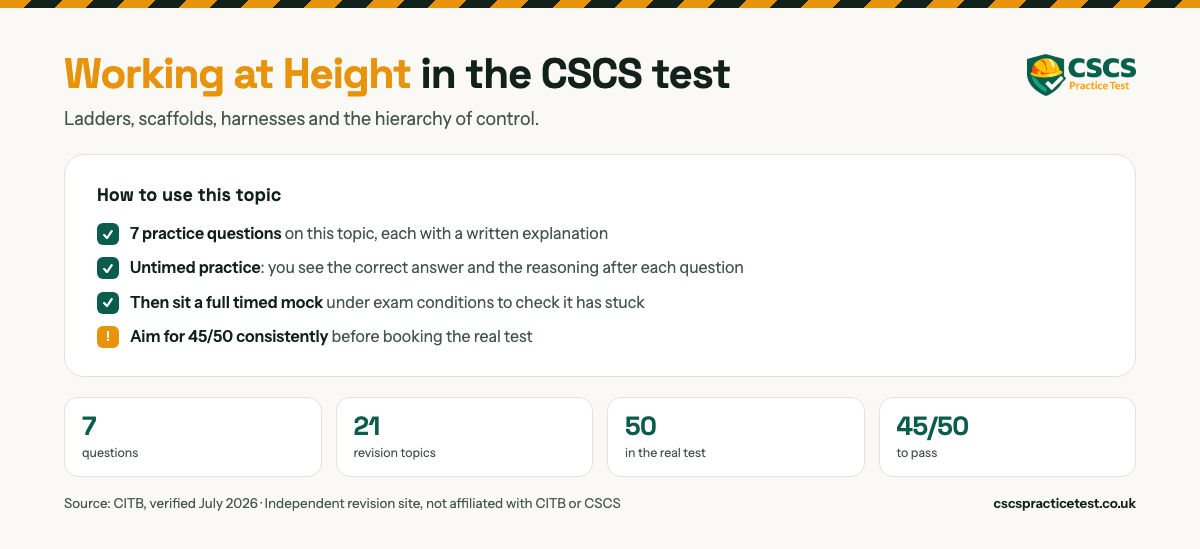
Ladders, scaffolds, harnesses and the hierarchy of control.
These questions cover working at heightfor the CITB Health, Safety and Environment (HS&E) test, the exam UK construction workers pass to get a CSCS card.
Working at Height: practice questions (untimed, instant feedback)
- 50 questions · pass mark 90%
- Untimed practice: you see the correct answer immediately after each question.
- Some questions need more than one answer, and these are clearly marked.
All 50 Working at Height questions and answers
These are the same 50 questions as the practice test above, written out with the correct answer and the reasoning behind it. Read them through when you want to revise rather than test yourself.
1. When is it acceptable to use a ladder at work?
Answer: For light work of short duration
- A) As long as it is long enough to reach
- B) As long as nobody else needs it for access
- C) Ladders are never allowed on site
- D) For light work of short duration (correct answer)
Why: Ladders are suitable only for light work of short duration.
2. How do you find the safe load rating of a scaffold platform?
Answer: Check the handover certificate or the scaffold signage
- A) Ask the site manager
- B) Ask the telehandler operator
- C) You will know it is exceeded when the ledgers start to bow
- D) Check the handover certificate or the scaffold signage (correct answer)
Why: A scaffold's safe load is stated on its handover certificate and its tag or signage.
3. Under the Work at Height Regulations 2005, what must an employer settle first when planning work at height?
Answer: Whether the work can reasonably practicably be done without working at height at all
- A) Whether the work can reasonably practicably be done without working at height at all (correct answer)
- B) Which harness and lanyard the workers will be issued with before the job begins on site
- C) How many workers will be needed on the platform at any one time during the shift
- D) Whether the weather forecast for the day allows the work to go ahead as planned
Why: Regulation 6(2) requires every employer to ensure that work is not carried out at height where it is reasonably practicable to carry it out safely otherwise than at height. Avoidance comes first. Only once the work genuinely has to happen at height do the later paragraphs apply: preventing falls under 6(3), then minimising the distance and consequences of a fall under 6(5). Choosing the right equipment matters, but it is a step down the hierarchy, not the top of it.
4. Which of these is NOT suitable for working at height?
Answer: A folding chair
- A) A scaffold
- B) A step ladder in good condition
- C) A folding chair (correct answer)
- D) A mobile elevating work platform
Why: A folding chair is not designed for access work and must never be used to gain height.
5. What should you do before any work at height starts?
Answer: Carry out a risk assessment
- A) Secure the work platform
- B) Hold a pre-start team briefing
- C) Carry out a risk assessment (correct answer)
- D) Issue safety harnesses to everyone involved
Why: A risk assessment comes first: it identifies the hazards and the controls needed.
6. How often should a ladder be inspected?
Answer: Before each use
- A) Once a year
- B) Once a month
- C) Before each use (correct answer)
- D) Every six months
Why: Check a ladder before every use to confirm it is sound and safe.
7. What is a guardrail on a scaffold for?
Answer: To stop workers falling
- A) To give a handhold for people on the platform
- B) To stop tools from falling
- C) To stop workers falling (correct answer)
- D) To help you balance
Why: Guardrails are edge protection that stops people falling from the platform.
8. At what height do the Work at Height Regulations start to apply?
Answer: At any height where a fall could cause injury, there is no minimum
- A) At any height where a fall could cause injury, there is no minimum (correct answer)
- B) At two metres above ground level, the long standing industry threshold
- C) At three metres, matching the threshold used for scaffold inspection
- D) At one and a half metres, measured from the working platform surface
Why: The definition turns on whether a person could fall a distance liable to cause personal injury, not on a measured height. There is no two metre rule in the Regulations.
9. Can work at height include a place below ground level?
Answer: Yes. The definition expressly includes a place at or below ground level
- A) No, work at height means work above the surrounding ground surface
- B) No, work below ground is covered only by the excavation requirements
- C) Yes, but only where the excavation is deeper than two metres overall
- D) Yes. The definition expressly includes a place at or below ground level (correct answer)
Why: The definition covers work in any place, including a place at or below ground level, so working beside an open excavation can be work at height.
10. Which means of access is expressly excluded from the definition?
Answer: A staircase in a permanent workplace, which is excluded by definition
- A) A staircase in a permanent workplace, which is excluded by definition (correct answer)
- B) A ladder used to reach a working platform on a scaffold structure
- C) A mobile elevating work platform operated by a trained operative
- D) A fixed ladder that is permanently attached to the structure itself
Why: Obtaining access or egress is work at height except by a staircase in a permanent workplace, which is why office stairs are not work at height.
11. What is the first step in the work at height hierarchy?
Answer: Avoid the work at height where it is reasonably practicable to do so
- A) Provide collective fall protection such as guard rails at the edges
- B) Provide personal fall protection such as a harness and a lanyard
- C) Provide sufficient training to everyone who will work at height
- D) Avoid the work at height where it is reasonably practicable to do so (correct answer)
Why: Regulation 6(2) requires that work is not carried out at height where it is reasonably practicable to do it safely otherwise than at height.
12. Where work at height cannot be avoided, what does regulation 6(3) require?
Answer: Suitable measures to prevent a fall liable to cause personal injury
- A) Suitable measures to prevent a fall liable to cause personal injury (correct answer)
- B) A written permit issued before any person goes up to the workplace
- C) Personal fall protection issued to everyone entering the work area
- D) A rescue team standing by for the whole duration of the operation
Why: Regulation 6(3) requires suitable and sufficient measures to prevent, so far as is reasonably practicable, any person falling a distance liable to cause personal injury.
13. Under regulation 6(4), what should be used in preference where practicable?
Answer: An existing place of work that complies with Schedule 1 requirements
- A) An existing place of work that complies with Schedule 1 requirements (correct answer)
- B) A harness attached to a suitable anchor point above the work position
- C) A ladder, provided that the work is short duration and low risk overall
- D) A safety net rigged beneath the level at which the work is done
Why: Regulation 6(4)(a) puts an existing place of work, or existing means of access complying with Schedule 1, ahead of providing fall prevention equipment.
14. What does regulation 6(5) require where the risk of a fall is not eliminated?
Answer: Equipment to minimise the distance and the consequences of a fall
- A) That the work is abandoned until the risk can be removed completely
- B) That only workers with more than five years experience carry it out
- C) That a supervisor watches the work continuously from ground level
- D) Equipment to minimise the distance and the consequences of a fall (correct answer)
Why: Regulation 6(5)(a) requires sufficient work equipment to minimise the distance and consequences of a fall, or where the distance cannot be minimised, the consequences.
15. What else does regulation 6(5) require alongside fall mitigation equipment?
Answer: Additional training and instruction, or other suitable measures
- A) Additional training and instruction, or other suitable measures (correct answer)
- B) A daily written record of every person working at height that day
- C) Notification to the enforcing authority before the work commences
- D) Insurance cover specifically for injuries caused by falls at work
Why: Regulation 6(5)(b) requires additional training and instruction, or other additional suitable and sufficient measures, to prevent falls liable to cause injury.
16. What three things must an employer ensure about work at height under regulation 4?
Answer: That it is properly planned, appropriately supervised and carried out safely
- A) That it is priced, programmed and resourced before the work starts
- B) That it is properly planned, appropriately supervised and carried out safely (correct answer)
- C) That it is inspected, recorded and signed off by a competent person
- D) That it is notified, approved and permitted by the principal contractor
Why: Regulation 4(1) sets those three limbs, and adds that planning must include the selection of work equipment under regulation 7.
17. What must planning for work at height include, under regulation 4(2)?
Answer: Planning for emergencies and for rescue from the work position
- A) The cost of hiring the access equipment for the whole of the project
- B) The names of everyone who will be working at height each day
- C) The programme dates on which the work at height will take place
- D) Planning for emergencies and for rescue from the work position (correct answer)
Why: Regulation 4(2) makes rescue planning part of the planning duty. A harness with no rescue plan leaves a suspended worker without a way down.
18. What does regulation 4(3) say about weather?
Answer: Work at height is carried out only when weather does not jeopardise safety
- A) Work at height must stop whenever any rain falls on the work area
- B) Weather is a matter for the individual worker to judge on the day
- C) Weather only matters where the work is more than ten metres high
- D) Work at height is carried out only when weather does not jeopardise safety (correct answer)
Why: Regulation 4(3) requires the employer to ensure work at height is carried out only when the weather conditions do not jeopardise the health or safety of those involved.
19. What does regulation 5 require about competence?
Answer: That nobody engages in the activity unless competent, or supervised in training
- A) That every person holds a card issued by a recognised scheme body
- B) That nobody engages in the activity unless competent, or supervised in training (correct answer)
- C) That only directly employed workers may carry out work at height
- D) That competence is assessed again at the start of every new project
Why: Regulation 5 covers organisation, planning and supervision as well as the work itself, and allows a trainee to act under the supervision of a competent person.
20. Does regulation 5 cover the person who plans the work as well as the person doing it?
Answer: Yes. It expressly covers organisation, planning and supervision too
- A) No, competence applies only to those who are physically working at height
- B) No, planning competence is dealt with under the CDM Regulations only
- C) Yes, but only where the work will last for more than thirty days
- D) Yes. It expressly covers organisation, planning and supervision too (correct answer)
Why: Regulation 5 names any activity, including organisation, planning and supervision, in relation to work at height or the work equipment used for it.
21. What is a fragile surface, as defined in the Regulations?
Answer: A surface liable to fail if any reasonably foreseeable loading is applied
- A) A surface liable to fail if any reasonably foreseeable loading is applied (correct answer)
- B) Any roof covering made from asbestos cement or from fibre sheeting
- C) Any surface that has been in place for more than twenty five years
- D) Any surface that a competent person has marked with a warning notice
Why: The definition is about performance under load, not about the material. A new sheet can be fragile and an old one may not be, so it is assessed rather than assumed.
22. What does regulation 9 require in relation to fragile surfaces?
Answer: That work is done without going on or near them where practicable
- A) That work is done without going on or near them where practicable (correct answer)
- B) That they are always removed and replaced before any work starts
- C) That a permit to work is issued before anyone approaches them
- D) That they are marked with a sign and then may be walked on safely
Why: Regulation 9(1) requires that nobody passes across or near, or works on, from or near a fragile surface where it is reasonably practicable to work safely without doing so.
23. Where work near a fragile surface cannot be avoided, what must be provided?
Answer: Platforms, coverings, guard rails or similar support or protection
- A) A second worker to watch the first one throughout the operation
- B) Platforms, coverings, guard rails or similar support or protection (correct answer)
- C) A written method statement signed by the principal contractor
- D) Personal fall protection worn by everyone within ten metres of it
Why: Regulation 9(2)(a) requires suitable and sufficient platforms, coverings, guard rails or similar means of support or protection so far as is reasonably practicable.
24. What is the first duty in relation to falling objects under regulation 10?
Answer: To take suitable steps to prevent the fall of material or objects
- A) To provide hard hats to everyone who is working below the area
- B) To fence off the whole of the ground beneath the work at height
- C) To post a signaller at ground level for the duration of the work
- D) To take suitable steps to prevent the fall of material or objects (correct answer)
Why: Regulation 10(1) puts prevention of the fall first, where necessary to prevent injury. Protecting people below comes second under regulation 10(2).
25. Where preventing objects from falling is not practicable, what does regulation 10(2) require?
Answer: Steps to prevent people being struck by falling material or objects
- A) That all work below the area stops until the work at height is finished
- B) That the objects are lowered by hand rather than by mechanical means
- C) That the area below is inspected each hour by a competent person
- D) Steps to prevent people being struck by falling material or objects (correct answer)
Why: Regulation 10(2) shifts to protecting people: suitable and sufficient steps to prevent any person being struck by falling material or objects liable to cause injury.
26. Can waste be thrown down from a scaffold into a skip below?
Answer: No, not where throwing or tipping is liable to cause injury
- A) Yes, provided the area beneath the scaffold has been fenced off
- B) Yes, provided a person at ground level watches for pedestrians
- C) No, unless the drop is less than two metres to the skip below
- D) No, not where throwing or tipping is liable to cause injury (correct answer)
Why: Regulation 10(3) prohibits material or objects being thrown or tipped from height in circumstances where it is liable to cause injury to any person.
27. When must work equipment be inspected under regulation 12(2)?
Answer: Before it is used in a position, where safety depends on assembly
- A) Once a year, on the anniversary of the date on which it was first supplied
- B) Before it is used in a position, where safety depends on assembly (correct answer)
- C) Only after it has been involved in an incident causing an injury
- D) Only where the equipment has been hired rather than owned outright
Why: Regulation 12(2) bars use after installation or assembly in any position unless it has been inspected in that position. Moving a tower means inspecting it again.
28. Equipment is exposed to conditions causing deterioration. How often must it be inspected?
Answer: At suitable intervals, and after exceptional circumstances occur
- A) At suitable intervals, and after exceptional circumstances occur (correct answer)
- B) Every seven days without exception, regardless of the conditions
- C) Only when the person using it reports a defect to the supervisor
- D) Once before first use and then not again during that same project
Why: Regulation 12(3) requires inspection at suitable intervals and each time exceptional circumstances liable to jeopardise safety have occurred, such as high winds.
29. What does regulation 13 require about places of work at height?
Answer: That the surface and fall protection are checked before each use
- A) That they are inspected every week by an appointed competent person
- B) That the surface and fall protection are checked before each use (correct answer)
- C) That they are photographed and the record kept for three months
- D) That they are signed off by the principal contractor each morning
Why: Regulation 13 requires the surface and every parapet, permanent rail or other fall protection measure to be checked, so far as is reasonably practicable, on each occasion before the place is used.
30. Under the Regulations, what does 'ladder' include?
Answer: A fixed ladder and a stepladder, as well as a portable leaning ladder
- A) Only portable leaning ladders that are used to reach a higher work level
- B) Only ladders that comply with the current British Standard for ladders
- C) Any means of access with rungs, including a scaffold access tower
- D) A fixed ladder and a stepladder, as well as a portable leaning ladder (correct answer)
Why: The interpretation regulation states that ladder includes a fixed ladder and a stepladder, so the ladder requirements are not limited to leaning ladders.
31. What does 'line' include in the Regulations?
Answer: Rope, chain or webbing, all of which count as a line
- A) Only steel wire rope of a specified minimum breaking strength
- B) Rope, chain or webbing, all of which count as a line (correct answer)
- C) Only the lanyard section of a personal fall arrest system
- D) Any marking painted on a floor to show a danger area edge
Why: The interpretation regulation defines line as including rope, chain or webbing, which matters for the requirements covering suspension and fall arrest equipment.
32. A worker will use a harness. What must the planning cover?
Answer: Rescue, because planning for emergencies and rescue is required
- A) Only the anchor point selection and the length of the lanyard used
- B) Only the training record of the person who will wear the harness
- C) Rescue, because planning for emergencies and rescue is required (correct answer)
- D) Only the inspection record for the harness and its attachments
Why: Regulation 4(2) requires planning to include emergencies and rescue. Suspension trauma makes prompt recovery a safety issue, not an afterthought.
33. Why is collective protection preferred over personal protection?
Answer: Because it protects everyone in the area without individual action
- A) Because collective protection is always cheaper to install on site
- B) Because it protects everyone in the area without individual action (correct answer)
- C) Because personal protection is prohibited on construction sites
- D) Because collective protection needs no inspection once installed
Why: The hierarchy in regulation 6 moves from avoiding, to preventing falls, to minimising distance and consequences. Guard rails work without the user doing anything.
34. What must the selection of work equipment take account of, under regulation 4(1)?
Answer: It must be included within the planning of the work at height
- A) The purchase price of the equipment against the project budget
- B) It must be included within the planning of the work at height (correct answer)
- C) The preference of the operatives who will be using it on site
- D) The availability of the equipment from the nearest hire depot
Why: Regulation 4(1) states that the planning of work at height includes the selection of work equipment in accordance with regulation 7. Selection is a planning decision.
35. A guard rail is removed to allow materials to be landed. What must happen?
Answer: It must be replaced as soon as practicable after the landing
- A) It may stay off for the rest of the shift to save time overall
- B) It must be replaced as soon as practicable after the landing (correct answer)
- C) It may be left off provided a warning sign is put in its place
- D) It may be left off if everyone in the area is wearing a harness
Why: Regulation 6(3) requires suitable and sufficient measures to prevent falls. Removing the collective protection reinstates the very risk the hierarchy is aimed at.
36. Which of these is a 'working platform' under the Regulations?
Answer: Any platform used as a place of work or as a means of access
- A) Only a scaffold erected by a card holding scaffolder on the site
- B) Only the deck of a mobile elevating work platform when in use
- C) Any platform used as a place of work or as a means of access (correct answer)
- D) Only a platform that is more than two metres above the ground
Why: The definition covers any platform used as a place of work or as a means of access or egress, and expressly includes scaffolds and suspended scaffolds.
37. Work can be done safely from the ground using an extending tool. What does regulation 6(2) require?
Answer: That the work is done from the ground rather than at height
- A) That the work is done from the ground rather than at height (correct answer)
- B) That the worker chooses whichever method is quicker to complete
- C) That a harness is worn regardless of the method that is chosen
- D) That the work at height is carried out with a permit in place
Why: Regulation 6(2) requires that work is not carried out at height where it is reasonably practicable to carry it out safely otherwise than at height.
38. Does the exclusion for a staircase apply on a construction site?
Answer: No, the exclusion is limited to a staircase in a permanent workplace
- A) Yes, all staircases anywhere on the site are excluded from the definition
- B) No, the exclusion is limited to a staircase in a permanent workplace (correct answer)
- C) Yes, provided the staircase has a handrail fitted on both sides
- D) No, staircases are never excluded under any circumstances at all
Why: The wording is except by a staircase in a permanent workplace. A temporary stair tower on a construction site does not attract the exclusion.
39. Who does the duty in regulation 4 fall on?
Answer: Every employer, who must ensure the work is planned and supervised
- A) The individual worker who is actually carrying out the work at height
- B) The client who commissioned the construction work being done
- C) Every employer, who must ensure the work is planned and supervised (correct answer)
- D) The equipment hire company that supplied the access equipment
Why: Regulation 4(1) opens with every employer shall ensure. The Regulations also apply to the self-employed and to those who control the work of others.
40. What is the purpose of regulation 12(2) in practical terms?
Answer: To ensure equipment is inspected in the position it will be used
- A) To ensure equipment is inspected in the position it will be used (correct answer)
- B) To ensure equipment is returned to the hire company when finished
- C) To ensure equipment is cleaned before it is put into storage
- D) To ensure equipment is labelled with the date of its purchase
Why: Because safety can depend on how equipment is installed or assembled, an inspection carried out elsewhere tells you nothing about this position.
41. High winds have hit a scaffold overnight. What does regulation 12(3) require?
Answer: An inspection, because exceptional circumstances liable to affect safety occurred
- A) Nothing, provided the scaffold was inspected within the last week
- B) An inspection, because exceptional circumstances liable to affect safety occurred (correct answer)
- C) That the scaffold is dismantled and then re-erected from scratch
- D) That a warning sign is fixed to the base lift of the scaffold before it is used
Why: Regulation 12(3)(b) requires inspection each time exceptional circumstances liable to jeopardise the safety of the work equipment have occurred.
42. Which best describes the structure of regulation 6?
Answer: A descending hierarchy: avoid, then prevent, then minimise the fall
- A) A single duty to provide fall arrest equipment for all such work
- B) A list of the approved equipment types that may be used at height
- C) A descending hierarchy: avoid, then prevent, then minimise the fall (correct answer)
- D) A set of minimum heights above which each measure becomes required
Why: Regulation 6 runs from avoiding work at height, to preventing falls, to minimising the distance and consequences where the risk is not eliminated.
43. A roofer must cross a roof containing rooflights. What does the law require first?
Answer: Finding a way to do the work without going on or near them
- A) Working across them carefully while treading only on the frames
- B) Marking each rooflight with paint so that they can be seen easily
- C) Finding a way to do the work without going on or near them (correct answer)
- D) Wearing a harness attached to an anchor at the roof ridge line
Why: Regulation 9(1) requires avoidance first. Rooflights are a classic fragile surface, and coverings or platforms come only where avoidance is not reasonably practicable.
44. Material is stored on a working platform. Which duty is most directly engaged?
Answer: Regulation 10, because steps must prevent material from falling
- A) Regulation 13, because the platform surface must be checked first
- B) Regulation 5, because storing material requires a competent person
- C) Regulation 10, because steps must prevent material from falling (correct answer)
- D) Regulation 4, because storage must be planned before it happens
Why: Regulation 10(1) requires suitable and sufficient steps to prevent the fall of any material or object where necessary to prevent injury, which covers stored material.
45. What does 'work equipment' mean under these Regulations?
Answer: Any machinery, appliance, apparatus, tool or installation used at work
- A) Only equipment designed specifically for preventing falls at height
- B) Any machinery, appliance, apparatus, tool or installation used at work (correct answer)
- C) Only equipment that has been hired in from a specialist access supplier
- D) Only equipment that is listed in Schedules 2 to 6 to the Regulations
Why: The definition is broad, covering any machinery, appliance, apparatus, tool or installation for use at work, and includes anything to which regulation 8 and Schedules 2 to 6 apply.
46. A worker could fall only half a metre, onto reinforcement bar starters. Is that work at height?
Answer: Yes, if a fall of that distance is liable to cause personal injury
- A) No, because half a metre is well below any recognised legal threshold
- B) No, unless the starter bars have been capped before work begins
- C) Yes, if a fall of that distance is liable to cause personal injury (correct answer)
- D) Yes, but only where the work will take longer than thirty minutes
Why: The test is whether a person could fall a distance liable to cause personal injury. A short fall onto projecting bars plainly can, so the Regulations apply.
47. Who must check a place of work at height before it is used?
Answer: The employer, so far as is reasonably practicable, on each occasion
- A) The employer, so far as is reasonably practicable, on each occasion (correct answer)
- B) The principal contractor, once at the start of each working week
- C) The equipment supplier, before the equipment ever leaves their depot
- D) The enforcing authority, during a routine inspection of the site
Why: Regulation 13 places the duty on every employer to ensure, so far as is reasonably practicable, that the surface and fall protection measures are checked on each occasion before use.
48. Where does personal fall protection sit in the regulation 6 hierarchy?
Answer: Below avoidance and collective prevention, as a later resort
- A) First, because it protects the individual worker most directly
- B) Below avoidance and collective prevention, as a later resort (correct answer)
- C) It is prohibited entirely on construction sites in Great Britain
- D) It is equal in standing with guard rails and other edge protection
Why: Regulation 6 works down from avoiding the work, to an existing compliant place of work, to equipment preventing a fall, and only then to minimising distance and consequences.
49. What does regulation 12(1) tell you about which equipment must be inspected?
Answer: Only equipment to which regulation 8 and Schedules 2 to 6 apply
- A) All equipment used anywhere on the construction site without exception
- B) Only equipment that the manufacturer states requires periodic inspection
- C) Only equipment to which regulation 8 and Schedules 2 to 6 apply (correct answer)
- D) Only equipment that has been in continuous use for over a month
Why: Regulation 12(1) limits the inspection regime to work equipment covered by regulation 8 and Schedules 2 to 6, which is where the detailed requirements sit.
50. A stepladder is used for a short task. Do the Regulations apply?
Answer: Yes. Ladder includes a stepladder, and the hierarchy still applies
- A) No, stepladders are outside the scope of these Regulations entirely
- B) No, provided the task takes less than thirty minutes to complete
- C) Yes. Ladder includes a stepladder, and the hierarchy still applies (correct answer)
- D) Yes, but only the inspection duties apply and not the hierarchy
Why: The definition of ladder includes a stepladder, and regulation 6 applies regardless of duration. Short duration affects equipment selection, not whether the law applies.
What this topic covers in the CSCS test
Falls from a height are the most common cause of fatal accidents at work in Great Britain. The Work at Height Regulations 2005 set out how the risk must be managed, and the test expects you to know the order in which controls are chosen. Work at height means any place where, without precautions, you could fall a distance liable to cause injury, including through a fragile roof or into a hole in the ground.
- The avoid, prevent, minimise hierarchy set out in regulation 6 of the Work at Height Regulations 2005
- Choosing the right access equipment, and when a ladder or stepladder is acceptable
- Guard rails, toe boards, platform width and scaffold duty ratings
- Inspection intervals for scaffolds, towers, MEWPs and ladders, and who is competent to inspect
- Fragile surfaces such as roof lights, liner panels, corroded metal sheets and non-reinforced fibre cement
- Stopping tools and materials falling on the people below
- Emergency and rescue planning, including how someone left hanging in a harness is recovered
Key facts worth memorising
- Avoid, prevent, minimise
- Regulation 6 requires employers to avoid work at height where it is reasonably practicable to do the job another way, then prevent falls, then minimise the distance and consequences of a fall.
- Guard rail at least 950 mm
- For construction work the top guard rail must be at least 950 mm above the edge, and any unprotected gap between guard rails must not exceed 470 mm.
- Scaffold inspection every 7 days
- A scaffold must be inspected by a competent person after installation and before first use, at intervals of no more than every 7 days after that, and following anything liable to affect its safety such as high winds.
- Ladders: 30 minutes as a guide
- HSE guidance says that if a task needs you to stay on a leaning ladder or stepladder for more than 30 minutes at a time, you should use different equipment.
- Assume a general purpose duty rating
- Unless your scaffold provider tells you otherwise, assume a scaffold is general purpose with a maximum load of 2 kN per square metre (200 kg per square metre).
- 31 fall deaths in 2025/26
- HSE recorded 31 worker deaths from falls from a height in 2025/26, out of 126 worker fatalities in total, making it the single largest cause. These are HSE's provisional figures.
What people get wrong
Ladders are banned on construction sites.
HSE calls this a common misconception. Ladders are legal and are sometimes the most suitable equipment, provided the risk assessment supports it and the ladder can be level, stable and secured.
Short duration on its own justifies using a ladder.
HSE is explicit that short duration is not the deciding factor. You must consider the risk first, and the 30 minute figure is guidance on when to switch equipment, not permission to climb.
A harness makes any work at height safe.
A harness is personal protection and only minimises the consequences of a fall. Collective protection such as a guard rail, which protects everyone without them having to do anything, comes first.
If a scaffold looks sound you can use it.
Check the tag and the inspection record. If it has not been inspected within the last 7 days, or since high winds or an alteration, it should not be used.
Answering these questions in the test
Most working at height questions are really testing the order of the controls, so read every option through that lens. If one answer lets you do the job from the ground, it beats everything else. If you must go up, the option giving collective protection (a guard rail, a fully boarded tower, a MEWP basket) beats one relying on the individual to clip on correctly. Watch for the numbers, because they appear often: check a ladder before every use, inspect a scaffold at least every 7 days, top guard rail at least 950 mm. Any answer involving improvised access, a chair, a stack of pallets, an oil drum or the top step of a stepladder, is always wrong.
Background reading
Drilling the questions tells you what you are getting wrong. It does not always tell you why. For this topic that is covered in Working at Height Hierarchy of Control. Avoid, then prevent, then minimise, and why there is no two metre trigger height in the Regulations.
Check which card scheme covers your trade
Scaffolders are carded by CISRS rather than CSCS, and every CISRS grade needs a CITB HS&E test pass on first issue, so this bank is the right practice. Which paper each grade needs is on CISRS card.
Sources
Written from the following. Where a figure could not be verified against one of these, it has been left out rather than approximated. Our sources and methodology explains how we date and re-check them. Spotted something wrong? Report an error and we will fix it.
Topics that come up alongside working at height
Ready for the real thing?
When you are scoring 90% or better here, take a CSCS mock test for Operatives under exam conditions, then how to book the CSCS test.